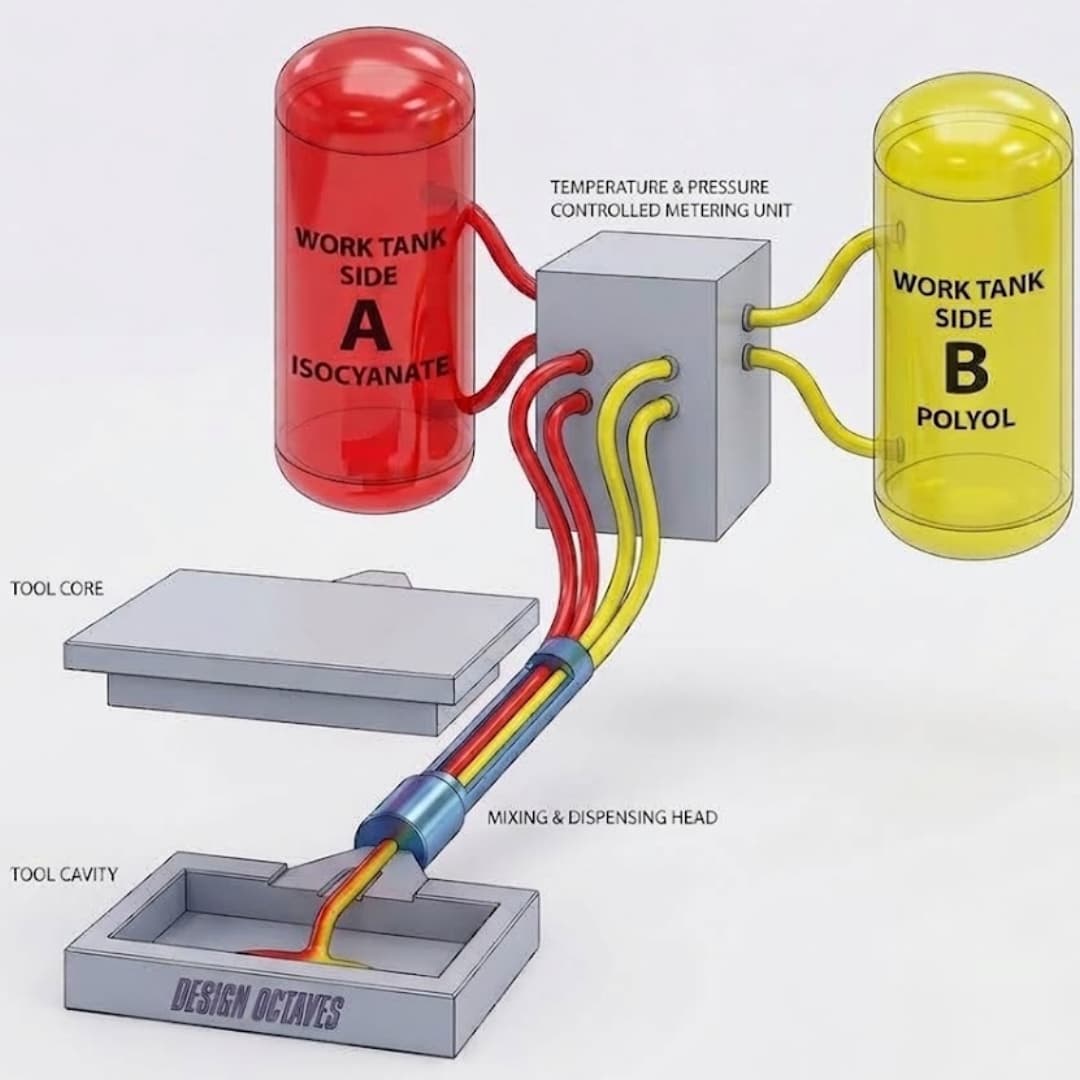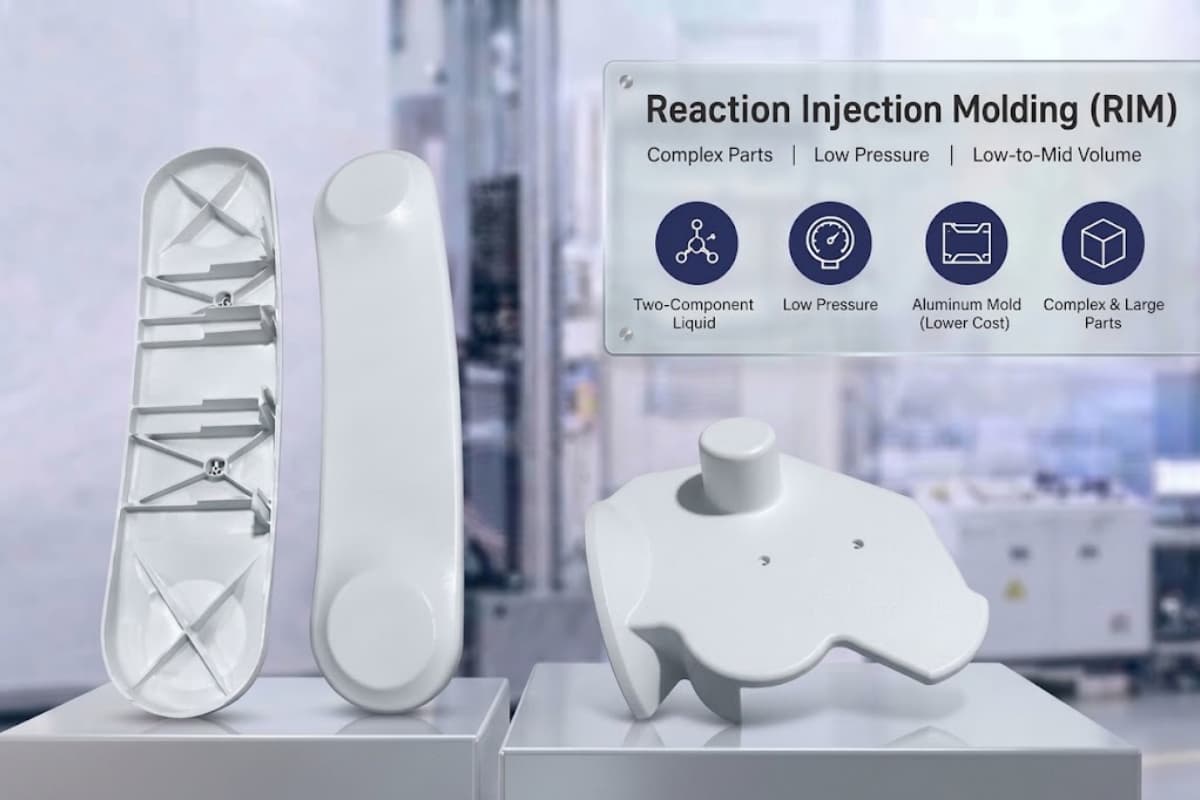

Reaction injection molding (RIM) does not use the solid plastic pellets common to conventional molding. The rim materials are low-viscosity liquid reactants—typically a polyol and an isocyanate, or similar reactive pairs—that are mixed, injected into a mold, and cured in place to form a cross-linked thermoset part. When engineers look for the right RIM material, the real question is not “what is RIM” but “which reactive system fits my part.”
Polyurethane (PU) is the default and by far the most widely used RIM material, because its chemistry can be tuned across an unusually wide property range—from soft, rubber-like elastomers to rigid, lightweight structural foams. Epoxy, nylon (polyamide), silicone (liquid silicone rubber, LSR), polyurea, and glass- or carbon-fiber-reinforced composites cover more specialized needs such as chemical resistance, low-temperature toughness, biocompatibility, or high stiffness.
Your material choice sets the part’s stiffness, impact resistance, heat resistance, surface quality, and whether the part can be recycled after molding. This guide reviews each RIM-capable material family, shows where each performs best, and gives a selection framework you can apply before requesting a quote. For the broader process picture, see how the RIM process works and our comparison of RIM vs. injection molding.
What Materials Can Be Used in Reaction Injection Molding?
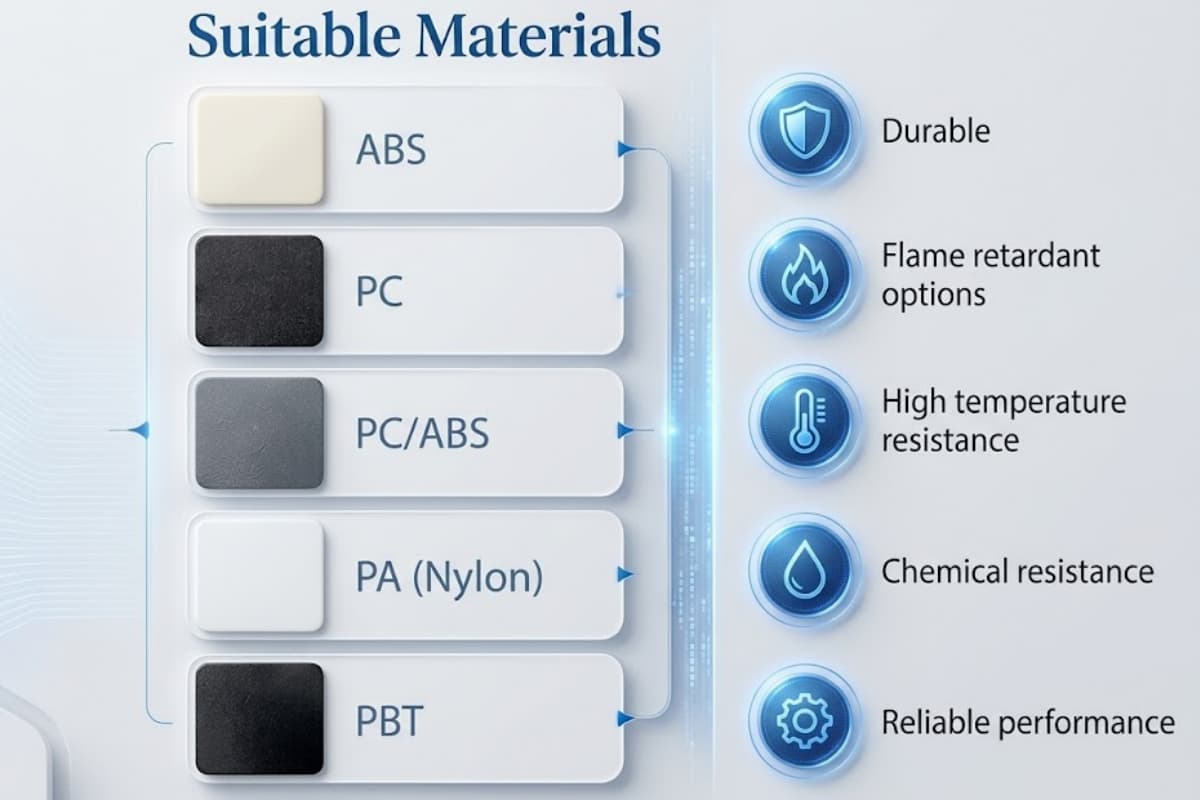
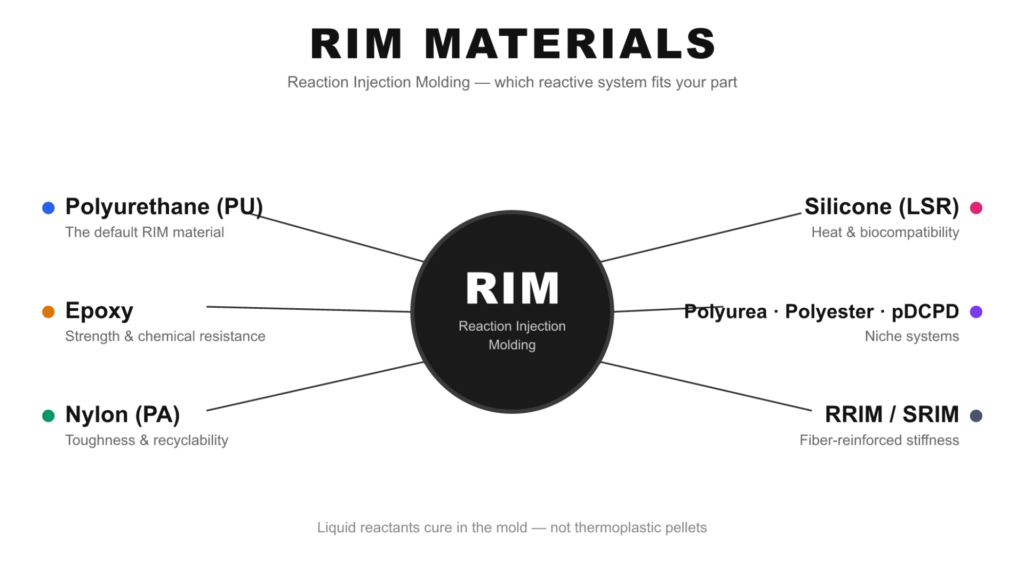
RIM can only process polymers that react and cure as liquids inside the mold. That rules out most standard thermoplastic pellets (ABS, PC, PP) and limits the field to a small set of reactive thermoset systems.
The main families are:
- Polyurethane (PU) — the dominant RIM material, used for the large majority of RIM parts.
- Epoxy — high strength and chemical resistance for demanding structural or electrical parts.
- Nylon / polyamide (PA) — including elastomer-modified nylon 6 systems, valued for toughness and recyclability.
- Silicone (LSR) — heat resistance, flexibility, and biocompatibility for medical and high-temperature parts.
- Polyurea, polyester, pDCPD, and reinforced composites — niche systems for abrasion, cost, or stiffness with fiber reinforcement.
The reason the list is short is chemical: a usable RIM material must stay liquid at low viscosity long enough to fill the mold, then cure rapidly without external heating. Polyurethane meets those constraints best, which is why it anchors most RIM programs. The exact formulation—hardness, density, filler content—should be confirmed against your application rather than assumed from a generic data sheet.
Polyurethane (PU): The Default RIM Material
Polyurethane earns its position as the standard RIM material because two liquid components (a polyol blend and an isocyanate) can be combined in different ratios and with different additives to “dial in” the final part character. One formulation can behave like a tough rubber; another can mimic a rigid engineering plastic. This formulation latitude is the single biggest reason engineers choose RIM over other low-volume methods.
Solid Elastomers
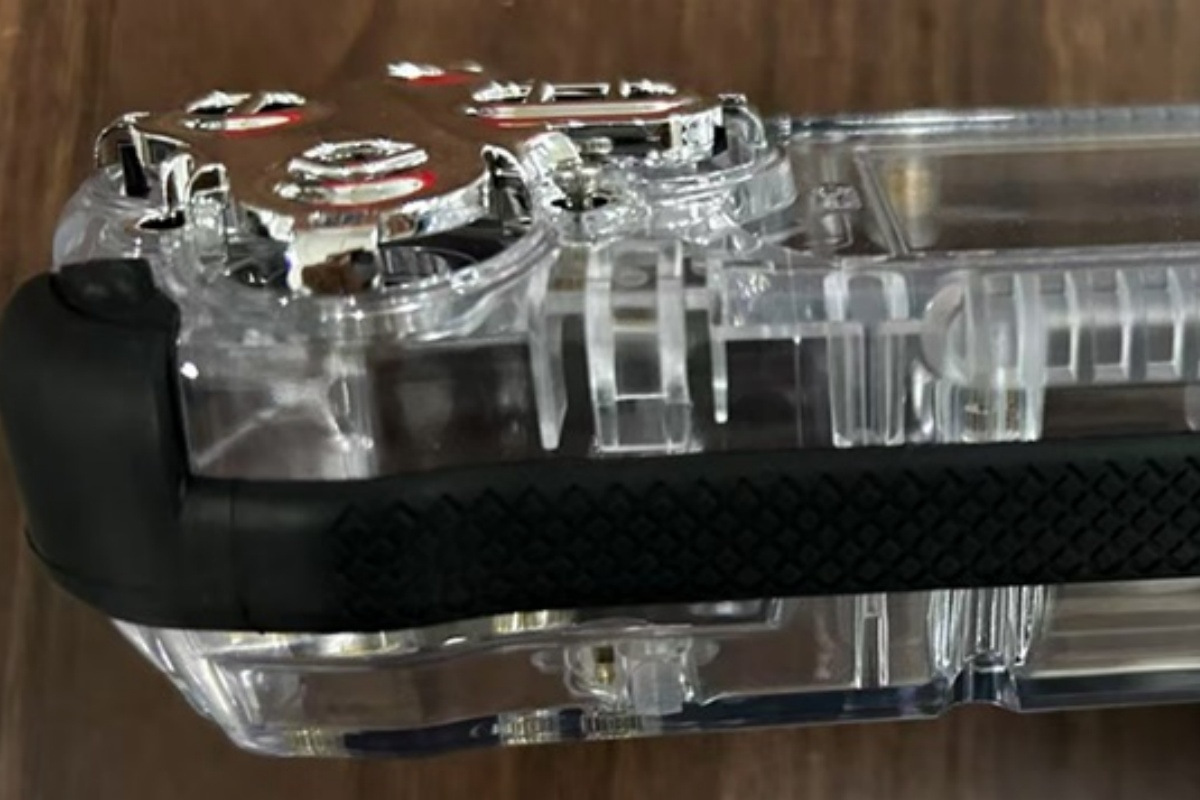
Solid PU elastomers are rubber-like, flexible, and highly impact resistant. They return to shape after bending or compression, which makes them suitable for parts that take repeated abuse—large flexible bumpers, fenders, and protective trims. Because the material flows as a liquid, it captures complex geometry and integral features such as ribs and bosses in a single shot.
Structural Foam
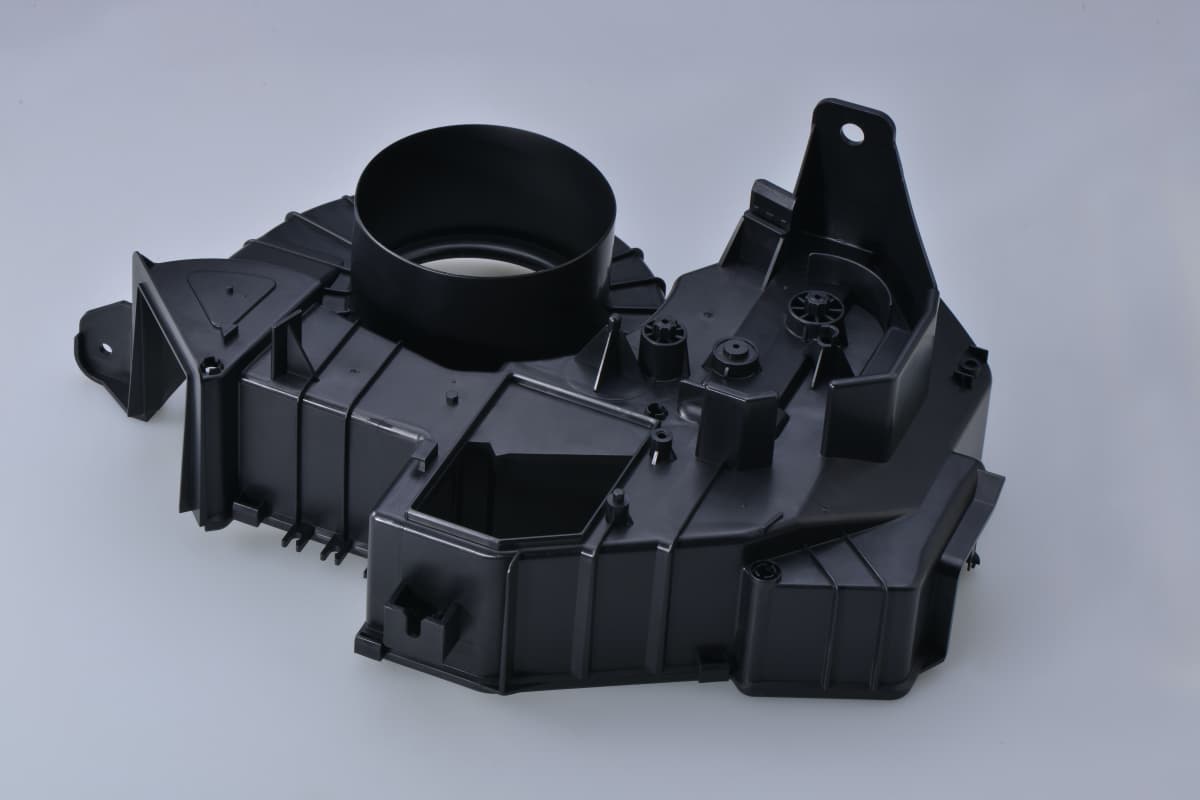
By adding a blowing agent, the reacting mix expands inside the mold to form a sandwich structure: a dense, solid outer skin over a microcellular core. The result is high stiffness at low weight—the same principle as an I-beam. Structural foam is the usual choice for large housings, enclosures for medical imaging equipment, and panels on construction or agricultural machinery, where a solid part would be too heavy or would sink under its own mass.
Rigid Polyurethane
Rigid PU systems deliver a hard, dimensionally stable part with a good surface finish that can be painted, textured, or colored in the mold. They suit rigid housings, covers, and cosmetic panels where appearance and stiffness matter more than flexibility.
| PU form | Typical properties | Common part examples |
|---|---|---|
| Solid elastomer | Flexible, high impact resistance, returns to shape | Bumpers, fenders, gaskets, grips |
| Structural foam | High stiffness-to-weight, sandwich skin/core | Large enclosures, equipment housings, panels |
| Rigid PU | Hard, stable, paintable surface | Covers, cosmetic panels, rigid brackets |
Specific hardness (Shore), density, and temperature limits vary by formulation and must be confirmed with the material supplier or your molding partner. For rapid-turn prototypes in these materials, see our rapid prototyping services.
Epoxy for RIM: Strength and Chemical Resistance
Epoxy RIM systems cure through a reaction between an epoxy resin and a hardener. They are chosen where PU is not enough: high mechanical strength, strong adhesion, and broad chemical resistance. Typical uses include electrical insulators, aerospace components, and precision mechanical parts that must hold tight tolerances and resist aggressive media.
Epoxy tends to be more brittle than PU and is more sensitive to moisture during processing, so it appears in fewer RIM programs but remains the right answer for certain high-performance parts. When the priority is chemical resistance or electrical insulation rather than flexibility, epoxy deserves a place on the shortlist. Tooling for epoxy RIM follows the same low-pressure logic as other RIM systems; details on mold construction are covered under aluminum mold fabrication.
Nylon (Polyamide) RIM: Stiffness, Toughness, Recyclability
Reactive nylon systems—elastomer-modified nylon 6 is a known example—bring a stiffness-toughness balance that holds up at low temperatures, with good fatigue and abrasion resistance. They are useful for parts that must stay strong and quiet under cyclic load.
The distinctive point versus other RIM materials is end-of-life: nylon RIM parts are thermoplastic after molding and can enter normal recycling streams, whereas most RIM-capable thermosets cannot be remelted and reshaped. For programs with a defined sustainability requirement, that difference can decide the material. Nylon RIM is a smaller niche than PU, but it is worth considering when stiffness, low-temperature toughness, and recyclability all matter at once.
Silicone (LSR) for RIM: Heat, Flexibility, Biocompatibility
Liquid silicone rubber (LSR) is a RIM-derived process that uses silicone-based reactive systems instead of polyurethane. Its strengths are temperature resistance across a wide range, excellent flexibility, electrical insulation, and biocompatibility. Those properties put it in medical device components, seals, and parts exposed to extremes of heat or cold.
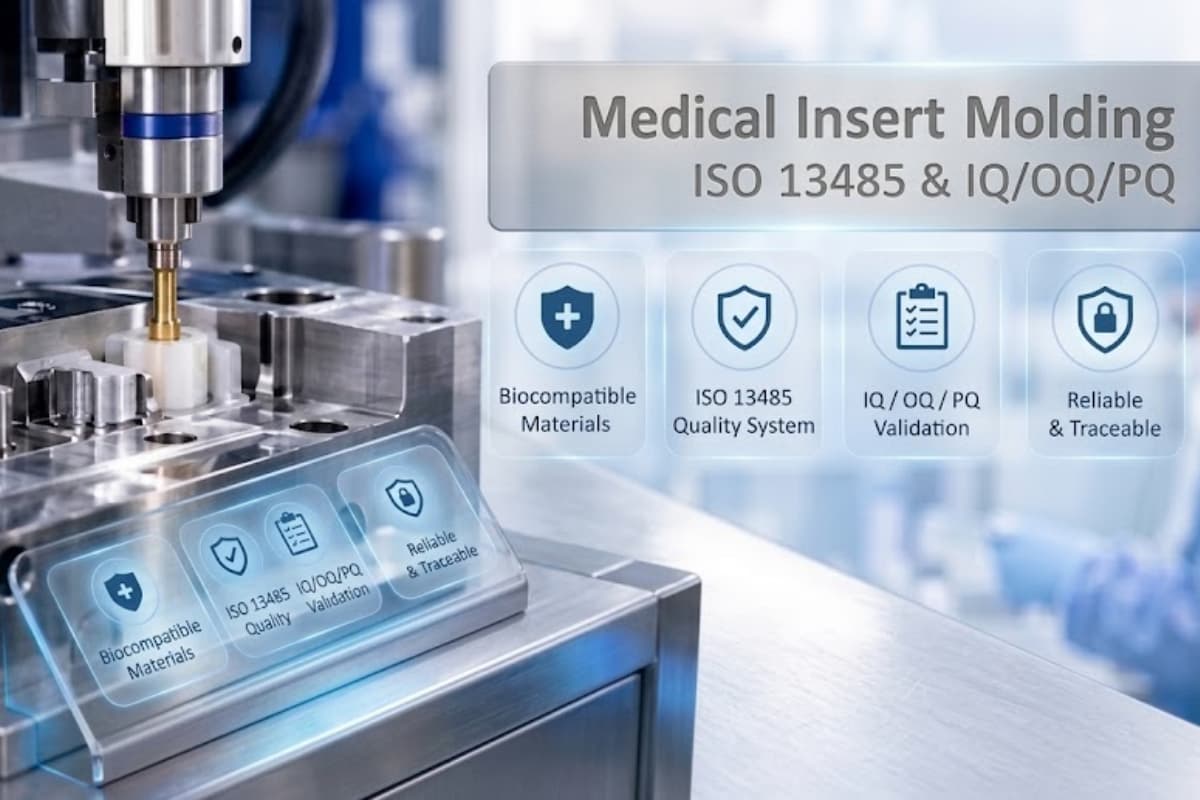
LSR requires dedicated equipment and careful mold design for flow and venting, and injection pressures run lower than for general RIM. If your part must comply with medical regulations or survive sterilization and wide temperature swings, silicone is often the material that passes where PU or epoxy will not. Medical-grade programs can be reviewed against our ISO 13485 system—see our reaction injection molding services for material and compliance options.
Other RIM-Capable Systems: Polyurea, Polyester, pDCPD, Composites
Beyond the four main families, several reactive systems extend RIM into narrower applications:
| System | Positioning |
|---|---|
| Polyurea | Very fast cure, high abrasion and chemical resistance; suited to protective coatings and demanding wear parts |
| Polyester-based | Low-cost option, properties tailored by formulation for mechanically stressed parts |
| pDCPD | High impact and corrosion resistance for large chemical tanks, covers, and agricultural panels |
| Glass/carbon-fiber composites (RRIM/SRIM) | Fiber reinforcement added for stiffness and dimensional stability; see reinforced RIM (SRIM/RRIM) |
When reinforcement is needed—glass or carbon fiber added to the liquid or pre-placed as a mat—the process becomes reinforced RIM (RRIM) or structural RIM (SRIM). These variants raise stiffness and lower thermal expansion toward metal-like behavior, which matters for bumpers and structural panels.
RIM Material Selection Framework
Choosing a material is a sequence, not a single lookup. Work through these dimensions in order:
- Mechanical demand — Does the part need to flex (elastomer), stay rigid (rigid PU, epoxy, nylon), or absorb impact (elastomer, structural foam)?
- Thermal and chemical environment — Will it see heat, cold, solvents, or outdoor UV? Silicone and epoxy lead on temperature and chemical resistance; PU covers most indoor and mild outdoor cases.
- Weight and size — Large parts benefit from structural foam’s stiffness-to-weight; very thick sections favor RIM over solid thermoplastics to avoid sink marks.
- Regulatory and end-of-life — Medical parts may need ISO 13485-tracked programs and biocompatible materials (silicone, certain PU); recyclability points to nylon.
- Volume and surface — RIM suits low-to-mid volumes with class-A or textured surfaces; confirm the finish and any painting or in-mold coating early.
| If your priority is… | Start with |
|---|---|
| Impact absorption, flexible trim | PU solid elastomer |
| Large, light, stiff housing | PU structural foam |
| Rigid, paintable cosmetic panel | Rigid PU |
| Chemical resistance, insulation | Epoxy |
| Low-temperature toughness + recyclability | Nylon (PA) |
| Heat, biocompatibility, flexibility | Silicone (LSR) |
| Maximum stiffness with fiber | RRIM / SRIM |
Before ordering, confirm these points with your molder:
- Target hardness, density, and any required temperature or chemical ratings
- Color, surface finish, and whether painting or in-mold coating is needed
- Regulatory framework (e.g., medical, automotive) and applicable material recognition
- Wall thickness, insert encapsulation, and any undercut that affects tooling
GoodTech’s RIM program runs under ISO 9001 and IATF 16949 quality systems, with ISO 13485 for medical-grade work, ISO 14001 environmental management, and UL 746D recognition for polymeric materials. Engineering teams in Chicago and Shenzhen, with manufacturing in Vietnam, can review your drawing against these requirements and recommend a formulation rather than leaving the choice to guesswork.
Why RIM Material Choice Differs From Injection Molding
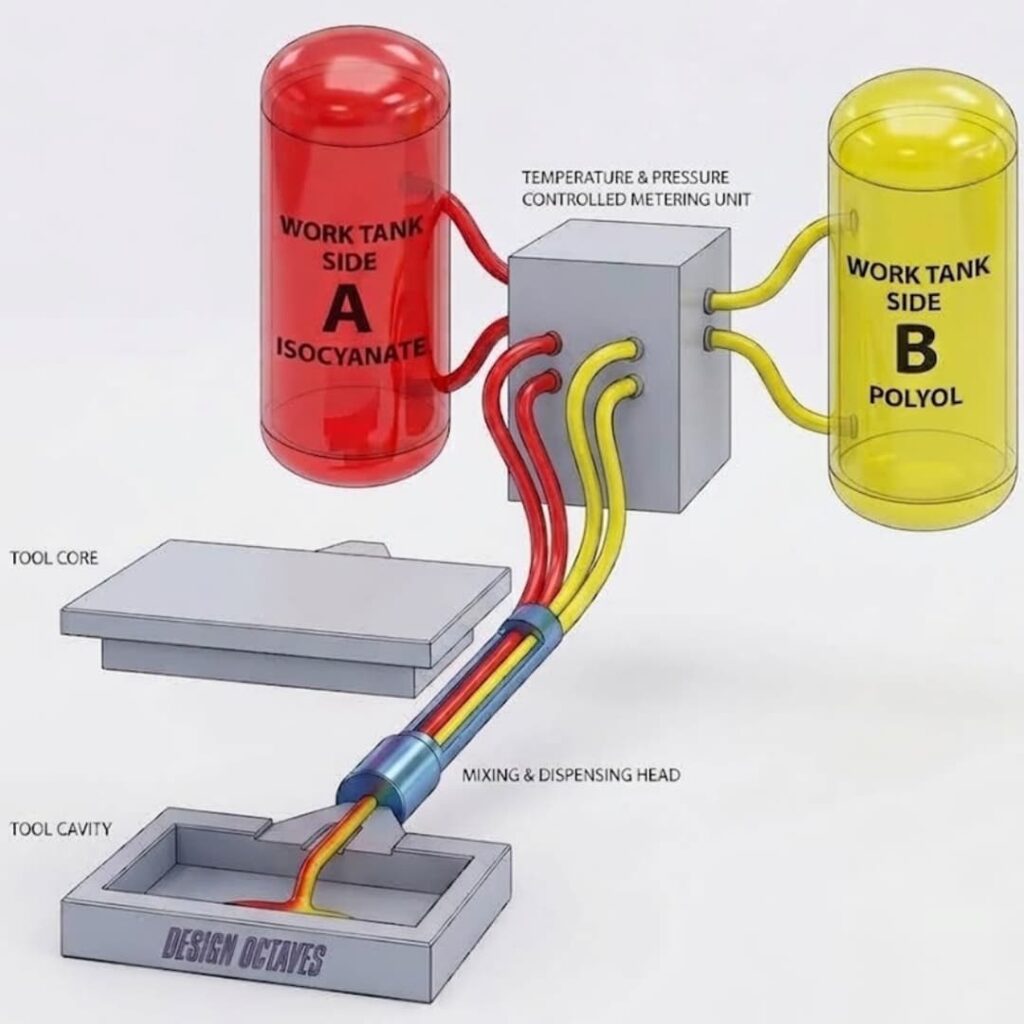
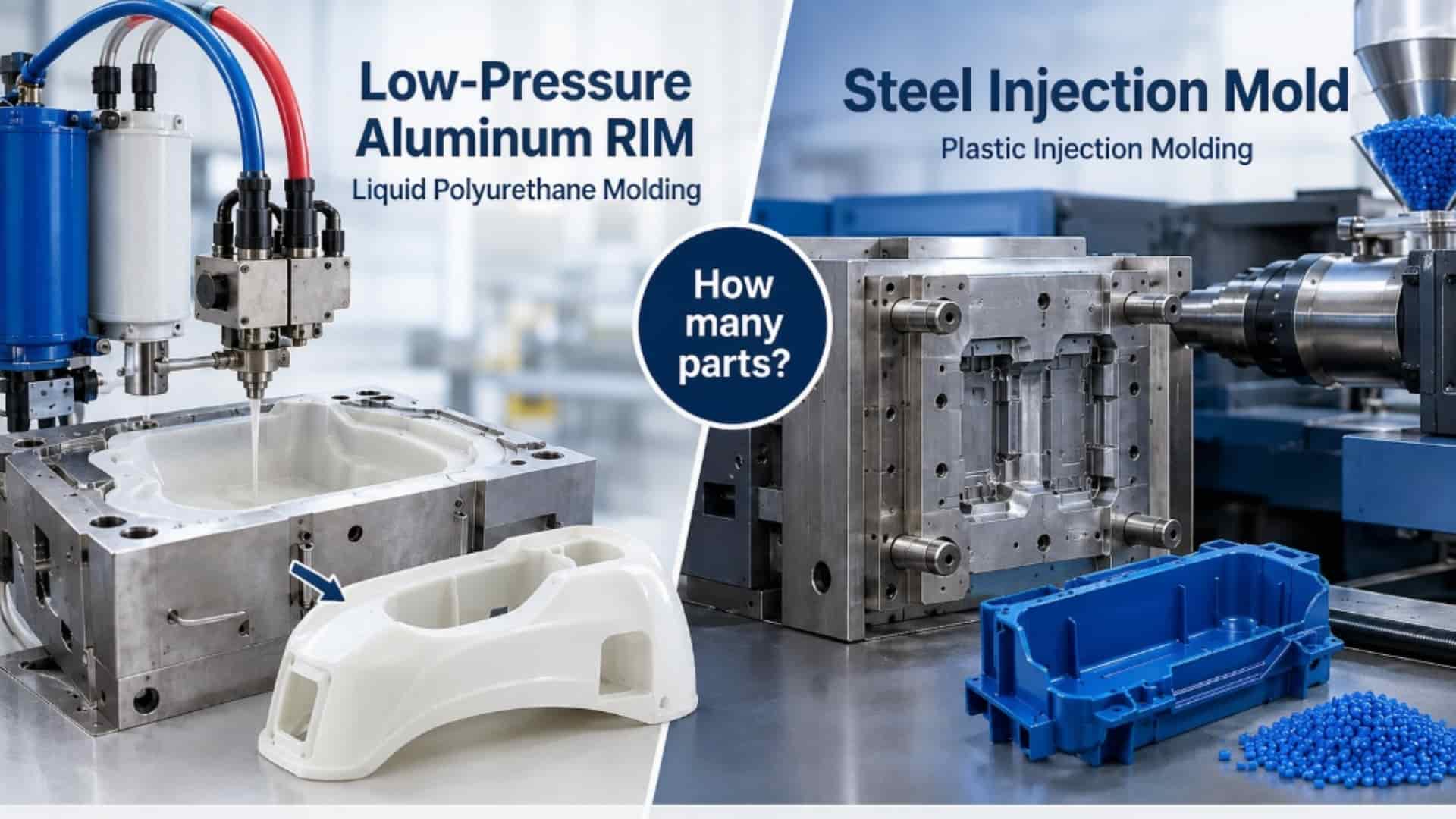
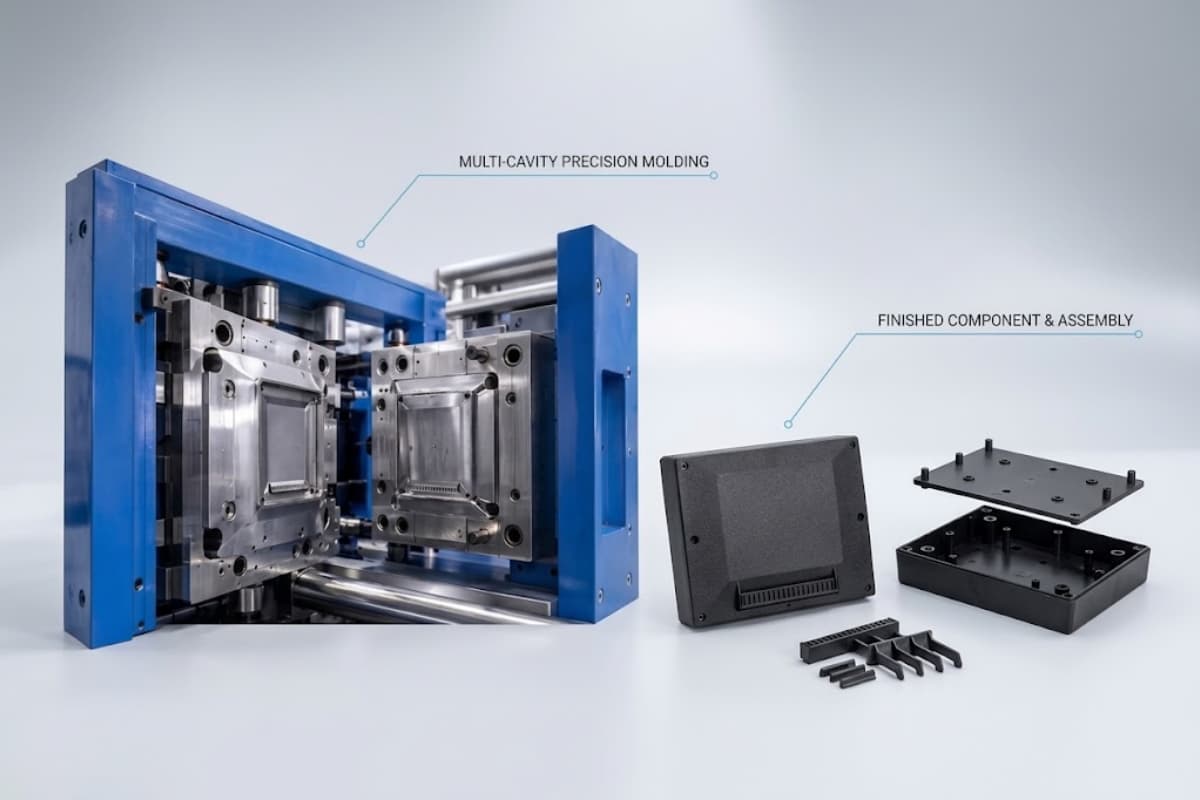
The confusion between RIM and injection molding often starts with materials. Conventional injection molding melts solid thermoplastic pellets (ABS, PC, PP, nylon) and injects them under high pressure into a steel mold. RIM mixes two liquid reactants and cures them under low pressure in an aluminum mold. The materials are therefore different in kind, not just in grade.
| Factor | RIM materials | Injection molding materials |
|---|---|---|
| Form before molding | Liquid reactive system | Solid thermoplastic pellets |
| Polymer type | Cross-linked thermoset (mostly PU) | Linear thermoplastic |
| Property adjustability | Wide, via formulation | Set by resin grade |
| Typical mold | Low-pressure aluminum | High-pressure steel |
| Best volume range | Low to mid | Mid to high |
| Recyclability after molding | Limited (nylon is an exception) | Generally recyclable |
This is why asking “can I use ABS in RIM” has a clear answer: no. RIM’s material set is small but unusually tunable, which is the trade that makes it attractive for large, complex, low-volume parts. For the full process comparison, see RIM vs. injection molding.
FAQ
What materials can be used in reaction injection molding?
RIM uses reactive thermoset liquids. The main families are polyurethane (PU), epoxy, nylon/polyamide, silicone (LSR), and reinforced composites, with polyurea, polyester, and pDCPD in specialized roles. PU is used for the majority of parts.
Is polyurethane the only material for RIM?
No. Polyurethane is the dominant material because it cures reliably and tunes across a wide property range, but epoxy, nylon, silicone, polyurea, and reinforced composites are all used where their specific properties are required.
Can silicone and nylon be reaction injection molded?
Yes. Silicone (LSR) is a RIM-derived process for heat- and biocompatibility-sensitive parts, and reactive nylon systems are used where stiffness, low-temperature toughness, and recyclability matter.
How do I choose the right RIM material for my part?
Start from the mechanical, thermal, and chemical demands, then weigh weight, regulatory requirements, and volume. The selection framework and matrix above give a starting point; exact specifications should be confirmed with your molder.
Key Takeaways
- RIM materials are reactive liquids that cure in the mold—not thermoplastic pellets—so the usable set is small but highly tunable.
- Polyurethane covers most RIM parts and can be formulated from flexible elastomers to rigid structural foam.
- Epoxy, nylon, and silicone each serve a defined need: chemical/electrical resistance, recyclable toughness, and heat/biocompatibility respectively.
- Material choice drives stiffness, weight, heat and chemical resistance, surface finish, and recyclability.
- Use a dimension-by-dimension framework and confirm exact specifications with your molder before ordering.
Conclusion and Next Step
The fastest way to a correct material decision is to bring your part requirements—function, environment, finish, and volume—to a molder who can match them to a formulation. GoodTech’s engineering teams in Chicago and Shenzhen, with manufacturing in Vietnam, can review your drawing for DFM and recommend a PU, epoxy, nylon, or silicone system against the right quality standard (ISO 9001, IATF 16949, ISO 13485, ISO 14001, UL 746D). Upload your design for a free DFM and material recommendation, or request a quote with your application requirements.