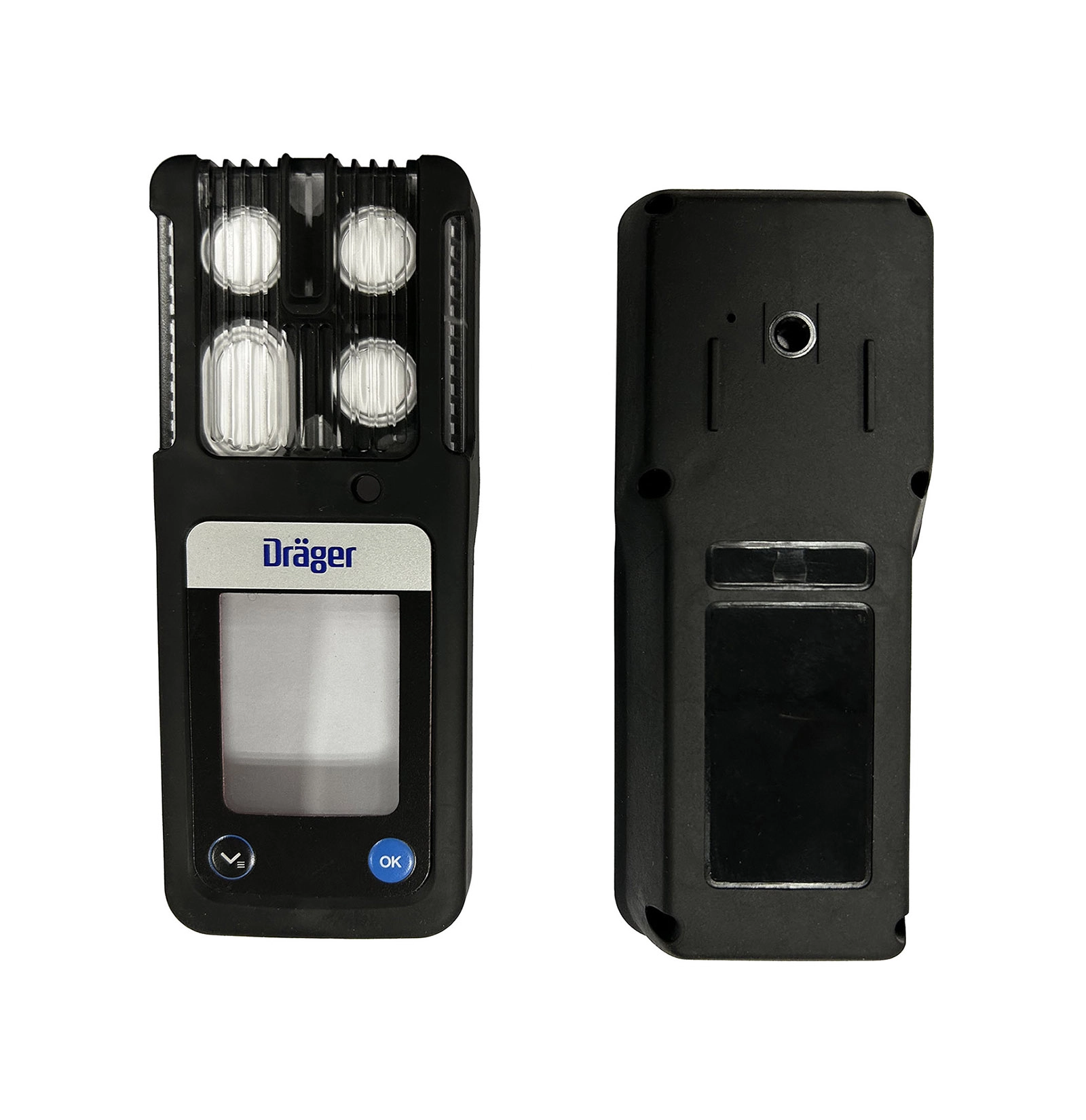

Picking the right way to join plastic parts comes down to four factors: how strong the joint must be, whether it needs to come apart, which materials are involved, and how many parts you will make. Among the common plastic joining methods, snap fits, ultrasonic welding, adhesive bonding, and heat staking each win on a different combination of those factors. Snap fits are molded in and need no extra hardware; ultrasonic welding gives fast, clean permanent joints but only between compatible thermoplastics; adhesive bonding joins dissimilar or odd shapes but needs surface prep and cure time; heat staking forms permanent rivets from the part’s own plastic and can capture metal inserts. This guide compares the four methods so you can choose before tooling is cut, and it clarifies where these post-mold assembly techniques stop and in-mold joining (overmolding, insert molding) begins.
These are assembly methods applied after parts are molded. They differ from in-mold joining processes such as overmolding or insert molding, where materials or metal are bonded during the molding cycle itself. The plastic part assembly methods below cover the main ways engineers join molded components after they leave the press. If you are deciding between molding the joint in versus assembling it after, our overmolding materials guide and insert molding design guide cover the in-mold side.
The Four Methods at a Glance
| Method | Joint type | Reversible? | Best material fit | Typical use |
|---|---|---|---|---|
| Snap fit | Mechanical, molded-in | Often yes | Any moldable plastic | Housings, covers, clips |
| Ultrasonic welding | Welded, permanent | No | Compatible thermoplastics | Same-material enclosures |
| Adhesive bonding | Bonded, permanent | No | Dissimilar or mixed | Gaskets, optics, multi-material |
| Heat staking | Formed rivet, permanent | No | Thermoplastic + metal/insert | Captive inserts, hinges |
Snap Fits: Molded-In Fastening
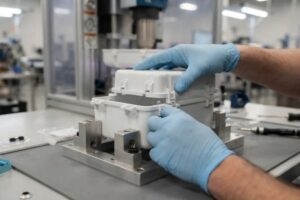
A snap fit is a flexible cantilever, ring, or torsional latch molded directly into the part, so it needs no screws, clips, or labor to fasten. It is the lowest-cost option at volume because the “hardware” is part of the molding cycle. Good plastic snap fit design limits strain on the beam, keeps wall sections uniform, and adds a lead-in and a draft angle so the latch engages without cracking. It only works in materials with enough flexural recovery (ABS, PC, PP, nylon). Our ribs and bosses design guide explains the wall-thickness and boss rules that keep snap features from sinking or cracking.
Choose snap fits when the joint must open for service, when you want near-zero assembly cost, and when the part material can flex without cracking. Avoid them for brittle materials or joints that must carry high sustained loads.
Ultrasonic Welding: Fast Welds for Compatible Thermoplastics
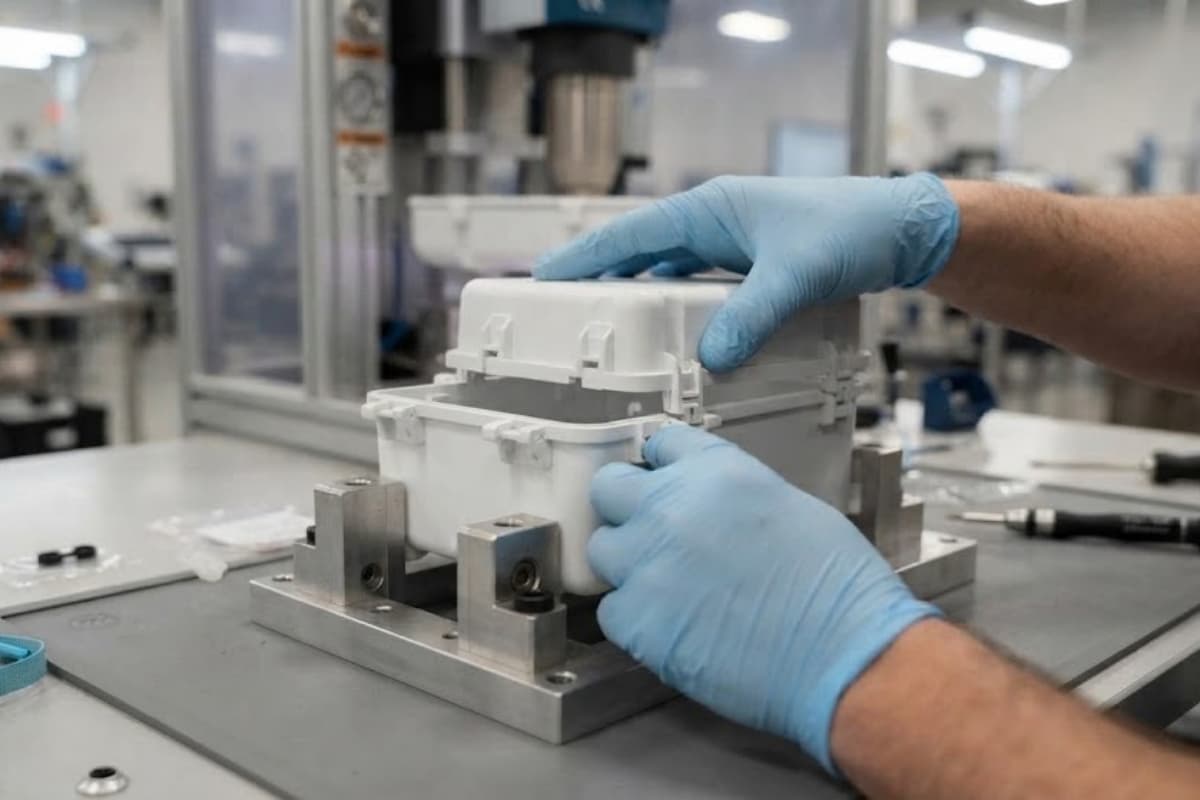
Ultrasonic welding plastic parts uses high-frequency vibration to generate heat at the interface and fuse two components — usually of the same resin — into one permanent joint in under a second. Among plastic welding methods it is the fastest and cleanest for same-material parts. An energy director (a small triangular bead) focuses the heat where the weld must form. It needs no consumables, which is why it dominates consumer-electronics and medical-device assembly.
The limitation is material: it works best between compatible amorphous or similar thermoplastics and poorly across dissimilar or filled grades. For engineers weighing ultrasonic welding plastic parts against adhesive or staking, the material rule is the first filter. Crystalline materials such as PP and PE weld but need more energy and tighter process control. It also cannot join already-assembled or heat-sensitive parts. For RIM polyurethane parts, welding is generally not applicable; those are better joined by adhesive or staking — see our RIM process overview.
Adhesive Bonding: Joining Dissimilar Materials and Spreading Load
Adhesive bonding plastic parts uses epoxy, polyurethane, or cyanoacrylate to glue components together, which makes it the only method here that easily joins dissimilar plastics, plastic to metal, or irregular surfaces, and it spreads stress across the whole bond line instead of a few points. That load distribution is why it is common for gaskets, lenses, and large thin shells.
The cost is process: most adhesives need surface preparation (cleaning, priming, sometimes plasma or flame treatment), a controlled cure time, and environmental limits on temperature and chemicals. It is permanent and generally not field-reversible. This is distinct from the chemical adhesion that happens during overmolding, where the substrate and molded elastomer bond in the mold rather than with a separate glue step.
Heat Staking Plastic: Rivets Formed from the Part’s Own Material
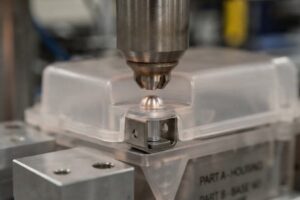
Heat staking plastic parts is a plastic assembly method where a heated tip softens a molded stud or boss and reshapes it into a rivet head that captures a mating part or metal insert. Because the rivet is the component’s own material, the joint is permanent, vibration-resistant, and needs no extra fastener. It handles dissimilar mates — for example, a plastic housing staking over a metal bracket or a PCB — which ultrasonic welding cannot do when the second material is not weldable plastic. Heat staking is often the right call when a plastic assembly method must capture a non-weldable insert.
Design the stud diameter and height for the expected load, and keep the staking zone away from thin walls that could warp. Heat staking is often compared with installing molded-in threaded inserts (covered in our insert molding guide) when the goal is a reusable threaded attachment rather than a permanent capture.
Which Method for Which Product
| Product example | Requirement | Recommended method |
|---|---|---|
| Consumer-electronics shell | Same material, high volume | Ultrasonic welding |
| Battery cover, serviceable clip | Must open | Snap fit |
| Lens or gasket seal | Dissimilar, stress spread | Adhesive bonding |
| Housing over metal bracket | Capture rigid insert | Heat staking |
| Medical device enclosure | Clean, same resin | Ultrasonic welding |
Industry pages detail the qualification bar per sector: medical device molding, automotive plastic molding, and consumer electronics molding.
How to Choose: Four Questions
- Must the joint open for service? If yes, snap fit. If no, continue.
- Are both parts the same weldable thermoplastic? If yes and volume is high, ultrasonic welding.
- Are the materials dissimilar, or is the shape irregular? If yes, adhesive bonding.
- Do you need to capture a metal insert or make a permanent rivet? If yes, heat staking.
Design for assembly early: keep features aligned with self-locating bosses and guides, minimize the number of separate fasteners, and confirm boss geometry with a DFM review so the part molds cleanly and assembles fast.
GoodTech Assembly-Ready Manufacturing
GoodTech molds and assembles parts under one roof — injection molding, RIM, and the post-mold joining methods above — so a part can move from molding to a finished assembly without re-sourcing. Engineering teams in Chicago, Shenzhen, and Vietnam run DFM feedback early, and the same program can combine molding with snap-fit, welding, bonding, or staking as the design requires.
Key Takeaways
- Snap fits are molded in and cheapest at volume but need a flexible material.
- Ultrasonic welding is fast and clean but limited to compatible thermoplastics.
- Adhesive bonding joins dissimilar materials and spreads load but needs surface prep.
- Heat staking forms permanent rivets from the part’s own plastic and captures metal.
- Choose by reversibility, material match, and volume — not by habit.
- Decide the joint type before cutting tooling; it changes the part geometry.
FAQ
Can ultrasonic welding join any plastic?
No. It works between compatible thermoplastics, best with similar resins. Dissimilar or highly filled grades weld poorly, and it cannot join metal or cured thermoset parts.
Which is cheaper, snap fit or adhesive?
Snap fits are usually cheapest at volume because the feature is molded in and needs no consumable or cure step. Adhesives add material, surface prep, and cycle time.
Why does adhesive bonding need surface preparation?
Most plastics are low-energy surfaces that glue slides off. Cleaning, priming, or plasma treatment raises bond strength and reliability.
Can heat staking join plastic to metal?
Yes. Heat staking plastic parts reforms the plastic stud over the metal part, capturing it permanently — something ultrasonic welding cannot do when the second material is not weldable plastic. The joint is vibration-resistant and needs no separate fastener.
How do I design a plastic part for easy assembly?
Use self-locating bosses and guides, minimize separate fasteners, and confirm wall and boss geometry in a DFM review so features mold without sink or stress.
What is the strongest way to join two plastic parts?
For same-material parts, ultrasonic welding gives a near-parent-material joint. For dissimilar parts, structural adhesive spreads load best. “Strongest” depends on the load direction and environment.
Work With GoodTech
Send us your 3D files and assembly requirements — we will recommend snap fit, welding, adhesive, or staking, with a DFM review and a quote. Contact the GoodTech team.