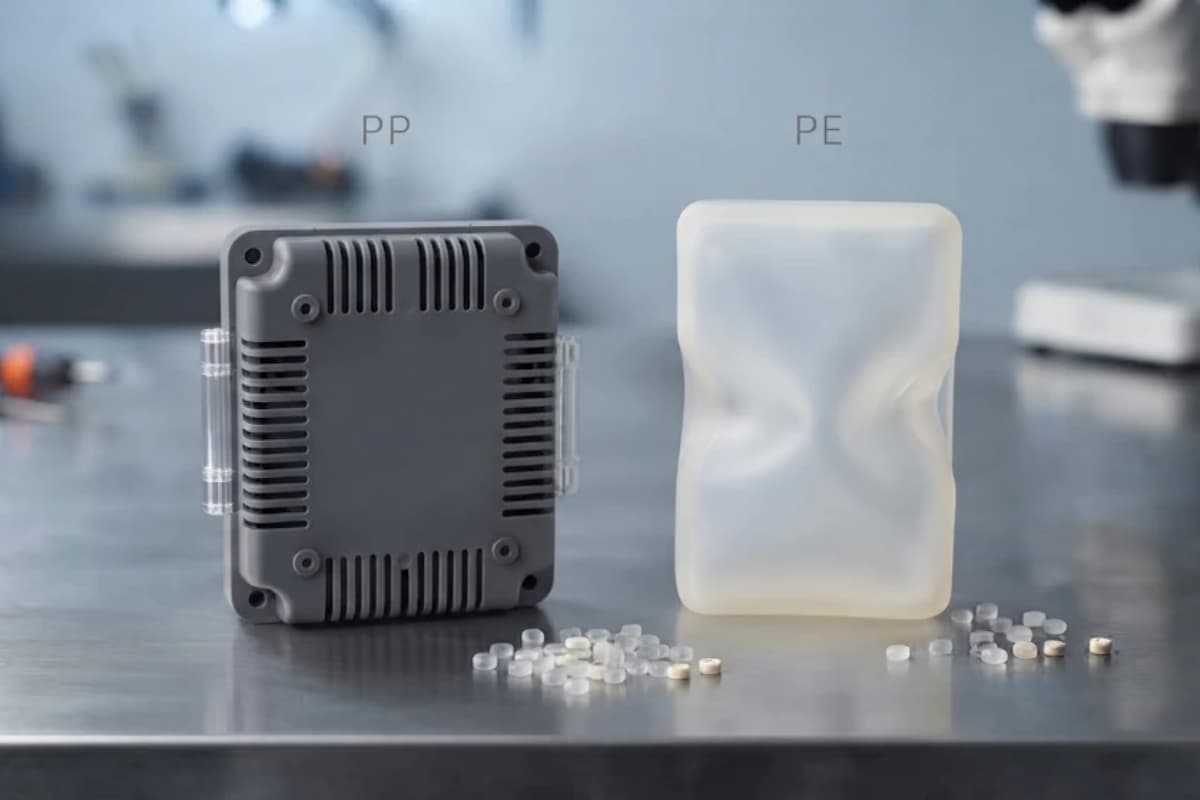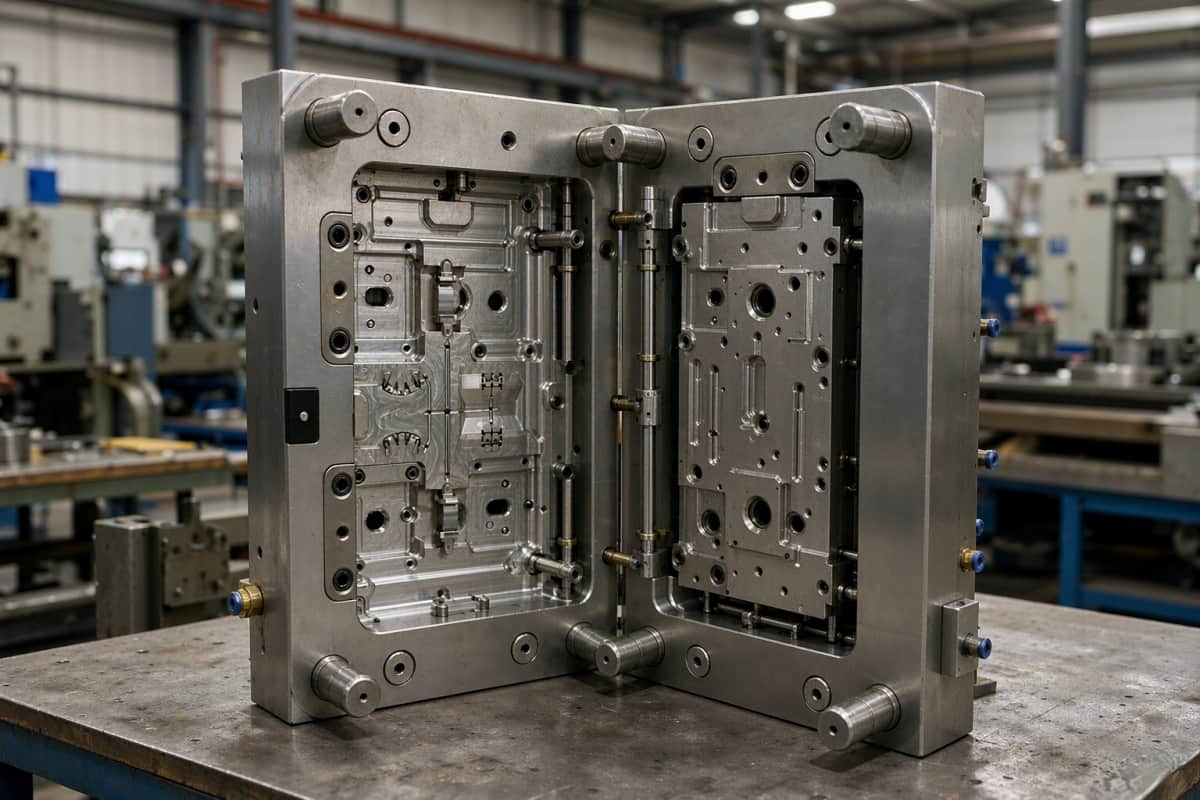

Quick answer: pick PP when the part needs stiffness, heat, or a living hinge; pick PE when it needs to survive cold weather, take hits, or squeeze and flex. Both are cheap, chemical-resistant commodity plastics — the real differences are stiffness, cold toughness, and shrinkage.
Polypropylene (PP) and polyethylene (PE) are the two cheapest, most widely molded plastics in the world, and on a quote sheet they look almost the same — light, tough against chemicals, and cheaper than almost everything else on the shelf. The differences that matter show up in three places: how stiff the part feels, how it behaves in heat and cold, and how much each plastic shrinks in the mold — and that last one ends up in your mold steel, not just the finished part. This guide compares them side by side, shows the numbers that matter, and gives simple rules for choosing before steel gets cut. For how each one processes in depth, see our PP injection molding guide and PE injection molding guide.
1. PP vs PE: Side-by-Side Comparison
| Property | PP | PE | Winner |
|---|---|---|---|
| Stiffness | Stiffer — holds shape even in thin walls | More flexible, slowly bends out of shape under steady load | PP |
| Heat resistance | ~100–120 °C continuous; survives steam and autoclave | ~70–90 °C continuous, softens earlier | PP |
| Fatigue / living hinges | Excellent — a good hinge flips hundreds of thousands of times | Bends fine, but won’t make a dependable hinge | PP |
| Impact in cold | Gets brittle near 0 °C unless modified | Stays tough well below freezing | PE |
| Flexibility / squeeze feel | Firm; not a squeeze material | Soft and rubbery (LDPE especially) | PE |
| Chemical resistance | Excellent — best against solvents and degreasers | Excellent — very strong against acids and alkalis | Tie |
| Food contact / cost | Plenty of FDA grades, slightly higher price | Plenty of FDA grades, usually the cheapest | PE |
| Clarity | Translucent (random copolymer clearer) | HDPE waxy translucent; LDPE clearer | Tie |
2. When Should You Choose PP?
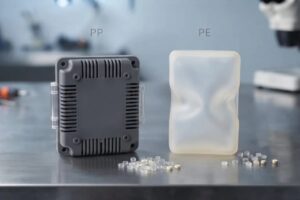
PP is the stiff, heat-friendly one of the two. Use it when the part has to hold a shape and take some heat:
- Living hinges — flip-top caps, hinged lids, snap closures. PP is pretty much the only real choice here; a well-designed PP hinge opens and closes hundreds of thousands of times without failing. Design rules in our living hinge guide.
- Heat and sterilization — hot-fill packaging, dishwasher-safe parts, medical trays that go through autoclave cycles at 121 °C again and again.
- Thin-wall parts that still need to be stiff — containers, crates, appliance internals where the wall is 1 mm or less.
- Contact with solvents and degreasers — PP holds up better here than PE does.
The thing to watch: plain PP gets brittle near 0 °C. A part that passes a drop test in August can crack in a delivery truck in January. If cold is part of the picture, ask for impact copolymer PP or switch to PE.
3. When Should You Choose PE?
PE is the tough, flexible one. Use it when the part has to take hits and keep bending:
- Cold environments — freezer parts, outdoor enclosures, cold-chain packaging. PE keeps its toughness where PP goes brittle.
- Squeeze and flex parts — LDPE squeeze bottles, soft closures, bellows. This is PE’s home turf.
- Chemical and water containers — HDPE tanks, drums, jerrycans. Chemical resistance plus toughness makes PE the default for liquid storage.
- High volumes where cost rules — PE resin usually prices a bit below PP, and it molds without any drying step.
The trade-offs: PE slowly bends out of shape under steady load, it softens around 70–90 °C, and no PE will give you a dependable living hinge.
4. The Numbers That Decide Your Mold
This is where the two really split. Both plastics shrink as they cool and harden — just by different amounts:
| Processing property | PP | HDPE | LDPE |
|---|---|---|---|
| Melt temperature | 160–170 °C | 130–140 °C | 105–115 °C |
| Mold temperature | 20–50 °C | 20–60 °C | 20–50 °C |
| Molding shrinkage | 1.2–1.6% | 1.5–3.0% | 2.5–3.5% |
| Shrink from one direction to the other | Some difference | A lot — watch for warpage | A lot |
| Drying needed | No | No | No |
| Cycle time | Fast — hardens quickly | Slower — needs more cooling | Slower |
Here’s the catch: the mold is cut to the shrinkage of one specific resin. A cavity sized for PP at 1.4% shrink comes out undersized if you run HDPE at 2.5%. PE also shrinks more in one direction than the other — that’s exactly what warps wide, flat parts, along with uneven cooling. So don’t swap PP for PE in a finished mold and expect good parts — the cavity size won’t match. Pick the material before the steel is cut, and if a change is forced later, plan on re-cutting steel.
5. “PP” and “PE” Are Family Names
Neither label is one material. PP comes in three common versions: homopolymer (the stiffest and most heat-friendly, but the most brittle in cold), impact copolymer (a bit of rubber mixed in — much tougher in cold, slightly softer), and random copolymer (clearer, common in packaging and medical). PE also has three: HDPE (the stiff one — drums, crates), LDPE (the soft, squeezable one), and LLDPE (mostly film). Most real decisions happen here, not between the two big labels: impact copolymer PP is the safer pick for anything that might see a winter, and HDPE beats LDPE for anything structural.
6. The Decision in Three Questions
- Does it flex thousands of times, or see over 100 °C? Yes → PP.
- Does it get dropped in the cold, or get squeezed? Yes → PE.
- Is it a rigid part at room temperature? Either works — then it comes down to price and how tight your dimensions are. Just lock the choice before the mold is cut.
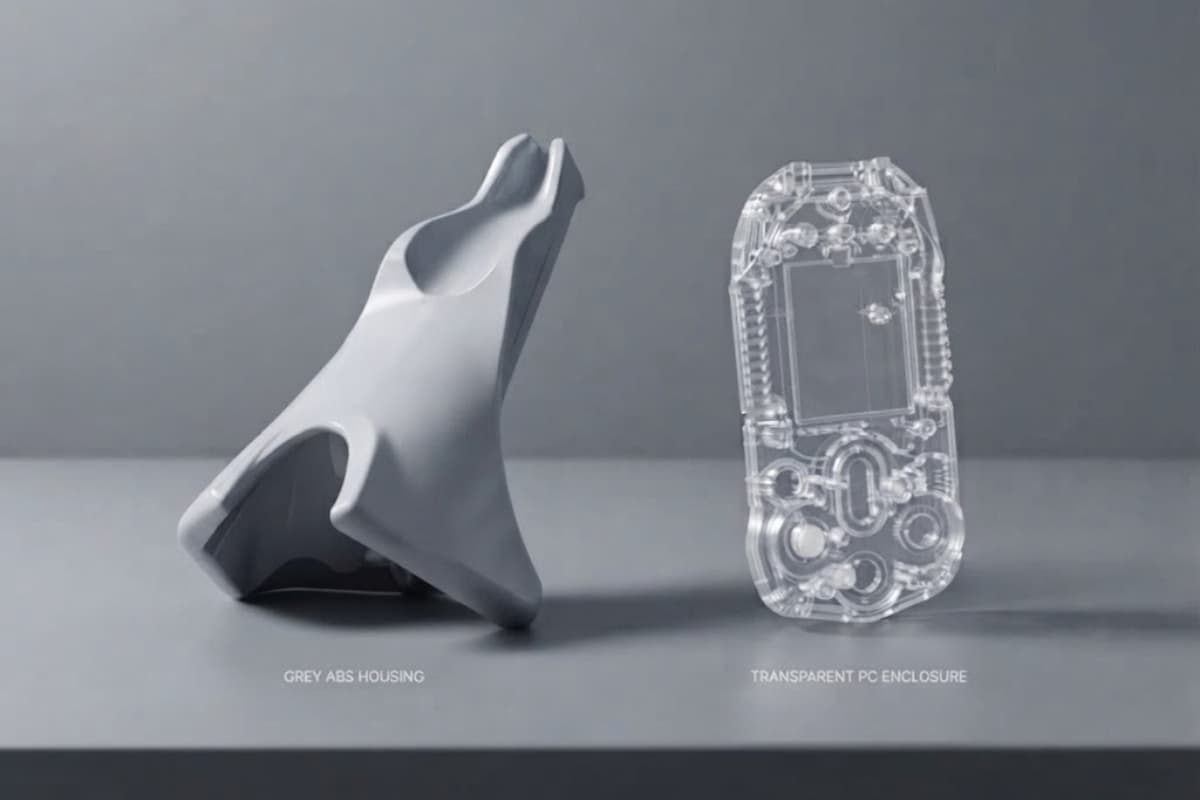
Shopping for stiffer, better-looking plastics instead? See our ABS vs PC comparison — and for the full material map, the 20 common plastics guide.
Frequently Asked Questions: PP vs PE
What is the difference between polypropylene and polyethylene?
Three things: stiffness, heat, and cold. PP is stiffer, handles ~100–120 °C, and is the only one that makes a dependable living hinge. PE is more flexible, stays tough below freezing, and usually costs a bit less. Both shrug off chemicals — PE is slightly better with acids and alkalis, PP with solvents.
Is polypropylene stronger than polyethylene?
Stiffer, yes — PP resists bending and holds shape in thin walls much better. Tougher, no — PE takes impacts better, especially in the cold. “Stronger” depends on how your part fails: from bending, pick PP; from cracking, pick PE.
Can you switch a mold from PP to PE?
Not without problems. PE shrinks 1.5–3.0% versus PP’s 1.2–1.6%, so parts molded in PE from a PP-sized cavity come out undersized — and more likely to warp. You’d need steel changes or a re-cut cavity.
Do PP or PE need drying before injection molding?
No — neither soaks up water, so there’s no dryer step. That’s part of why both are cheap to mold. One exception: if you run a lot of regrind in humid weather, damp pellets can leave silver streaks on the part.
Related Reading
- Polypropylene (PP) Injection Molding Process
- Polyethylene (PE) Injection Molding Process
- How to Design a Living Hinge in Injection Molding
- ABS vs PC for Injection Molding: How to Choose
- 20 Types of Plastic Materials: Properties and Uses
Still not sure which way your part leans? Send us the drawing, where the part will live — including the coldest temperature it will ever see — and your yearly volume. Our engineers will pick the material, check how it affects the tool, and quote your custom injection molding project with the right resin from day one.