
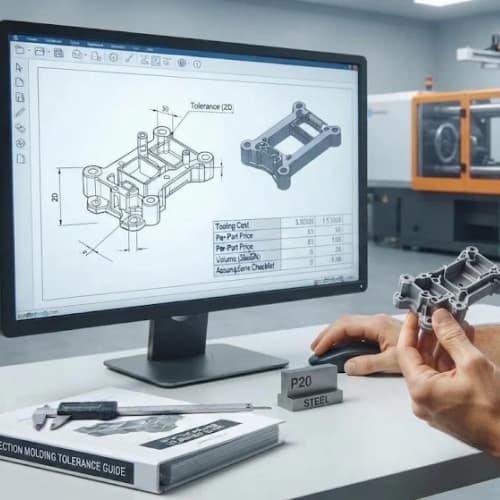
Most inaccurate injection molding quotes trace back to an incomplete RFQ. Send a 3D model, a 2D drawing with tolerances, a specific resin grade, realistic volumes, and your shipping terms, and a molder can price tooling and per-part costs accurately on the first pass. Just as important: ask what assumptions sit behind each quote, because two suppliers can quote the same part thousands of dollars apart for reasons that have nothing to do with quality. This guide covers what to prepare, what a complete quote should break down, and how to compare quotes fairly.
If you have ever sent the same part file to three suppliers and received three prices that don’t seem to describe the same project, this is the article for you. The gap usually isn’t one supplier being greedy — it’s three suppliers making different assumptions about steel, cavities, sampling, and inspection because the RFQ left those questions open.
What Should You Send With an Injection Molding RFQ?
A supplier can only quote what they can see. The clearer your package, the fewer assumptions they have to make — and every assumption is a place where the final invoice can drift away from the quote. Here is what a complete RFQ contains:
| RFQ Item | What to Provide | Why It Matters |
|---|---|---|
| 3D CAD model | STEP or IGES file (native format if possible) | Drives mold structure, draft, gate, and ejection decisions. Photos and sketches force guessing. |
| 2D drawing | Critical dimensions, tolerances, datums, revision number | Tolerance level changes mold steel, machining time, and inspection cost. Our injection molding tolerances guide shows what is achievable and how to specify it. |
| Material | Exact resin grade and color, or performance requirements if undecided | Resin drives shrinkage, tool steel choice, and part price. If the grade is open, say so — ask suppliers to quote a proposed grade as an assumption, not a decision. The engineering plastics selection guide helps narrow candidates. |
| Volumes | Annual volume, typical order size, expected product life | Determines cavity count, mold steel, and runner type — the biggest levers on both tooling and per-part price. |
| Appearance | Surface finish (SPI class or texture code), which faces are cosmetic | Polish and texture levels change mold cost significantly. Marking cosmetic faces prevents over-quoting the whole tool. |
| Secondary operations | Inserts, overmolding, printing, assembly, packaging | Quoted separately or bundled — make suppliers state which. |
| Compliance | RoHS, REACH, FDA food contact, UL, biocompatibility | Regulated parts change resin sourcing, documentation, and quality planning. |
| Timeline and logistics | Sample and production target dates, ship-to location, Incoterms | Lead time and freight assumptions differ by region; DAP quotes are not comparable to FOB quotes. |
| Commercial constraints | Budget range (optional), target launch date | Lets the supplier propose a matched tooling path instead of defaulting to the most expensive option. |
You don’t need every design decision locked before asking for quotes. A good RFQ separates fixed requirements from open questions — and tells the supplier which is which. That single habit prevents most “quote vs. invoice” surprises.
How Does Production Volume Change the Quote?
Volume is the first thing a molder will ask about, because it decides the tooling path — and the tooling path decides most of the price. Quoting 500 parts with a production mold wastes money; quoting a million parts with a prototype mold guarantees a rebuild. Public industry benchmarks (2024–2026) for typical tooling costs are useful for orientation, but always confirm with a project-specific quote:
| Volume Band | Typical Tooling | Typical Tooling Cost | What You Get |
|---|---|---|---|
| 1–100 parts | 3D printing, CNC, or soft aluminum tool | $0 – $5,000 | Form-and-fit validation; not real production resin in many cases |
| 100–5,000 parts | Aluminum or P20 bridge tool, single cavity | $6,000 – $15,000 | Real resin, real process — good for DVT builds and early market tests |
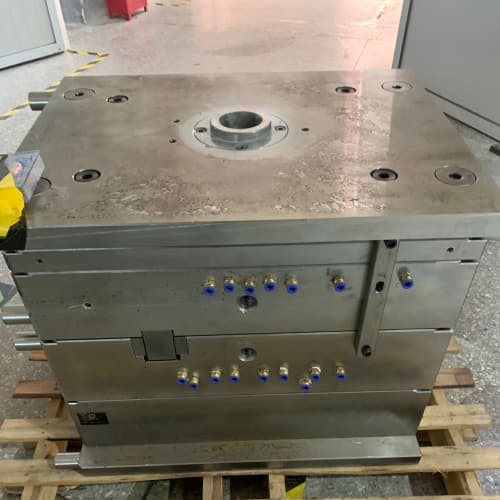
| 5,000–50,000 parts | P20/H13 production tool, 1–4 cavities | $15,000 – $40,000 | Stable process, lower per-part price, moderate tool life |
| 50,000+ parts | Hardened steel (S136/H13), multi-cavity, often hot runner | $40,000 – $80,000+ | Lowest per-part cost, tightest repeatability, longest tool life |
When you share volumes honestly, suppliers can also propose a staged path: a bridge tool now, hardened production steel later. The trade-offs between those options are covered in the aluminum vs. steel molds guide. If per-part price is your dominant concern, remember that cycle time is usually its biggest driver once the tool exists.
What Should a Good Injection Molding Quote Break Down?
A lump-sum number tells you nothing about what you’re buying. A complete quote separates the three cost layers — the same structure detailed in our injection molding cost breakdown:
- One-time tooling cost: mold design, steel and components, machining, trial runs, and the number of sampling shots included before extra charges start.
- Per-part price: cycle time × machine rate, material weight, degating and labor or automation, and yield/scrap allowance — quoted at defined volume bands (e.g. 1k–5k / 5k–20k / 20k+).
- Conditions and exclusions: what happens on design changes, mold maintenance ownership, warranty terms, and payment schedule.
Two items deserve a specific mention because they are quietly excluded more often than any other. First, sampling: some quotes include T1–T3 trials, others charge per trial — a difference of thousands of dollars on a complex tool. Ask for the T1 sample evaluation criteria up front so you know what “approved” means. Second, mold ownership: who owns the steel, where it is stored, and whether it can be moved to another molder. These cost nothing to clarify now and everything to argue about later.
Why Do Injection Molding Quotes Differ Between Suppliers?
Because they are answering different questions. When the RFQ leaves a variable open, each supplier fills it with their own default — and every default moves the number. The table below lists the assumptions that most often explain a 30–50% spread between quotes for the same part:
| Quote Line | What to Check | Typical Impact When Assumptions Differ |
|---|---|---|
| Mold steel | P20 vs. H13 vs. S136 | Cheaper steel lowers tooling price but wears faster — a rebuild can erase the savings |
| Cavity count | 1 vs. 4 vs. 8 cavities | More cavities raise tooling cost but cut per-part price; wrong assumptions distort both numbers |
| Runner type | Cold runner vs. hot runner | Hot runners add tooling cost, reduce material waste — shifts money between the two columns |
| Sampling runs | T1–T3 included or extra | Commonly $2,000–$8,000 per extra trial on a mid-complexity tool |
| Inspection scope | FAI, Cpk on CTF features, or visual only | Full FAI with capability studies adds real cost now, prevents disputes later |
| Secondary operations | Included, quoted separately, or excluded | Assembly, printing, and packaging quoted separately can look like a cheaper part price |
| Incoterms | FOB vs. DAP/DDP | Freight, insurance, and duties can move landed cost 10–20% on overseas shipments |
| Payment terms | Deposit vs. milestone vs. net-30 | Affects cash flow planning, not just the headline number |
One more difference worth noticing: how suppliers respond. A supplier who asks clarifying questions about your tolerances, gate location, or annual volume is doing engineering review before quoting — a good sign, not an annoyance. A supplier who returns a full quote in two hours without a single question either didn’t read the RFQ or plans to invoice the differences later. Whether a mold flow analysis is part of pre-quote review is a similar quality signal on complex parts.
Which RFQ Mistakes Lead to Bad Quotes?
Most pricing pain traces back to a handful of repeat mistakes. Each one forces the supplier to assume, and each assumption becomes a change order or a dispute later:
| Mistake | What Happens | Do This Instead |
|---|---|---|
| Sending photos or sketches instead of CAD | Geometry assumptions inflate every line item | Send STEP/IGES; if the design is rough, say which dimensions are open |
| No tolerances on the drawing | Supplier quotes general tolerances, then precision requirements trigger rework pricing | Mark critical-to-function dimensions; see the tolerances guide |
| “Just quote it cheap” with no volumes | Quotes come back on mismatched tooling paths — impossible to compare | Give annual volume, order size, and product life |
| Asking only for the mold price | Sampling, maintenance, and per-part pricing surface later as surprises | Request tooling + per-part + conditions as one structured quote |
| Comparing on unit price only | The cheapest quote often excludes sampling, inspection, or packaging | Compare on landed cost per part across identical assumptions |
| Sending full product architecture to every supplier | IP exposure far beyond what the quote needs | Send the component in question; sign an NDA before sharing sensitive geometry |
How Do You Compare Injection Molding Quotes Fairly?
Build a simple matrix with one row per quote line — tooling scope, steel, cavities, runner, sampling, inspection, secondary ops, packaging, Incoterms, payment, warranty — and fill in what each supplier actually assumed. Within an hour you can usually see exactly where the price differences come from. Three practical rules:
- Compare like with like. A DAP-priced quote with full FAI is not cheaper than an FOB quote with visual inspection only — it’s just more complete. Normalize the assumptions first, then compare.
- Weight responsiveness as a data point. How a supplier behaves during quoting — questions asked, DFM feedback offered, turnaround honesty — is the best preview of how production problems will be handled.
- Ask about change management before the PO. Design changes after steel is cut run from hundreds to thousands of dollars depending on the feature. Agree now on who approves what, and what a change order costs.
Frequently Asked Questions: Injection Molding Quotes
What should an injection molding RFQ include?
At minimum: a 3D CAD file, a 2D drawing with tolerances, a resin grade or performance requirements, annual and per-order volumes, cosmetic face markings, secondary operations, compliance needs, and shipping terms. The more of these you fix in advance, the fewer assumptions each supplier has to price in.
Can I get an injection molding quote without CAD files?
You can get a rough budget number from photos and dimensions, but not a reliable quote. Suppliers either decline or add a geometry-assumption margin. If CAD doesn’t exist yet, say so explicitly and ask for a feasibility-range estimate instead — some suppliers will scan or remodel a physical sample for a fee.
Why do injection molding quotes differ between suppliers?
Because of different assumptions: mold steel, cavity count, runner type, sampling runs, inspection scope, secondary operations, and Incoterms. Ask each supplier to state their assumptions in writing. The differences usually explain most of the price spread — not quality.
How do I compare injection molding quotes?
Build a line-by-line matrix of what each quote includes, normalize the assumptions, and compare landed cost per part at your real volumes — not headline tooling price or headline unit price. Include responsiveness and DFM feedback quality in the evaluation.
How long does an injection molding quote take?
Simple parts: a few business days. Complex multi-cavity or regulated parts: one to two weeks, because mold design review, material sourcing, and process planning take real engineering time. Be suspicious of same-day quotes on complex parts — something was skipped.
What is the difference between a mold quote and a part quote?
A mold quote covers the one-time tool: design, steel, machining, and trial shots. A part quote covers recurring production: resin, machine time, labor, and yield, usually per thousand pieces at defined volume bands. Always ask for both, itemized — suppliers who merge them make it impossible to see what changes if volumes shift.
Get an Injection Molding Quote for Your Part
If you’re preparing an RFQ now, send us the 3D model, your target volumes, and which dimensions matter most — even if the design is still open in places. Our engineering team reviews manufacturability before quoting, states every assumption in writing, and returns tooling and per-part pricing broken down by volume band. Include your ship-to location and target dates, and we’ll come back with a quote you can compare line by line. Request a custom injection molding quote or start from our custom molding supplier guide to see how we work.