
Overmolding applications center on one idea: combine a rigid substrate with a soft or functional second layer in a single molded part, so the product gains grip, sealing, damping, or appearance without separate assembly. Instead of gluing a rubber grip on a handle or painting a color break, the second material is molded directly onto the substrate. The result is one solid part with layered properties. Below are the functions overmolding delivers and how industries use them.
What Overmolding Actually Does
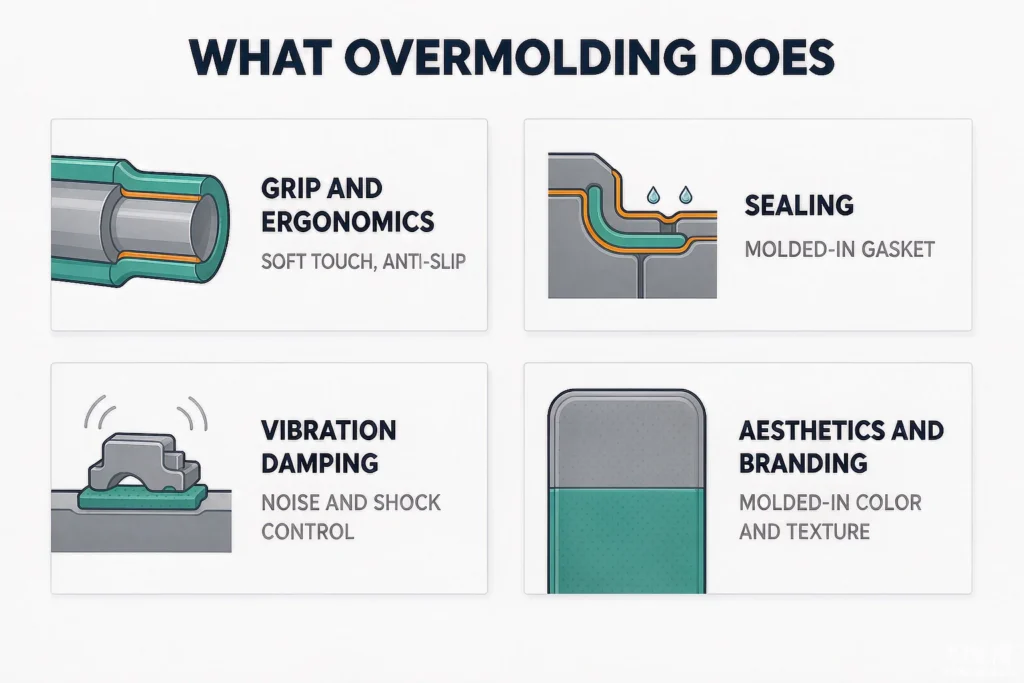
Overmolding adds value through four functions:
- Grip and ergonomics — a soft TPE or TPU layer improves hold and comfort on tools, handles, and devices.
- Sealing — an integral elastomer ring or gasket blocks water, dust, and chemicals without a separate seal component.
- Vibration and shock damping — the soft layer absorbs noise and impact in automotive and industrial parts.
- Aesthetics and branding — multiple colors and textures are molded in, removing paint and assembly steps.
Each function depends on the material pair and bond path described in our TPE and TPU overmolding materials guide and the geometry rules in our overmolding design guidelines.
Overmolding vs Assembly or Painting
Overmolding is often chosen over post-assembly or surface finishing because it consolidates steps:
| Approach | Bond/Finish | Parts Count | Tooling | Best When |
|---|---|---|---|---|
| Overmolding | Chemical/mechanical, molded-in | Lower (consolidated) | Higher (two-shot or sequential) | High volume, sealed/gripped features |
| Adhesive + separate grip | Adhesive joint | Higher | Low | Low volume, simple parts |
| Painting/coating | Surface only | Same | Low | Color only, no function |
| Insert molding | Mechanical (metal insert) | Lower | Mid | Embedded metal/threads |
Overmolding wins when the soft layer must seal, damp, or survive handling as part of the structure. It is not the automatic choice for a part that only needs a color change.
Application Matrix by Industry
| Industry | Typical Substrate | Overmold | Function | Example Part |
|---|---|---|---|---|
| Medical | PC, ABS, nylon | TPE, TPU | Grip, sealed housing | Instrument handles, device shells |
| Automotive | PA, PP, PC/ABS | TPU, TPE | Damping, seals, wear | Connectors, clips, trims |
| Consumer electronics | PC/ABS, PC | TPE-S | Grip, seals, color break | Housings, port covers |
| Power tools & hardware | PP, nylon | TPE, TPU | Ergonomic grip | Drill handles, screwdrivers |
| Appliances | PP, ABS | TPE | Comfort, cleanability | Knobs, dispensers |
| Household goods | PP, PE | TPE-S | Grip, feel | Brushes, utensils |
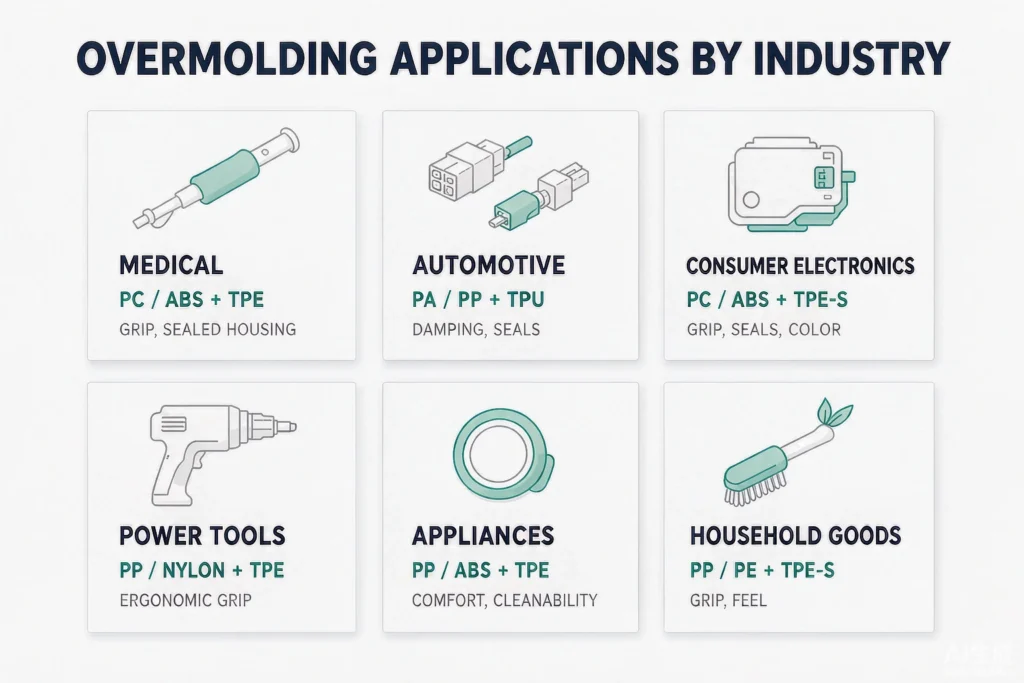
Medical programs carry documentation and material-control requirements; our medical injection molding trends article covers the broader context. Electronics enclosures have tight bond-line and cosmetic expectations covered in our consumer electronics molding guide.
Soft-Touch Grips
Soft-touch overmolding is the most visible use. A TPE or TPU layer over a PP or nylon handle improves hold, reduces slip, and raises perceived quality. The grip does not peel because the pair is either chemically compatible or interlocked by design. For tools and devices that are used wet or with gloves, the elastomer also adds chemical resistance at the contact surface.
Integrated Seals and Gaskets
Overmolding builds the seal into the part. A flexible ring molded around an electronic enclosure or a fluid connector removes the separate gasket, the assembly step, and the failure point of a glued seal. The bond must be designed for the environment—chemical exposure, temperature cycling, and pressure—which is why material selection and shut-off control matter.
Vibration Damping and Ergonomics
In automotive and industrial parts, the soft layer absorbs vibration and noise. A damped clip or trim piece stays quiet and resists loosening. The same property improves comfort on handheld and wearable products. Damping value depends on elastomer hardness and layer thickness, both set during design.
When Overmolding Is the Wrong Choice
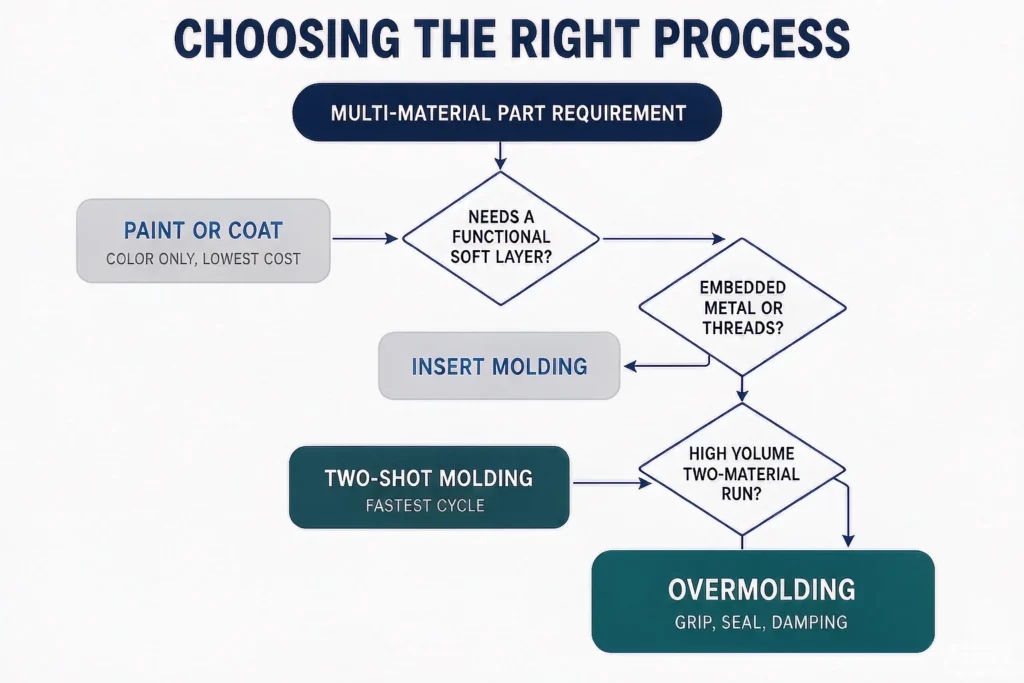
Overmolding is not free of trade-offs, and it is the wrong tool in some cases:
- Very low volume with simple needs — if a part only needs a color or a loose grip, painting or a pushed-on sleeve is cheaper.
- Mixed-material recycling goals — bonded multi-material parts are harder to recycle than mono-material parts.
- Metal or threaded features dominate — when the part needs embedded metal strength or threads, insert molding is often the better process.
- Highest throughput two-material runs — very high volumes may justify two-shot molding over sequential overmolding for cycle time.
Key Takeaways
- Overmolding adds grip, sealing, damping, and appearance in one molded part.
- It replaces adhesive, painting, and separate seals when the soft layer is functional.
- Medical, automotive, electronics, tools, and appliances each use distinct substrate–elastomer pairs.
- It is the wrong choice for simple color-only needs, easy recycling goals, or metal-dominated parts.
- Material and design rules decide whether the bond survives end use.
FAQ
What is overmolding used for?
Mainly soft-touch grips, integrated seals, vibration damping, and molded-in color or texture—replacing glue, paint, and separate components.
Which industries use overmolding most?
Medical, automotive, consumer electronics, power tools, and appliances are the largest users, each for different functional reasons.
Is overmolding better than painting a color break?
For function and durability, yes—the color and texture are molded in and will not chip or wear like paint. For color only, painting can be cheaper.
When should I use insert molding instead?
When the part needs embedded metal, threads, or conductive paths, insert molding anchors those features better than overmolding.
Tell us your industry and the function you need—grip, seal, damping, or appearance—and we will map a substrate–elastomer pair and a process path. Review our Overmolding & Multi-Shot Injection Molding Services or contact our engineering team.