
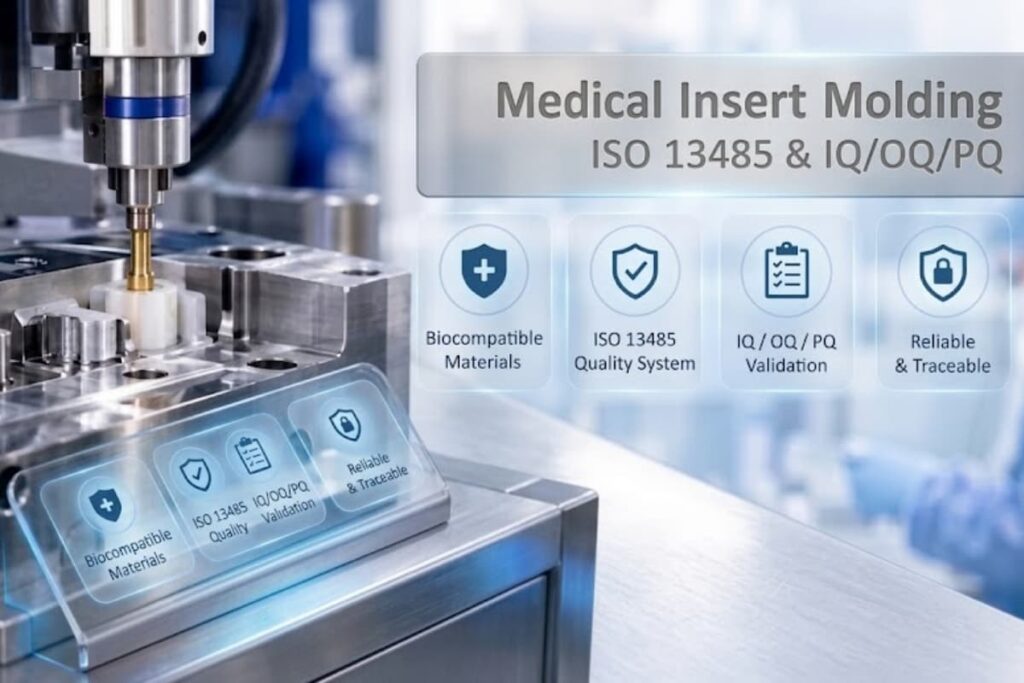
Medical device makers use insert molding to lock a metal or ceramic feature—a threaded bushing, a contact pin, a radiopaque marker band—into a plastic component in one cycle, with no fasteners, adhesives, or post-assembly joints that could loosen in a sterile field. The method reduces failure points and seals barriers, but regulated programs add two non-negotiable layers: biocompatible material selection and process validation under ISO 13485. This guide covers where medical insert molding is used, how to select materials, the design rules for regulated parts, and what IQ/OQ/PQ validation requires before commercial production.
Why Medical Devices Rely on Insert Molding
A molded-in insert removes the joints, screws, and potting steps that traditional assembly introduces. Fewer joints means fewer points that can vibrate loose, leak, or trap contamination. For a surgical handle or a sealed connector, that integration is the difference between a part that can be validated as a single entity and an assembly whose every interface must be inspected.
The broader case for molding in the regulated sector is in our medical device injection molding guide.
Common Medical Applications
| Application | Insert type | Plastic | Key requirement |
|---|---|---|---|
| Surgical instruments & handles | Stainless 316L, ceramic | PC, PEEK, PSU | Ergonomic grip, sterilizable, no loose parts |
| Electrical connectors / contacts | Copper pin, brass sleeve | PBT, PPS, PA | Signal stability, insulation, sealing |
| Catheter marker bands | Radiopaque metal band | Pebax, TPU | Imaging visibility, smooth bond |
| Implant housings | Titanium, PEEK, SS | PEEK, PC | Biocompatibility, sterile barrier |
| Drug-delivery devices | SS, brass, ceramic | PP, PC, COC | Dose accuracy, clean interface |
Each application inherits the same DFM rules as industrial insert molding—wall thickness, boss diameter, knurl interlock—plus the material constraints below. Material options across thermoplastic, thermoset, and LSR are in our medical injection molding materials guide.
Material Selection for Medical Insert Molding
Material choice must satisfy function, sterilization, and biocompatibility together.
- Inserts. Stainless 316L is the default for sterile, corrosion-resistant parts; brass is common for threads but faces lead-content restrictions in some markets; titanium and ceramic serve weight or imaging needs.
- Plastics. PEEK is chosen for high-temperature and implant-adjacent use; PC and polypropylene (PP) for housings and drug-contact parts; PBT/PPS for connectors needing thermal and chemical resistance.
- Biocompatibility. Any material contacting tissue, blood, or skin needs evaluation to ISO 10993; certain drug- or fluid-contact resins may also be assessed against USP Class VI. These are published standards, not a supplier’s individual claim—confirm the specific grade and intended contact duration with your molder.
- Sterilization compatibility. Match the resin to the sterilization method: ethylene oxide (EtO), gamma irradiation, or steam (autoclave). Each stresses the plastic differently; PEEK and PP tolerate steam better than many amorphous resins.
Selecting the grade is only half the task; proving the process makes it consistently is the other half, covered next and in our ISO 13485 medical molding guide.
Design Rules for Regulated Parts
Regulated insert molding follows the same mechanical principles as any insert molding, with extra discipline on three points:
- Insert location. Tight locating tolerance (automated placement holds about ±0.05 mm) so the captured feature sits where the device function demands, every lot.
- Stress control. Smooth radii and gradual wall transitions prevent stress concentrations that could initiate cracking in cyclic sterilization.
- Traceability. Mark or document the insert lot, resin lot, and process parameters per unit or lot so any field issue can be traced to its source.
Boss and rib geometry is in our ribs and bosses guide; achievable tolerances in the injection molding tolerances reference.
Process Validation Under ISO 13485: IQ/OQ/PQ
Insert molding is a “special process” under EN ISO 13485:2016+A11:2021, clause 7.5.6: any production process whose output cannot be fully verified by later inspection or testing must be validated. You cannot cut open every molded part to confirm the internal bond, so the process itself must be proven in advance. The same trigger appears in FDA 21 CFR Part 820 and EU MDR Article 10.
Validation runs as three sequential qualifications—you cannot skip ahead:
- Installation Qualification (IQ). Verify the machine, mold, and auxiliary systems are installed to spec: model and serial match, utilities and cooling connected, sensors calibrated, software versions recorded, environment within range. IQ answers “is everything installed correctly?”
- Operational Qualification (OQ). Prove the process runs as intended across its full operating range, including worst-case edges. For molding this means melt temperature, mold temperature, injection and hold pressures, and cooling time tested at minimum, maximum, and typical setpoints. OQ answers “does it operate correctly across the window?”
- Performance Qualification (PQ). Demonstrate consistent conforming output under real production conditions—typically three consecutive successful production runs sampled on a statistically justified plan, with the actual operators, materials, and environment. Industrial parts commonly target Cpk ≥1.33; medical and safety-critical parts ≥1.67. PQ answers “does it make good parts every time?”
Revalidation is triggered by equipment changes, material or parameter changes, environment changes, and periodic review—missed revalidation is a common clause 7.5.6 finding. FMEA is normally run before formal validation to prioritize risks. The full standard walkthrough is in our ISO 13485 medical molding guide, the ten supplier criteria in our ISO 13485 criteria guide, and first-article proof in the T1 sample evaluation guide.
Supplier Qualification Checklist for Medical Insert Molding
When you audit a medical insert molding supplier, verify:
- [ ] Current ISO 13485 certification and scope covering molding
- [ ] Documented IQ/OQ/PQ protocol and approval before production release
- [ ] Material traceability: resin and insert lot records, certificates of analysis
- [ ] Biocompatibility evidence (ISO 10993) for contact materials; USP Class VI where applicable
- [ ] Sterilization compatibility validated for the intended method
- [ ] Contamination and clean handling controls appropriate to the device risk [cleanroom level to be confirmed with the supplier]
- [ ] Calibrated equipment and defined preventive-maintenance plan
- [ ] Change-control and revalidation procedure
- [ ] Complaint, CAPA, and traceability (DMR/DHR) systems
- [ ] IP protection controls for outsourced tooling—see our IP protection guide for outsourcing molding to China
A ready-to-use version is our injection molding supplier audit checklist.
Insert Molding vs Overmolding for Medical Parts
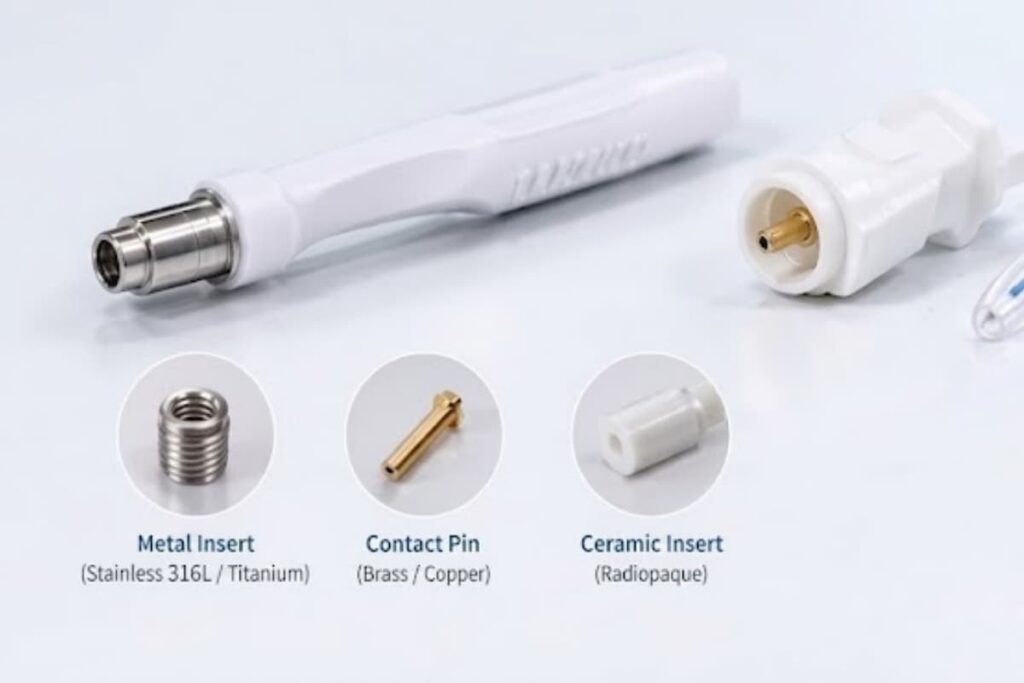
In medical programs the choice often comes down to what the metal feature must do:
- Insert molding when a fixed, load-bearing, or sealing metal feature (thread, pin, marker band) must be captured with no loose joint.
- Overmolding when the value is a soft, bonded skin on a plastic substrate (ergonomic grip, sealed elastomer) and chemical/mechanical bonding is sufficient.
Both need the same validation discipline. Compare the two in our insert versus overmolding and two-shot versus overmolding guides. Current direction of the sector is in our medical injection molding trends article.
FAQ
Does medical insert molding require a cleanroom? It depends on the device risk classification and intended use; many programs use controlled contamination and clean-handling zones rather than a full cleanroom. Confirm the required level with your supplier and the notified body—do not assume.
Is PEEK insert molding biocompatible per ISO 10993? PEEK is widely used in medical and implant-adjacent parts and can be evaluated to ISO 10993, but biocompatibility is granted per grade and contact condition, not to the material name alone. Require the specific evaluation for your application.
What does IQ/OQ/PQ prove that inspection does not? Inspection cannot see the internal bond or confirm every unit is identical; validation proves the process produces conforming parts consistently, which is why ISO 13485 clause 7.5.6 mandates it for special processes.
When is revalidation required? On equipment, material, parameter, software, or environment changes, and on a periodic schedule. Skipping revalidation is a frequent audit finding.
Insert or overmold for a surgical handle grip? If the grip is a soft bonded skin on a plastic shell, overmolding fits; if a fixed metal shaft or feature must be captured with no loose joint, insert molding is the choice.
Contact Us
Ready to turn your medical insert molding requirement into a validated, audit-ready production process? Whether you are developing a surgical handle, sealed connector, catheter marker band, implant-adjacent housing, or drug-delivery component, we can support the full path: material selection, insert design, DFM, mold design, precision insert placement, traceability, clean handling, and IQ/OQ/PQ validation.
Send us your drawings, insert specifications, resin and sterilization requirements, and target volumes for a confidential review. Our team will provide feasibility feedback, identify risks early, and outline the next steps for prototyping or commercial production.