
Nylon injection molding produces strong, tough, wear-resistant parts from polyamide (PA6 or PA66) on standard molding equipment — but only if the resin is dried properly first. Key process windows: dry PA6 at 80–90 °C and PA66 at 100–110 °C for 4–6 hours to below 0.1% moisture; melt PA6 at 230–260 °C and PA66 at 260–290 °C; mold at 60–100 °C; and design for 1.0–2.0% shrinkage unfilled (0.3–0.8% glass-filled). Nylon wins where parts take impact, cyclic load, or abrasion — gears, brackets, connectors, housings — and glass-filled grades routinely replace die-cast metal. This guide covers grade selection, drying, shrinkage and moisture tolerances, and mold design rules.
PA6 vs PA66: Which Nylon Should You Mold?
Both are unfilled polyamides with the same hygroscopic behavior, but they differ in heat, stiffness, and processing window:
| Property | PA6 (Nylon 6) | PA66 (Nylon 6/6) |
|---|---|---|
| Melting point | ~225 °C | ~265 °C |
| Melt temperature (molding) | 230–260 °C | 260–290 °C |
| Drying temperature | 80–90 °C, 4–6 h | 100–110 °C, 4–6 h |
| Stiffness and heat deflection | Lower — tougher, more fatigue-resistant | Higher — better dimensional stability at temperature |
| Moisture absorption (saturation) | 2.5–3.0% | 1.5–2.5% |
| Processing window | Wider (~15–20 °C more forgiving) — better for thin-wall and complex geometry | Narrower, higher energy — choose for under-hood heat |
| Typical cost | Lower | Higher (adiponitrile supply chain is more concentrated) |
| Typical parts | Gears under cyclic load, sporting goods, housings, handles | Automotive electrical, under-hood clips, connectors, fasteners |
A practical rule: choose PA6 for toughness, fatigue life, surface gloss, and cost; choose PA66 for heat exposure, stiffness, and tighter dimensional requirements. A modified PA6 (glass or mineral filled) often matches standard PA66 stiffness at lower cost — validate on molded parts, not datasheets alone.
Where Nylon Injection Molding Is Used
| Application | Typical Parts | Why Nylon |
|---|---|---|
| Automotive | Connectors, under-hood clips, radiator end tanks, brackets | Heat resistance (PA66), weight reduction vs metal |
| Mechanical and industrial | Gears, bushings, rollers, cams, machinery housings | Fatigue and wear resistance, runs with little lubrication |
| Power tools and appliances | Tool housings, handles, internal brackets | Toughness under impact, cost-effective at volume |
| Fasteners and cable management | Cable ties, glands, clips, snap-fits | Flexural resilience, snap-in assembly without failure |
Glass-Filled Nylon: When the Upgrade Pays Off
Adding 10–40% glass fiber (GF30 is the mainstream grade) roughly doubles stiffness and heat resistance and cuts shrinkage dramatically — which is why glass-filled nylon is the standard replacement for die-cast metal brackets and housings. The trade-offs are real: glass fiber is abrasive (molds need H13 or coated steel), shrinkage becomes anisotropic (parts warp toward fiber orientation), and weld lines become the weakest points. The comparison:
| Criterion | Unfilled PA | Glass-Filled PA (GF30) |
|---|---|---|
| Stiffness and heat resistance | Good | Substantially higher |
| Mold shrinkage | 1.0–2.0% | 0.3–0.8%, anisotropic |
| Warpage risk | Low — isotropic shrinkage | Higher — gate and fiber orientation decide flatness |
| Mold steel requirement | P20 acceptable | H13 or hardened/coated — glass is abrasive |
| Weld line strength | Adequate | Weak point — gate so weld lines fall in low-stress areas |
| Resin cost | Lower | Roughly 20–40% higher |
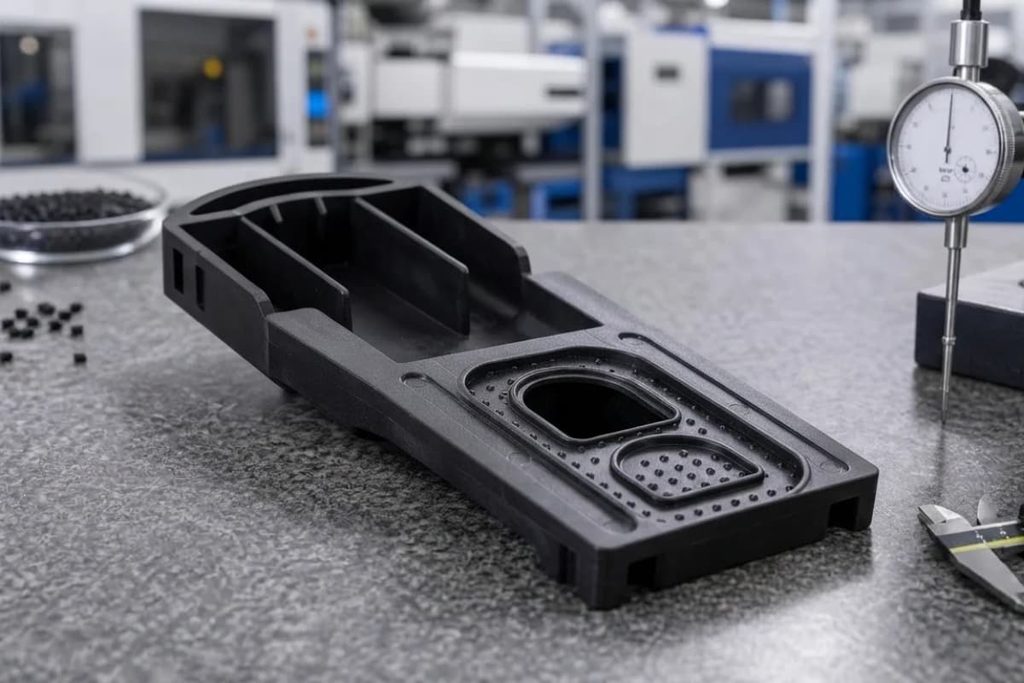
Nylon Injection Molding Process Parameters
| Parameter | PA6 | PA66 | Glass-Filled Grades |
|---|---|---|---|
| Drying (desiccant dryer) | 80–90 °C, 4–6 h | 100–110 °C, 4–6 h | 100–120 °C, 6–8 h |
| Target moisture | < 0.1–0.2% (confirm against grade datasheet) | ||
| Melt temperature | 230–260 °C | 260–290 °C | Upper end of range for the base resin |
| Mold temperature | 60–90 °C | 70–100 °C | Upper end — promotes crystallinity and stiffness |
| Injection pressure | 80–140 MPa (GF grades need the higher end) | ||
| Holding pressure | 50–70% of injection pressure; time ~10–15 s per mm of wall | ||
Mold temperature is not a comfort setting — it controls crystallinity, and crystallinity controls strength, stiffness, and shrinkage. Running too cold gives you weaker, more dimensionally unstable parts even when the surface looks fine.
Drying: the Step That Decides Nylon Quality
Nylon is the most hygroscopic common engineering plastic: PA6 reaches 2.5–3% moisture at saturation, and even 0.1% of residual water flashes to steam in the barrel — silver streaks, bubbles, voids, and hydrolytic chain scission that permanently cuts strength. The rules we hold every nylon run to:
- Dry in a desiccant dryer (not hot air) at grade-specific temperature for 4–6 hours; glass-filled grades need 100–120 °C and up to 8 hours.
- Verify moisture before molding, not just timer-based drying — a dew point of −40 °C or lower in the dryer confirms it is actually working.
- Keep dried pellets sealed. Open hoppers re-absorb moisture in hours — this exact failure mode (parts voided after a weekend shutdown) is the classic nylon defect report.
- Pre-dry masterbatch and colorant too; undried additive is an easily missed splay source.
Wet resin produces symptoms shared with other defects. If you are diagnosing splay or voids, our common molding defects guide walks through the same triage process for any resin.
Shrinkage and Moisture: Tolerances That Actually Hold
Nylon tolerances fail for two reasons. First, mold shrinkage is high — 1.0–2.0% unfilled, and anisotropic once glass-filled — so cavity dimensions must be compensated against the actual grade and fiber content. Second, and more often missed: nylon parts keep absorbing moisture after molding, growing slightly and gaining toughness as they do. Dimensions measured dry are not dimensions in service.
For tight assemblies we mold and measure to the conditioned state — the equilibrium moisture of the end-use environment — rather than the dry-as-molded state. Define tolerances against end-use humidity (our tolerance design guide covers the framework), store precision parts sealed, and state on the drawing whether dimensions are dry or conditioned.
Mold Design Rules for Nylon
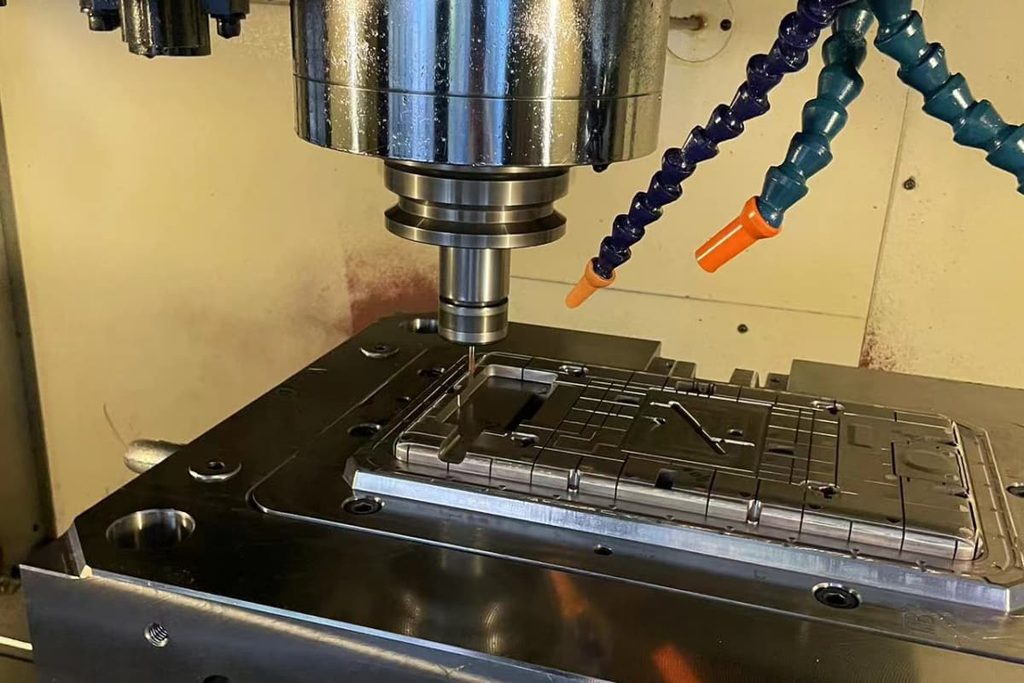
- Steel selection: P20 for general purpose; H13 or hardened/coated steel for glass-filled grades — fiber abrasion will wear soft steel out fast.
- Gate placement: gate at thick sections for packing, and position gates so weld lines land in low-stress areas; in GF grades, fiber orientation across a weld line is the weakest point in the part.
- Venting: nylon’s low viscosity fills fast and traps gas — vent parting lines and flow ends at 0.02–0.03 mm depth.
- Cooling: uniform channels 10–15 mm from the cavity surface; uneven cooling plus anisotropic shrinkage is the main warpage driver on long thin parts.
- Draft and ejection: 1–2° per side, more on textured surfaces; use multiple ejector pins to distribute force.
On material trade-offs: nylon and acetal (POM) are the classic pairing for gears and moving parts — nylon brings toughness and fatigue life, POM brings lower friction and far better dimensional stability in humid service. The full decision framework is in our Nylon vs POM comparison, with processing details in POM injection molding and our material selection guide.
Frequently Asked Questions: Nylon Injection Molding
Should I choose PA6 or PA66?
Choose PA6 for toughness, fatigue resistance, better surface gloss, wider processing window, and lower cost — the default for gears under cyclic load, housings, and handles. Choose PA66 for higher heat exposure, stiffness, and tighter dimensional stability — the default for under-hood automotive and electrical connectors. A glass-filled PA6 often matches standard PA66 stiffness at lower cost; validate on molded parts rather than datasheets.
Why must nylon be dried before injection molding?
Nylon absorbs moisture rapidly (PA6 up to 2.5–3% at saturation), and at melt temperatures of 230–290 °C residual water flashes to steam — causing silver streaks, bubbles, voids, and hydrolysis that permanently reduces molecular weight and strength. Dry in a desiccant dryer: 80–90 °C for PA6, 100–110 °C for PA66, 4–6 hours, to below 0.1–0.2% moisture, and keep dried pellets sealed until molding.
What temperature do you mold nylon at?
Melt temperature is 230–260 °C for PA6 and 260–290 °C for PA66; glass-filled grades run at the upper end of their base resin’s range. Mold temperature runs 60–100 °C — higher for structural and GF grades because it drives crystallinity, which determines strength, stiffness, and shrinkage. Confirm the exact window against the grade datasheet.
What shrinkage should I design for with nylon?
Unfilled nylon shrinks about 1.0–2.0%; glass-filled grades shrink 0.3–0.8% but anisotropically — more across flow than along it — which raises warpage risk on long thin parts. Compensate cavities against the actual grade and fiber content, and remember nylon also grows after molding as it absorbs moisture, so state whether drawing dimensions are dry-as-molded or conditioned.
Why do nylon parts change size after molding?
Nylon is hygroscopic in service as well as in the bag: parts absorb ambient moisture over days to weeks, swelling slightly and becoming tougher. This is why precision assemblies are dimensioned to the conditioned state (equilibrium moisture of the end-use environment) instead of the dry-as-molded state — and why tight-tolerance nylon parts are stored sealed and measured under controlled humidity.
Is glass-filled nylon worth the extra cost?
Yes when the part replaces metal or needs stiffness and heat resistance beyond unfilled PA — GF30 typically raises stiffness and heat deflection substantially while cutting shrinkage to 0.3–0.8%, at roughly 20–40% higher resin cost. The costs beyond price: abrasive glass demands hardened mold steel, anisotropic shrinkage demands careful gate and cooling design, and weld lines become critical weak points. For non-structural parts, unfilled PA6 is usually the better value.
Get a Nylon Injection Molding Quote
Send us your 3D file or 2D drawing with the target grade (or let us recommend PA6 vs PA66 vs glass-filled from the service environment), expected annual volume, and tolerance requirements — noting whether dimensions are dry or conditioned. Our engineers review drying, shrinkage compensation, gate and weld-line placement before pricing, so the quote reflects what will actually run in production. Contact GoodTech to start your nylon molding project, or see our quote guide for the full RFQ package and our low volume injection molding guide for tooling options under 10,000 parts. If your part also needs an elastomer layer, our TPU injection molding guide covers the TPU-over-nylon pairing.