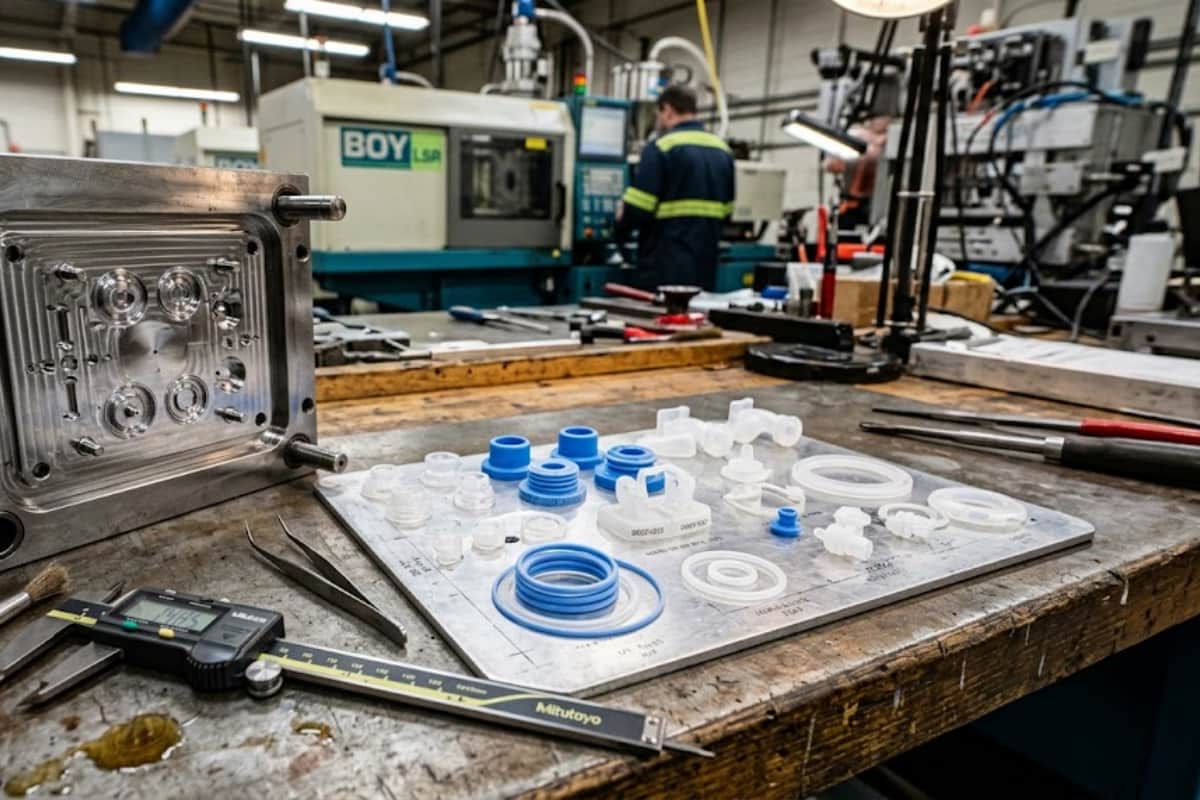

The future of injection molding is usually described in terms of robots and artificial intelligence. The reality is less dramatic and more useful: the shift is from controlling a machine to controlling a process, and from inspecting parts to predicting them. Automation removes handling labour; connectivity removes information delay; data closes the loop between what the mold was designed to do and what it is actually doing on every shot.
For an OEM buying molded parts, that distinction matters commercially. A supplier with a closed data loop quotes tighter tolerances with confidence, detects drift before it becomes scrap, and can prove process capability with records instead of assurances. A supplier with new robots and no data discipline is simply automating the same uncertainty.
This article sets out what is genuinely changing in injection molding, what it means for part cost, quality and lead time, and the specific questions to ask a supplier about digital maturity.

What Is Actually Changing (and What Is Not)
Three forces driving the shift
| Force | What it changes | Commercial effect |
|---|---|---|
| Labour and skill scarcity | Machine tending, part handling, inspection and packing are automated | Stabilises cost where labour availability is constrained; shifts the constraint to engineering skill |
| Connectivity and cheap sensing | Cavity pressure, temperature and position data is now affordable at machine level | Makes process control closed-loop rather than operator-dependent |
| Customer expectations | Traceability, capability data and change control are expected as standard | Suppliers must prove capability, not describe it |
The honest starting point
Two things are often overstated. First, “lights-out” molding is not the default — it is a specific, engineered configuration that suits high-volume, stable, low-complexity parts with mature tooling. Second, Industry 4.0 does not fix an unstable process. Data collection on an uncontrolled process produces a very well-documented bad part. The sequence that works is process discipline first, then instrumentation, then automation — not the reverse.
Automation: From Machine Tending to Lights-Out Cells

Levels of automation
It helps to think in levels rather than in marketing categories.
| Level | What is automated | Typical requirement | Realistic scope |
|---|---|---|---|
| 1. Machine control only | Injection profile, holding, cooling, ejection | Modern machine with closed-loop control | All production |
| 2. Part take-out | Robot or sprue picker removes the part | Robot, end-of-arm tooling, conveyor | Most production above small volumes |
| 3. Secondary operations in line | Degating, assembly, printing, packing | Bespoke automation cell, part-specific fixturing | Family of parts, stable volume |
| 4. Supervised multi-machine cells | One operator supervises several machines | MES, alarms, automated quality checks | Stable, medium-to-high volume |
| 5. Lights-out / unattended | Production continues without operators | Mature process, in-line inspection, automatic rejection, alarm escalation | Narrow band: high volume, simple geometry, validated tooling |
The economic logic is simple: automation converts variable labour cost into fixed capital cost. That is favourable when volume is high, demand is steady, and the part geometry is stable over the tool life. It is unfavourable when volumes are uncertain, the design is still changing, or the part needs human judgement on cosmetics.
Where automation pays and where it does not
Automation pays when:
- The cycle is long enough that machine time dominates labour content
- Part handling damage is a quality risk (cosmetic or medical parts)
- The operation is ergonomically difficult or hazardous
- Consistency of the secondary operation matters (printing position, assembly force)
- Volume is committed and stable over a tool’s life
Automation does not pay when:
- Volume is low or intermittent — see low-volume versus high-volume planning
- The finish requires human cosmetic judgement
- Part geometry or the secondary operation changes frequently
- The capital payback exceeds the product’s market life
For OEMs, the practical implication is to ask not “is the supplier automated?” but “what is automated on a job like mine, and why?“
Industry 4.0 in Injection Molding: What Data Actually Gets Used
“Industry 4.0” is a broad label. In a molding plant, it reduces to three layers, and only the top layer changes the part you receive.
The connected machine layer (OPC UA, EUROMAP 77 / 83)
Modern injection molding machines expose their process data over OPC UA, the open interoperability standard for industrial machine communication. Two companion specifications matter in practice:
- EUROMAP 77 — the OPC UA interface between injection molding machines and MES systems
- EUROMAP 83 — the OPC UA interface for peripheral equipment such as temperature controllers, dryers, material handling and robots
The significance for buyers is not the acronyms; it is that machine data can now be collected automatically and consistently instead of being written on a paper setup sheet. If a supplier claims a connected plant, ask whether their machines actually support EUROMAP 77 or an equivalent OPC UA interface, and what historically recorded process data they can retrieve for your part six months into production.
The MES layer
A Manufacturing Execution System sits above the machines and links work orders, tooling, materials, process parameters and quality results to a specific production event. In a molding plant, a functioning MES answers questions that are otherwise answered by memory:
- Which tool, cavity, machine and shift produced this specific part?
- What were the actual process parameters on that shot, and do they fall inside the approved window?
- Which resin lot was in the dryer, and was it dried to specification?
- What is the current scrap rate for that tool, and what is trending?
For regulated products, this is not a convenience — it is the practical infrastructure behind traceability requirements. Electronic records used in regulated manufacturing need to satisfy data-integrity expectations (often summarised as ALCOA+: attributable, legible, contemporaneous, original, accurate, complete, consistent, enduring, available). Our quality system and quality equipment pages describe how documented process control and measurement are handled today.
Process data that changes the part
Not all data is equal. The signals that actually change what comes out of the mold are:
| Signal | Why it matters |
|---|---|
| Cavity pressure | The single most informative in-mold signal; governs packing, shrinkage and dimensional consistency |
| Melt and mold temperature | Sets cooling rate, which sets shrinkage and warpage |
| Injection velocity profile | Controls fill balance across cavities and weld-line position |
| Holding pressure and time | Determines final dimensions and sink severity |
| Cycle time and cooling time | Trade-off between dimensional stability and productivity |
| Cushion position | Detects material feed problems before parts go out of specification |
This is the foundation of precision molding with advanced process control: when the machine reacts to cavity pressure rather than to a timer, tight tolerances become a process outcome rather than an inspection lottery.

Smart Manufacturing Metrics That Matter
Smart manufacturing is judged by metrics, not by the number of screens on the wall. The widely used framework for manufacturing KPIs is ISO 22400, which standardises definitions so that two plants quoting “OEE” mean the same thing.
| Metric | Definition | What good looks like |
|---|---|---|
| OEE (Overall Equipment Effectiveness) | Availability × Performance × Quality | Useful as a trend; a single absolute number is meaningless without its definition |
| Scrap rate | Rejected parts ÷ total parts | Should be measured per tool and per cavity, not per plant |
| Cycle time adherence | Actual cycle ÷ quoted cycle | A drift upward signals cooling or tooling problems |
| First-pass yield | Parts passing without rework | The metric that most directly reflects process control |
| Energy per part | kWh ÷ part, or kWh per kg of resin | Sensitive to cycle time, barrel efficiency and dryer management |
| Process capability (Cpk) | Capability on CTF dimensions | ≥ 1.33 on critical features; ≥ 1.67 on safety-critical |
| Unplanned downtime | Hours lost to tool or machine failure | Predictive maintenance should move this measurably |
| Tool maintenance adherence | Planned maintenance completed on schedule | The cheapest preventive measure for dimensional drift |
Two cautions. First, an impressive OEE number without a stated definition is marketing. Second, OEE optimised for throughput can reduce capability — pushing cycle time down at the cost of packing and dimensional stability. Ask how the supplier balances OEE against Cpk, and you will learn more about the process than from any dashboard tour.
The Digital Thread: From Mold Flow to Shipped Part

The most underrated part of “smart manufacturing” is not on the shop floor at all — it is the continuity of information from design intent to production record.
A functioning digital thread means:
- Mold flow analysis simulates fill, packing, cooling and warpage before the tool is cut, and the predicted weld-line and gate positions inform the design.
- DFM review flags unachievable tolerances and problematic geometry before quotation, not after T1.
- Tool data — steel grade, cavity dimensions, cooling layout, texture specification, maintenance history — is documented against the tool asset.
- Process parameters are established by scientific molding methods (design of experiments, not operator preference) and locked as an approved window.
- Dimensional results from the CMM and in-line measurement feed back so the process window is adjusted when the tool wears, with the change recorded.
- Shipment records link the delivered parts to the process parameters and material lots that produced them.
Where the thread breaks — typically between the process window and the shop floor, or between the tool drawing and the tool asset record — that is where quality problems originate. This is why continuous improvement programmes that name specific projects and measure their effect are more convincing than a tour of new equipment.
The same logic applies to adjacent manufacturing processes. Digitally driven CNC machining, 3D printing and rapid prototyping now share geometry and simulation data with the molding process, so a bridge tool can be cut directly from validated CAD rather than reinterpreted from scratch.
Machine Learning and Predictive Maintenance
Two applications of machine learning are genuinely useful in molding today, and one is mostly aspirational.
Useful: process drift detection. A model trained on good production can flag when a shot’s process signature (cavity pressure curve shape, peak pressure, integral of pressure over time) begins to deviate before dimensional results fall out of tolerance. The benefit is early warning, not autonomous control.
Useful: predictive maintenance. Tool and machine wear can be anticipated from vibration, cycle count, temperature deviation and cycle-time trend, shifting maintenance from reactive to scheduled. In molding, the highest-value target is usually the tool, not the machine — shut-off wear and gate erosion are what move dimensions over the tool’s life.
Mostly aspirational: fully autonomous process optimisation. Where machine learning genuinely helps is narrowing the search space during process development — identifying promising parameter combinations faster than a full factorial experiment. It does not remove the need for a validated process window, and it does not remove the need for a qualified engineer to decide what “good” means for your part.
Digital Twins: Useful, Oversold, and Worth Understanding
A digital twin is a computational model of a physical asset that stays synchronised with it. In injection molding, the term covers three quite different things:
| Type | What it models | Practical value |
|---|---|---|
| Part/process simulation | Fill, packing, cooling, warpage in the cavity | High — prevents tooling mistakes before steel is cut |
| Tool/machine twin | Machine and tool behaviour, wear, maintenance state | Moderate — supports scheduling and maintenance planning |
| Real-time production twin | Live plant state fed from machine and MES data | Emerging — valuable at scale, hard to justify for a single job |
The first category is mature and already delivers most of the value: simulating the mold before cutting it is the cheapest way to avoid an unmakeable part. The third is where the impressive demonstrations live but where return on investment depends on plant scale, product stability and how much of the plant is instrumented. Be sceptical of “digital twin” as a label; ask what the model is synchronised with, how often, and what decision it changes.
Energy, Material and Sustainability

Sustainability in molding is mostly a process-efficiency argument, which is why it converges with cost reduction:
- Cycle time is the dominant driver of energy per part. Most of a machine’s energy demand is the hydraulic or servo load and the heater band draw during the cycle.
- All-electric machines reduce energy consumption and improve repeatability, which also helps capability. The trade-off is capital cost, not quality.
- Dryer and material handling often account for a surprising share of plant energy; correctly sized dryers with controlled dew point reduce both energy and moisture-related defects.
- Regrind reduces material cost but changes shrinkage behaviour. A written maximum percentage with traceability is a quality control measure as much as a cost measure.
- Scrap reduction is the highest-leverage sustainability action available, because it eliminates the energy and material invested in a part that is thrown away.
- Conformal cooling shortens cooling time and can improve dimensional stability simultaneously, which is why it appears in both cost and quality discussions — see conformal cooling versus standard cooling.
For buyers, the practical framing is to ask for energy and scrap data per part and treat them as process-health indicators rather than as a separate CSR exercise.
What This Means for OEMs Buying Molded Parts

Abstracting from the technology, four changes affect you directly:
- Capability becomes provable. A supplier with recorded process data can demonstrate Cpk on your dimensions across a production window, not just at a single sampling point. That is the difference between a quoted tolerance and a warranted one.
- Drift is caught earlier. Closed-loop control plus trend monitoring shortens the time between a process shift and its detection — which reduces the size of any containment you have to manage.
- Traceability gets cheaper. When material lots, process parameters and inspection results are captured automatically, providing a full record for a regulated product stops being a manual exercise.
- Cost structure shifts. Automation moves cost from labour to capital and amortisation. For high-volume, stable programmes that can lower unit cost; for low-volume or evolving designs it can raise it. Understand which side of that line your programme sits on, and read our cost breakdown for how the components fit together.
What to Ask a Supplier About Digital Maturity
Use these questions. The quality of the answers tells you more than any factory tour.
- Which machines are closed-loop, and do any use cavity pressure sensing in production — not just in development?
- Do your machines expose process data over OPC UA / EUROMAP 77, and what historical process data can you retrieve for our part six months into the run?
- Is there an MES linking tool, machine, material lot and inspection results to a specific production event? What does it record?
- How is the process window established — scientific molding and DOE, or operator experience? Who approves a change to it?
- How do you detect process drift between scheduled inspections, and what triggers a containment action?
- What is your PPM and first-pass yield on comparable parts, measured per tool rather than per plant?
- How is tool maintenance scheduled — by cycle count, by condition, or by failure?
- What is your energy consumption per kilogram of resin processed, and how has it changed over the last two years?
- How do you handle electronic process records for regulated products, and do they meet your customers’ data-integrity requirements?
- Which parts of your operation would you not automate, and why?
Question 10 is often the most revealing. A supplier who can explain what they have deliberately left manual understands their own process.
Hype Versus Reality
| Claim | Verdict | The practical question |
|---|---|---|
| “Our plant is fully automated” | Usually partial | What is automated on a job like mine? |
| “We use AI to control the process” | Often overstated | Does the model change setpoints autonomously, or only flag drift for an engineer? |
| “We have a digital twin” | Depends entirely on the type | What is the model synchronised with, and what decision does it change? |
| “Lights-out manufacturing” | Narrow applicability | Which products run unattended, and for how long? |
| “Industry 4.0 certified” | Not a real certification | Which standards do your interfaces comply with — OPC UA, EUROMAP 77, ISO 22400 definitions? |
| “Paperless quality records” | Genuinely valuable | Can you retrieve the record for a specific shipped lot, and is it attributable? |
FAQ
Is lights-out injection molding actually happening? In specific segments, yes — typically high-volume, stable, geometrically simple parts produced on validated tooling with in-line inspection and automatic rejection. It is not the default for most work. Complex cosmetic parts, low volumes and frequently changing designs generally remain supervised.
What is EUROMAP 77 and why does it matter to a buyer? It is the OPC UA companion specification that standardises the interface between injection molding machines and MES systems, so process data can be collected automatically rather than typed onto a setup sheet. For a buyer it means historical process parameters for your part can be retrieved and audited instead of reconstructed from memory.
Does Industry 4.0 reduce part cost? It can, but not automatically. It reduces information delay and inspection effort, which lowers overhead; automation converts labour cost into capital amortisation, which lowers unit cost only at volume. On low-volume or evolving programmes, the capital element can raise it. The reliable wins are usually earlier defect detection and less manual quality documentation.
Which process data should I expect a good supplier to record? At minimum: cycle time, injection and holding pressures, injection velocity profile, barrel and mold temperatures, cushion position, and the actual process window used for each production run. For precision work, cavity pressure data per cavity. The record should be linked to tool, machine, material lot and shift.
How does smart manufacturing relate to ISO 13485 and FDA expectations? Connectivity supports compliance rather than replacing it. Regulated manufacturing still requires validated processes, documented change control and data integrity. An MES makes traceability and record retrieval easier and more reliable, but the validation of the system itself — including IQ/OQ/PQ where applicable — still has to be done.
Can small and mid-size molders realistically adopt this? Yes, incrementally. The highest-return steps are usually cheap: closed-loop process control on existing machines, cavity pressure monitoring on critical tools, scientific molding to establish a documented process window, and automated capture of process parameters. Full MES integration and unattended cells come later and only where volume justifies them.
Will automation replace the need for DFM engineering? No — it increases the value of it. Automation stabilises what has already been designed; it cannot rescue a part with unachievable tolerances or unbalanced walls. Engineering decisions happen earlier in the future, not later.
Does automation help with tolerance capability? Indirectly and materially. Robotic take-out reduces handling variation and damage, closed-loop control reduces cycle-to-cycle scatter, and in-line measurement shortens the feedback loop between a process shift and its correction. The tolerance itself is still set by tooling and resin behaviour.
Key Takeaways
- The real shift is from controlling a machine to controlling a process — connectivity and sensing now make closed-loop control practical at production scale.
- Automation converts labour cost into capital cost. It pays at high, stable volume with mature tooling, and can raise cost on low-volume or evolving programmes.
- Ask about OPC UA / EUROMAP 77 support and what historical process data a supplier can retrieve for your specific part.
- Cavity pressure is the most valuable in-mold signal and the practical prerequisite for tight tolerance work.
- Judge digital maturity with ISO 22400-style metrics per tool — scrap, first-pass yield and Cpk — not with a dashboard tour.
- The digital thread from mold flow to shipment record is more valuable than any single technology, and it is where quality problems are prevented.
- Be sceptical of “digital twin” and “AI control” as labels; ask what the system is synchronised with and what decision it changes.
- Data does not fix an unstable process. Process discipline first, then instrumentation, then automation.
Evaluating a supplier’s digital capability? GoodTech is built on engineering-driven process control — mold flow analysis and DFM before tooling release, closed-loop molding, documented process windows, and ISO 9001 / IATF 16949 / ISO 13485 aligned quality systems. We are happy to walk you through which machines are instrumented, what process data we record, and how that translates into capability evidence for your part.
Request our manufacturing capability and process-control overview →