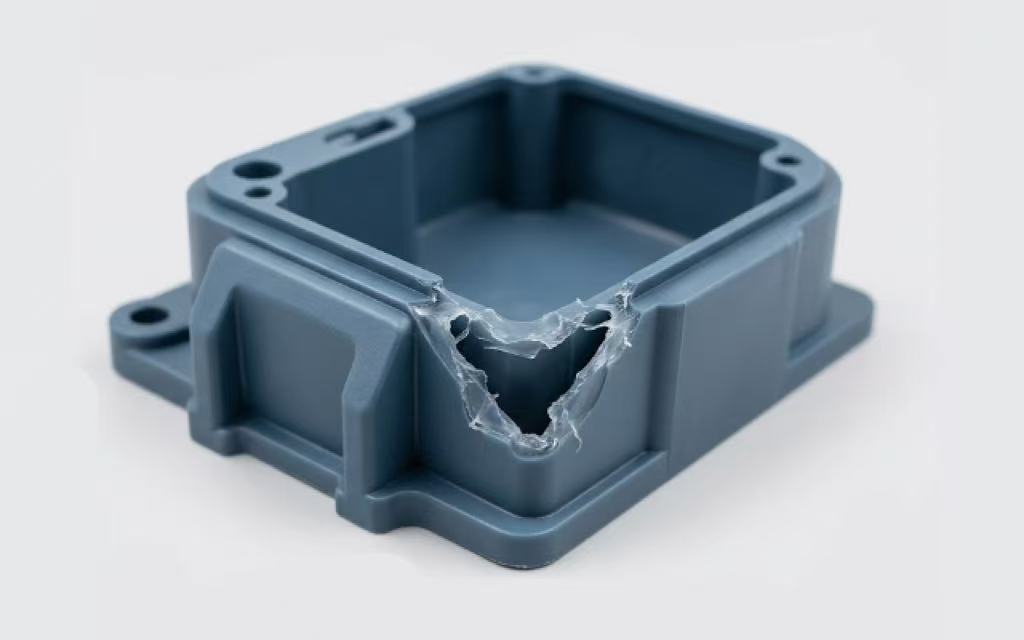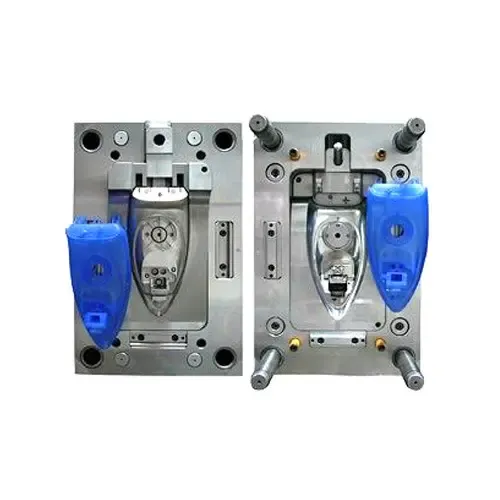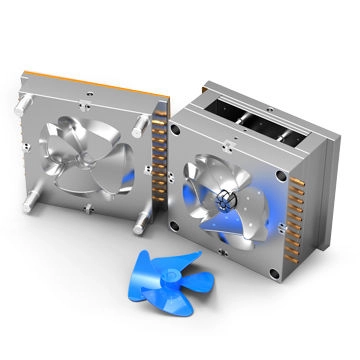

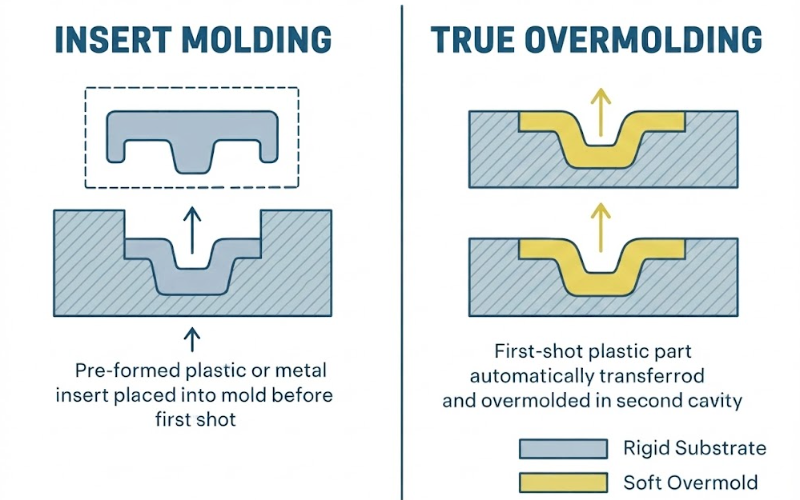
Choosing the right multi-material manufacturing method is critical for mechanical performance, structural durability, and overall unit economics. When designing complex plastic enclosures or multi-component sub-assemblies for applications ranging from electronics‑semiconductors to automotive‑transportation, engineers and product developers frequently evaluate insert moulding and overmoulding (including two shot injection moulding). The core distinction lies in their mechanics: insert moulding places pre‑formed components—typically metal threaded inserts, pins, or stamped leads—into the mould cavity prior to resin injection, whereas overmoulding molds a secondary layer of elastomer or plastic over a primary substrate. The primary decision factors depend on mechanical pull‑out strength requirements, bond integrity, cycle times, and tooling investment. This article explores the technical fundamentals, process requirements, DFM considerations, and application parameters to help engineering teams determine the optimal process for their specific project.
Core Definitions: Understanding Insert Moulding vs. Overmoulding
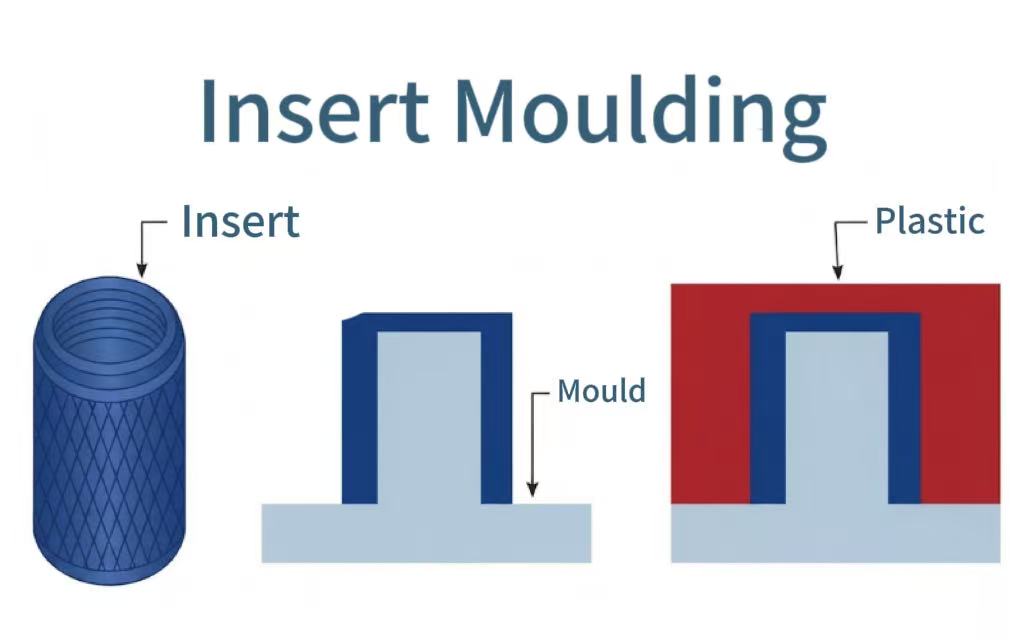
Understanding the fundamental mechanics of each process eliminates design confusion and prevents costly manufacturing errors during tooling fabrication.
Insert moulding integrates discrete components—most commonly brass threaded inserts, electrical contacts, or structural studs—into a custom injection moulding setup. Once the inserts are loaded manually or via automated robotics, molten thermoplastic flows around them, locking them into position upon cooling.
Overmoulding builds upon a pre‑molded substrate (the first shot) by injecting a second material over or through it. This technique is frequently utilized for creating soft‑touch grips, waterproof seals, or multi‑colored aesthetic surfaces.
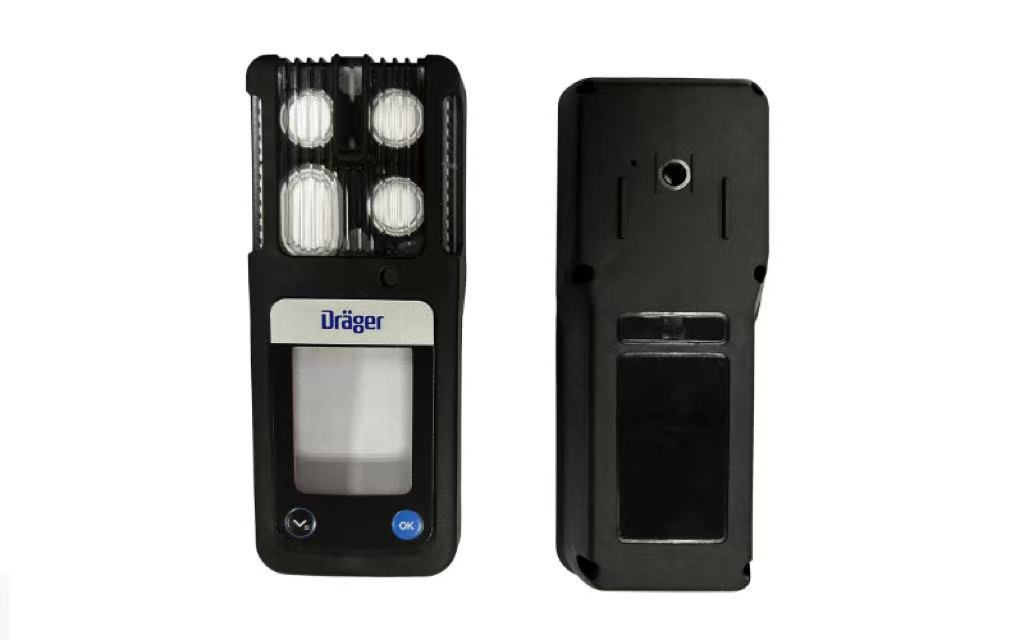
Two‑shot injection moulding represents a specialized, automated form of overmoulding executed within a rotary‑platen machine, allowing both materials to be shot sequentially in a single automated cycle without manual part transfer.
Quick Comparison Table
| Process Parameter | Insert Moulding | Overmoulding (Including Two‑Shot) |
|---|---|---|
| Primary Objective | Embed pre‑formed components (metal/plastic) into a plastic matrix | Bond a secondary plastic or elastomer layer over a primary substrate |
| Typical Insert/Substrate | Threaded brass inserts, stamped pins, metal studs | Pre‑molded rigid plastic parts, stamped metal frames |
| Tooling & Equipment | Standard or vertical injection moulding machines | Rotary‑platen multi‑barrel machines (for two‑shot) or secondary tooling |
| Primary Material Combinations | Thermoplastics + Metal components | Rigid plastic + Elastomer (TPE/TPU), or Rigid Plastic A + Rigid Plastic B |
Technical Comparison: Process, Tooling, and DFM Considerations
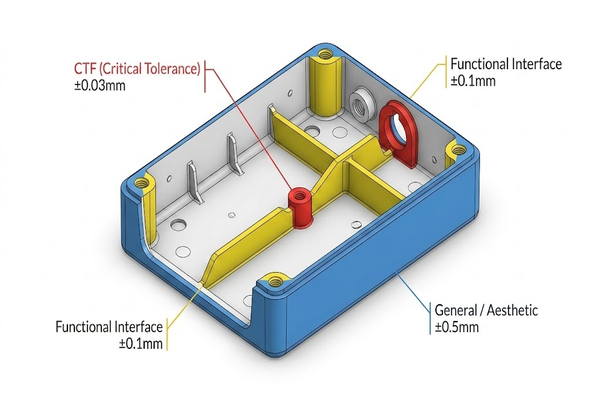
Executing multi‑material components successfully requires rigorous Design for Manufacturing (DFM) analysis. For both insert moulding and overmoulding, mould design must account for differential thermal contraction rates between disparate materials, preventing warping, flash, or interface delamination.
DFM Priorities for Insert Moulding
- Secure insert retention – Features such as knurling, grooves, or through‑holes prevent the metal insert from rotating or pulling out under mechanical torque.
- Uniform wall thickness – Transitions around the insert must remain even to avoid sink marks and residual stress concentrations.
- Gate placement optimisation – Incoming molten plastic must not dislodge or deform the positioned insert during injection.
DFM Priorities for Overmoulding and Two‑Shot
- Chemical or mechanical bonding compatibility – The melt temperature of the secondary shot must be high enough to thermally bond with the first substrate without re‑melting or warping it.
- Mechanical interlocks – When chemical bonding is insufficient (due to incompatible polymers), slots, holes, or undercuts must be engineered into the primary substrate to physically anchor the overmoulded layer.
- Rigorous quality control – Inspection of interface adhesion, dimensional stability, and flash control along shut‑off surfaces is essential at the prototyping stage.
Decision Framework: When to Use Insert Moulding
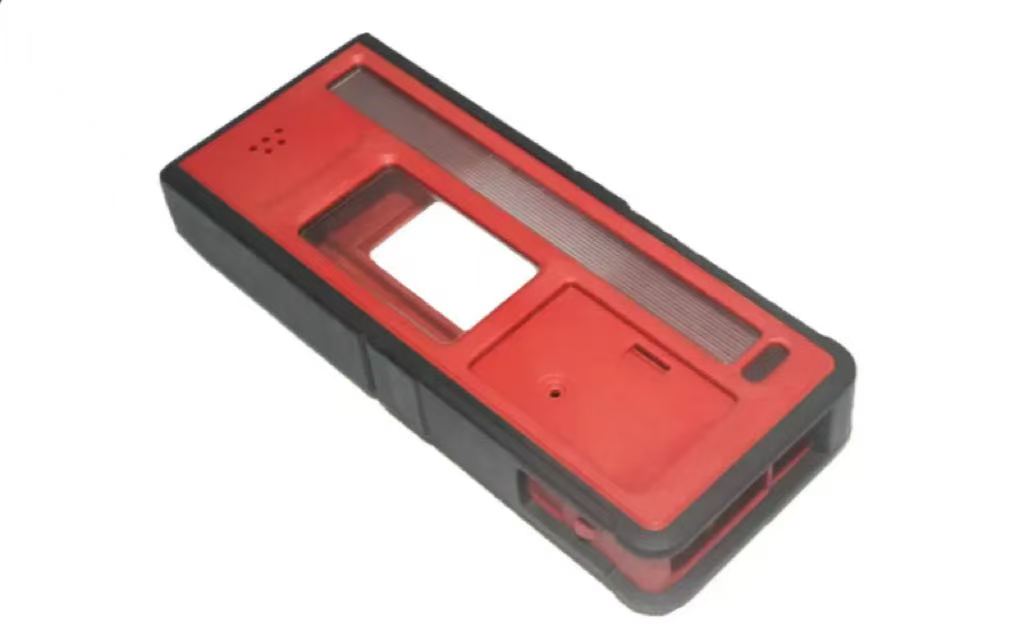
Insert moulding is the definitive process choice when a plastic component requires robust, permanent metallic fastening points or electrical connectivity. Selecting this technique eliminates secondary post‑molding assembly steps—such as ultrasonic insertion or heat‑staking—thereby reducing labour costs and improving structural reliability.
Primary Application Scenarios
- Plastic enclosures requiring metal threaded inserts for frequent screw disassembly.
- Electrical housings requiring embedded contact pins.
- Structural brackets requiring high‑strength metal reinforcement points.
Key Advantages
- Exceptional mechanical pull‑out and torque‑out resistance.
- Elimination of manual post‑mold fastener insertion.
- Reduced part count in final bill‑of‑materials.
Design Considerations
- Inserts must feature clean surfaces free of oils or oxidation to ensure proper resin wet‑out and interfacial grip.
- Vertical clamping machines are frequently preferred for insert moulding to utilise gravity in keeping vertical inserts securely seated during cycle operations.
Decision Framework: When to Use Overmoulding (and Two‑Shot Injection Moulding)
Overmoulding and two‑shot injection moulding are specified when a component requires ergonomic tactile enhancement, vibration dampening, environmental sealing, or multi‑color branding.
Industry Application Examples
| Industry / Application | Substrate Material | Overmould Material | Functional Purpose |
|---|---|---|---|
| Automotive & Transportation | Rigid ABS / PC | TPE (Thermoplastic Elastomer) | Soft‑touch control knobs, vibration‑dampening clips, and weather‑resistant gaskets |
| Medical & Dental | Rigid PP / Nylon | Medical‑grade Silicone or TPE | Ergonomic surgical instrument handles, slip‑resistant grip zones, and fluid‑tight seals |
| Electronics & Semiconductors | Engineering Plastics | TPE or Soft Polyurethane | Impact‑resistant protective bumpers, waterproof enclosure seals, and port covers |
| Consumer Goods & Appliances | ABS / Polycarbonate | Soft‑grip TPE | Ergonomic tool handles, shock‑absorbing appliance feet, and dual‑color aesthetics |
Evaluating Cost, Efficiency, and Production Scalability
Commercial evaluation requires balancing initial tooling investments against per‑unit production efficiency and labour expenses.
- Insert moulding often requires lower initial tooling complexity if standard vertical machines and manual loading are utilised for low‑to‑medium volume runs; however, manual insert loading limits cycle time and increases labour dependency. Conversely, automated vertical setups or robotic pick‑and‑place systems can scale efficiency for higher volumes.
- Overmoulding and two‑shot injection moulding generally demand higher upfront tooling investments due to the requirement for complex multi‑cavity moulds, core‑backs, or rotary platens. However, two‑shot injection moulding eliminates intermediate handling and manual transfer steps, significantly reducing long‑term piece‑part labour costs in high‑volume mass production.
When assessing an injection mould manufacturer, project managers must weigh batch scale, labour rates, and automation feasibility to optimise total production economics.
Sourcing a Reliable Partner for Complex Moulding Projects in China
Partnering with an experienced China injection moulding company requires systematic supplier evaluation, particularly for intricate multi‑material projects. Procurement teams should review specific engineering competencies before committing to production tooling.
Key Evaluation Criteria
- DFM Engineering Competency – Verify whether the supplier provides comprehensive DFM feedback regarding draft angles, wall thickness ratios, and gate placement.
- Quality Control Systems – Check for systematic inspection protocols, including coordinate measuring machine (CMM) dimensional verification, optical comparator checks, and bond‑strength peel testing for overmoulded components.
- Equipment Versatility – Ensure the manufacturer operates a balanced mix of horizontal and vertical injection moulding presses capable of handling specialised insert loading and multi‑shot configurations.
- Material Traceability – Confirm that the supplier utilises certified engineering resins from established global chemical manufacturers to guarantee batch‑to‑batch consistency.
Conclusion and Next Steps for Your Project
Selecting between insert moulding and overmoulding depends directly on your assembly’s mechanical requirements—whether you need permanent metallic fastening points or a protective, ergonomic elastomer skin. By defining your structural load criteria, expected production volume, and material compatibility early in the design cycle, you can optimise both product durability and manufacturing efficiency.
For tailored engineering feedback on your upcoming design, explore our plastic injection moulding capabilities or reach out to our team with your 3D CAD files to request a DFM review and project quotation.
Key Takeaways
- Insert moulding embeds pre‑formed components (such as metal threaded inserts) into a plastic matrix to provide superior mechanical fastening strength.
- Overmoulding and two‑shot injection moulding bond a secondary elastomer or plastic layer over a substrate to provide tactile grip, sealing, and impact protection.
- DFM analysis is vital for managing differential thermal shrinkage, ensuring proper polymer‑to‑polymer bonding, and preventing component displacement during injection.
- Process selection depends on whether the design requires structural metal integration or ergonomic/sealing surface enhancement.
Frequently Asked Questions (FAQ)
Q: Can insert moulding be automated?
A: Yes. While low‑volume runs often utilise manual insert placement, high‑volume production lines implement robotic pick‑and‑place automation to load inserts safely and maintain short cycle times.
Q: What is the main difference between overmoulding and two‑shot injection moulding?
A: Overmoulding can be performed on separate machines using secondary tooling where the first‑shot part is manually transferred. Two‑shot injection moulding utilises an integrated rotary‑platen machine to shoot both materials sequentially in a single automated cycle.
Q: How do I prevent delamination in overmoulding?
A: Delamination is prevented by selecting chemically compatible polymer pairs, maintaining correct melt temperatures, and incorporating mechanical interlocks such as undercuts or holes when chemical bonding is insufficient.
Final CTA
Ready to evaluate your multi‑material part design? Contact our engineering team today through our contact us page to submit your 3D CAD files and request a professional DFM review and project quotation. To understand our core philosophy and background further, read more on our about us page.