
TPU injection molding turns thermoplastic polyurethane — an elastomer with rubber-like elasticity — into durable, wear-resistant parts on standard injection molding machines. Typical process windows are a melt temperature of 185–235 °C (scaled to Shore hardness), a mold temperature of 20–60 °C, and mandatory drying at 80–110 °C for 2–4 hours to bring residual moisture below 0.02%. TPU is the material of choice when a part must flex, absorb impact, resist abrasion, or survive oils and fuels: wheels and rollers, seals and gaskets, cable jackets, protective overmolds, and soft-touch grips. This guide covers the process parameters, grade selection, drying requirements, mold design rules, and overmolding compatibility you need before committing to tooling.
What Is TPU and Why It Molds Like a Plastic but Performs Like Rubber
Thermoplastic polyurethane (TPU) is a block copolymer built from hard segments and soft segments. The hard segments behave like a thermoplastic — they melt, flow, and re-solidify on standard injection molding equipment. The soft segments give the finished part its rubber-like elasticity, resilience, and damping behavior. The result is a material you can injection mold on conventional machines without the cure time, tooling, or waste of thermoset rubber.
TPU is available in a hardness range of roughly Shore 60A to Shore 75D, and it can be molded transparent, translucent, or color-matched. Published property ranges for unfilled grades include tensile strength of about 25–55 MPa, elongation at break of 400–600%, and service temperatures down to around −40 °C for polyether grades. Its abrasion resistance is among the best of any common polymer, and it survives oils and greases that attack natural rubber.
The practical consequence for buyers: TPU fills the gap between rigid engineering plastics (which cannot flex) and rubbers or liquid silicone rubber (which require thermoset curing or more expensive LSR tooling). If your part bends, compresses, or takes repeated impact, TPU is usually the first material to evaluate.
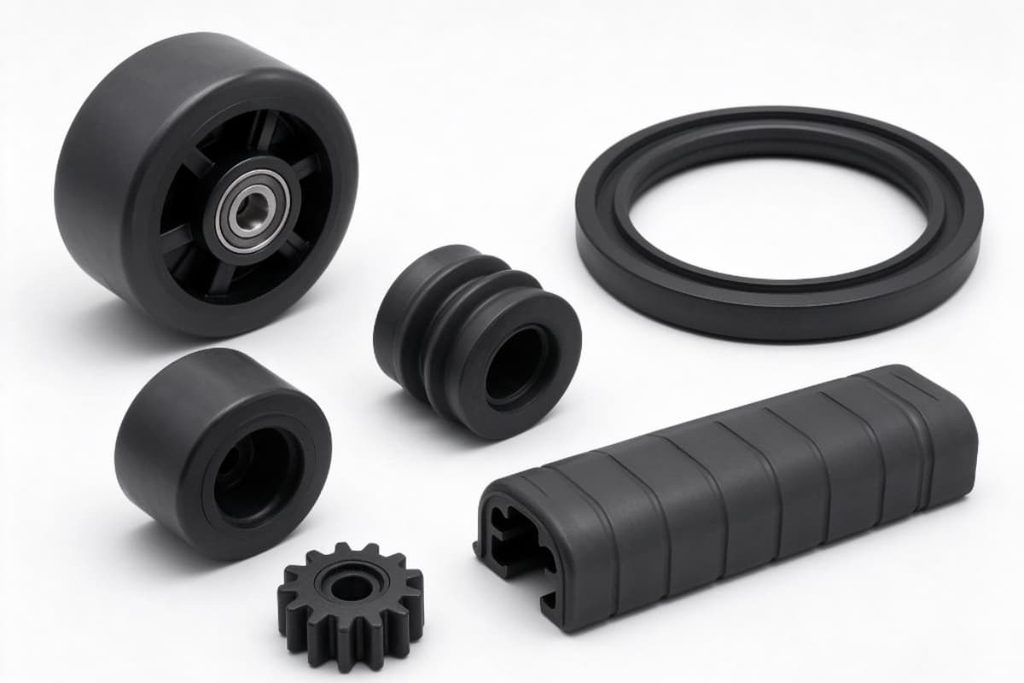
Where TPU Injection Molding Is Used
TPU parts appear wherever wear, impact, and flexibility converge. The most common production categories we see:
| Application | Typical Parts | Why TPU Wins |
|---|---|---|
| Wheels and rollers | Caster wheels, skate wheels, printer and conveyor rollers | Best-in-class abrasion resistance; load-bearing elasticity |
| Seals and dampers | O-rings, gaskets, bellows, vibration dampers, bushings | Elastic memory, compression resistance, oil and fuel resistance |
| Cable and wire | Cable jackets, strain reliefs, coiled cords, connectors | Flex fatigue resistance, kink resistance, abrasion at entry points |
| Protective overmolds | Tool grips, phone and device cases, bumpers, shock pads | Impact absorption, soft touch, bonds to rigid substrates |
| Footwear and sports | Outsoles, midsoles, insoles, protective gear | Energy return, abrasion, lightweight toughness |
| Industrial and outdoor | Drive belts, drone bumpers, grommets, mining screens | Tear strength, hydrolysis resistance (polyether grades), UV-stabilized options |
TPU vs TPE vs TPR: What Is the Difference?
These three names get used interchangeably, but they describe different material families — and the difference shows up in performance and price. TPE (thermoplastic elastomer) is the umbrella term; TPR usually refers to styrene-based TPEs; TPU is the high-performance end of the family.
| Property | TPU | TPE / TPR (SEBS-based) |
|---|---|---|
| Abrasion resistance | Excellent — among the best of any thermoplastic | Fair to good |
| Oil and fuel resistance | Excellent (grade-dependent) | Limited |
| Elastic memory / recovery | Excellent — holds shape after repeated load | Good, softer feel |
| Typical hardness range | Shore 60A–75D | Shore 20A–70A, softer |
| Processing difficulty | Higher — strict drying, shear control | Easier, wider window |
| Resin cost | Higher | Lower |
| Best for | Wheels, seals, gears-in-contact, oil exposure | Soft-touch grips, low-cost overmolds |
A quick rule: if the part rubs, slides, rolls, or touches oils, TPU lasts many times longer than SEBS-based TPE. If the requirement is purely a cheap, soft overmolded grip with no wear or chemical exposure, TPE is often the more economical choice. Our TPE and TPU materials compares the two families in more depth for overmolding projects.
Polyester vs Polyether TPU: Choosing the Right Grade
Beyond hardness, the most important grade decision is the soft-segment chemistry: polyester or polyether. This choice determines how the part behaves in humid, oily, or cold environments.
| Criterion | Polyester TPU | Polyether TPU |
|---|---|---|
| Abrasion and tear resistance | Superior | Good |
| Oil, fuel, grease resistance | Excellent | Moderate |
| Hydrolysis resistance (hot water, humidity) | Weak — avoid continuous warm water | Excellent |
| Microbial resistance | Vulnerable | Resistant |
| Low-temperature flexibility | Adequate | Flexible to about −40 °C |
| Typical cost | Lower (roughly 15–30% less resin cost) | Higher |
| Typical applications | Industrial seals, rollers, wheels, mechanical wear parts | Outdoor cables, medical devices, marine and wearable products |
Choosing wrong here is an expensive mistake: a polyester grade specified for a humid outdoor product will hydrolyze and lose mechanical properties within months, while a polyether grade specified for an oil-contact part underperforms at a premium price. We confirm the chemistry at DFM review based on service conditions, regulatory requirements, and any biocompatibility needs for medical-grade programs.
TPU Injection Molding Process Parameters
TPU’s processing window scales directly with Shore hardness — harder grades carry more hard-segment content and need more heat. The table below consolidates published guidelines and the ranges we work to in production. Always confirm against the specific grade datasheet before cutting steel.
| Parameter | Soft TPU (65–80 Shore A) | Medium TPU (85–95 Shore A) | Hard TPU (50–74 Shore D) |
|---|---|---|---|
| Drying (desiccant dryer) | 80–90 °C, 2–4 h | 90–100 °C, 2–4 h | 100–110 °C, 2–4 h |
| Max moisture before molding | ≤ 0.02% (200 ppm) | ||
| Melt temperature | 185–205 °C | 195–215 °C | 210–235 °C |
| Mold temperature | 20–40 °C | 30–50 °C | 40–60 °C |
| Injection / holding pressure | 50–100 MPa (holding typically 30–50% of injection) | ||
| Mold shrinkage (typical, wall-dependent) | 0.8–1.8% | 0.6–1.2% | 0.4–0.8% |
Three process controls matter more than the raw numbers. First, screw geometry: run a low-compression screw (2.0–2.5:1) at moderate RPM — a high-compression screw overheats the melt through shear, causing yellowing and degradation. Second, keep back pressure low and residence time short; overheated TPU gels and is difficult to purge. Third, purge completely with PP or PE at shutdown — left-in TPU carbonizes and contaminates the next run.
Drying: The Step That Makes or Breaks TPU Parts
TPU is highly hygroscopic — it pulls moisture out of the air rapidly, and dried pellets re-absorb it within about an hour of open-air exposure. At barrel temperatures of 185–235 °C, that trapped moisture turns to steam. The result is surface splay (silver streaks), internal voids and bubbles, and — more damaging — hydrolytic chain cleavage, which permanently cuts tensile and tear strength even when the part looks acceptable.
- Dry in a desiccant (dehumidifying) dryer, not a hot-air hopper: 80–110 °C for 2–4 hours depending on hardness, to below 0.02% residual moisture.
- Transfer dried pellets into sealed, moisture-proof containers and keep the machine hopper closed.
- Re-dry any pellets exposed to open air for more than about an hour — the rule of thumb is to dry again rather than risk the run.
- Pre-dry masterbatch and additives too. Undried colorant is a common and easily missed cause of splay on otherwise dry material.
Wet TPU produces the same visible symptoms as several other defects. If you are seeing splay or surface streaks on molded parts — in TPU or any other resin — our common molding defects walks through the diagnosis process we use on the production floor.
Mold Design Rules for TPU
TPU molds mostly follow rigid-plastic conventions with a few elastomer-specific adjustments:
- Draft and ejection: soft grades (Shore A 60–75) grip polished cavities and resist ejection. Add 1°+ draft on deep pull surfaces, use VDI 18–24 texture on cosmetic soft surfaces, and reduce ejection speed on first articles.
- Shrinkage compensation: design for roughly 0.5–2% depending on grade and wall thickness. Soft grades shrink more and are more sensitive to wall thickness variation — uniform walls produce more consistent dimensions than abrupt geometry changes.
- Venting: TPU fills fast and traps gas at end-of-fill. Vent the parting line at 0.02–0.03 mm; trapped air burns on translucent or light-colored parts.
- Gating: use wide tab or fan gates on soft grades to reduce shear and jetting, and gate across the longest flow path to sweep air out.
- Stripping undercuts: a genuine TPU advantage — flexible undercuts on grips and seals can often be stripped from the mold without side actions, saving real tooling cost. Confirm with the molder before relying on it.
- Wall thickness: keep overmolded TPU layers around 0.8–3.0 mm. Below 0.8 mm, long flow paths short-shot and bond quality becomes inconsistent.
TPU Overmolding: Substrate Compatibility
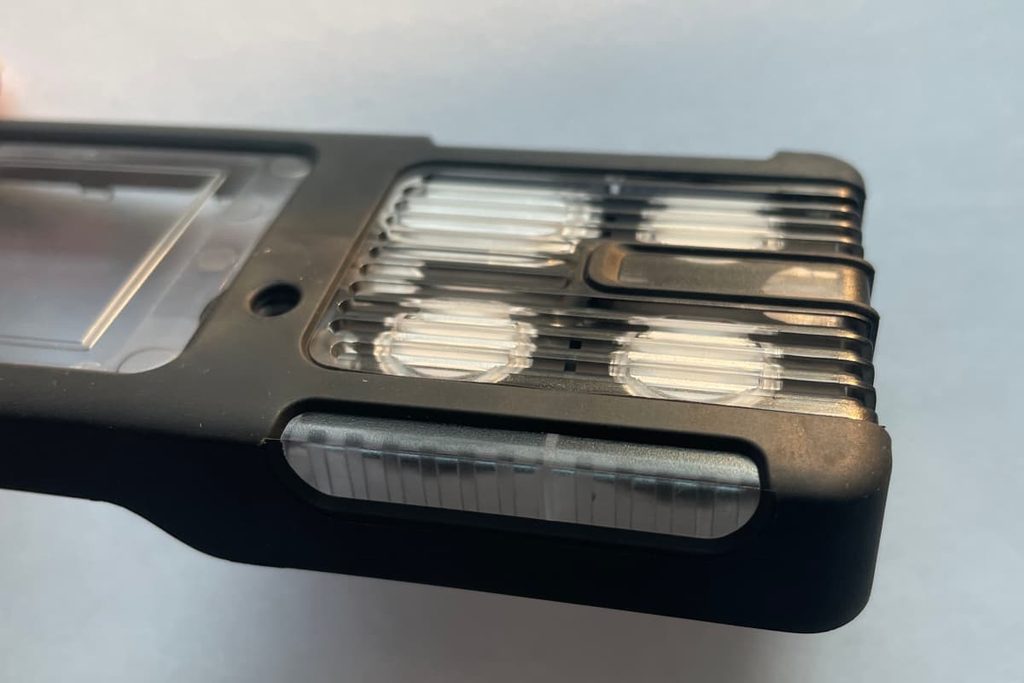
TPU is one of the best elastomers for overmolding onto rigid substrates — but adhesion chemistry is substrate-specific, and getting it wrong means delaminated parts. The matrix below reflects what holds up in production:
| Substrate | TPU Adhesion | Notes |
|---|---|---|
| PA6 / PA66 (nylon) | Excellent — chemical + mechanical | Bonds directly without primer in two-shot or insert molding |
| PC | Excellent — chemical bond | Watch melt temperature so the PC substrate does not degrade |
| ABS | Excellent — chemical bond | Reliable direct bonding; verify peel strength on first articles |
| PC/ABS | Excellent | Standard pairing for device shells and grips |
| PBT / PA modified grades | Partial — grade-dependent | May need adhesion-modified TPU or mechanical interlocks |
| PP / PE | Poor — no chemical bond | Non-polar polyolefins repel polar TPU; use mechanical through-holes or switch to a PP-based TPE |
| PMMA / PVC | Good | Keep TPU melt below ~220 °C to avoid warping thin substrates |
Two practical notes from our overmolding process guide: keep the soft layer between 0.8 and 3.0 mm, and mind the shrinkage mismatch — a soft material shrinking significantly more than the rigid substrate will warp the assembly toward the soft side. For a real production example on thin-wall PC housings, see our TPE-over-PC thin-wall case study, where substrate and mold-temperature decisions on a 190 mm gas-detector housing drove the material choice.
How to Get an Accurate TPU Injection Molding Quote
TPU quotes fail most often on missing grade information. Before sending a drawing, prepare: the target Shore hardness and test standard (datasheets differ by up to five points), the chemistry (polyester or polyether, or let the molder recommend based on service conditions), expected annual volume, and any regulatory requirements — food contact, medical biocompatibility, flame retardancy, or UV stabilization. Resin runs roughly $2.5–6/kg depending on grade and certification, so certification requirements can move the material line item significantly.
Our injection molding quote guide covers the full RFQ package in detail, and our low volume injection molding explains tooling options for production runs under 10,000 parts. For a broader view of how TPU compares with rigid engineering plastics, start with our material selection guide; if the part needs higher service temperatures or medical-grade biocompatibility, our LSR injection molding guide covers the silicone alternative. Ready to move? request a TPU quote and our engineers will review DFM before pricing.
Frequently Asked Questions: TPU Injection Molding
What is the difference between TPU, TPE, and TPR?
TPE is the umbrella term for thermoplastic elastomers; TPR usually refers to the styrene-based (SEBS) members of that family. TPU is the high-performance end: significantly better abrasion resistance, oil and fuel resistance, and elastic memory, at higher resin cost and a stricter processing window (strict drying, shear control). Choose TPE/TPR for soft, low-cost grips; choose TPU where the part rolls, slides, or contacts oils.
Why does TPU need to be dried before injection molding?
TPU is highly hygroscopic. At barrel temperatures of 185–235 °C, absorbed moisture flashes to steam, causing splay marks, bubbles, and voids — and hydrolytic chain cleavage that permanently reduces tensile and tear strength even when the surface looks fine. Dry in a desiccant dryer at 80–110 °C for 2–4 hours (scaled to hardness) to below 0.02% moisture, and re-dry pellets exposed to open air for more than about an hour.
What temperature do you injection mold TPU?
Melt temperature scales with hardness: roughly 185–205 °C for soft grades (65–80 Shore A), 195–215 °C for medium grades (85–95 Shore A), and 210–235 °C for hard grades (50–74 Shore D). Mold temperature runs 20–60 °C, also scaled to hardness. Confirm against the grade datasheet — these are working windows for unfilled grades, not universal settings.
What shrinkage should I design for with TPU?
Typical mold shrinkage for unfilled TPU runs about 0.4–1.8%, depending on hardness and wall thickness — softer grades shrink more (roughly 0.8–1.8%) and are more sensitive to wall thickness variation. Most production molds are designed with 1–2% nominal compensation. Uniform walls produce more consistent shrinkage than parts with abrupt geometry changes; confirm the exact value against the supplier datasheet for the specified grade.
Which plastics can TPU be overmolded onto?
TPU bonds directly and reliably to PA6/PA66 (nylon), PC, ABS, and PC/ABS without primers in two-shot or insert molding. PBT and some modified PA grades need adhesion-modified TPU or mechanical interlocks. Standard TPU does not bond to PP or PE — non-polar polyolefins repel polar TPU — so use mechanical through-holes or switch the soft layer to a PP-based TPE. Always verify peel strength on first articles before committing to tooling.
Polyester or polyether TPU: which grade should I choose?
Choose polyester TPU for maximum abrasion, tear, oil, and fuel resistance at lower cost — the standard for industrial seals, rollers, and mechanical wear parts kept out of continuous warm water. Choose polyether TPU for hydrolysis resistance (hot water, humidity, marine service), microbial resistance, and low-temperature flexibility down to about −40 °C — the default for outdoor cables, medical devices, and wearables. Confirm at DFM review against actual service conditions.
Start Your TPU Injection Molding Project
Send us your 3D file or 2D drawing together with the target Shore hardness, expected annual volume, and any service-environment requirements (oil contact, humidity, outdoor UV, medical). Our engineers review DFM before pricing — including grade selection between polyester and polyether, shrinkage compensation for your wall thickness, and overmolding bond feasibility — so the quote you receive reflects what will actually run in production. Contact GoodTech to start your TPU project.