
Reaction injection molding (RIM) is a low-pressure manufacturing process that builds a solid plastic part by injecting two reactive liquid components—typically a polyol and an isocyanate—into a closed mold, where they chemically cross-link and cure. Unlike conventional injection molding, which melts solid thermoplastic pellets and forces them in under thousands of psi, RIM relies on chemistry, not brute force: the part is formed inside the mold by an exothermic polymerization reaction. That single difference is why RIM can use inexpensive aluminum tooling, mold very large or complex parts, and stay economical at low volumes. This guide covers how the RIM process works, the materials you can mold, design rules (DFM), how it compares to injection molding, typical applications, and the cost and volume trade-offs—so you can decide whether RIM fits your next program.
What Is Reaction Injection Molding (RIM)?
RIM is defined by a simple sequence: meter → mix → fill → cure → demold. The raw materials are two low-viscosity liquids kept in separate, temperature-controlled tanks (typically 27–49 °C / 80–120 °F) to hold viscosity steady. When a shot is triggered, precision pumps deliver the components at a fixed stoichiometric ratio (commonly 1:1 by volume) into a high-pressure impingement mixing head, then the blended liquid flows into the mold where it reacts and solidifies.
The key distinction from traditional molding:
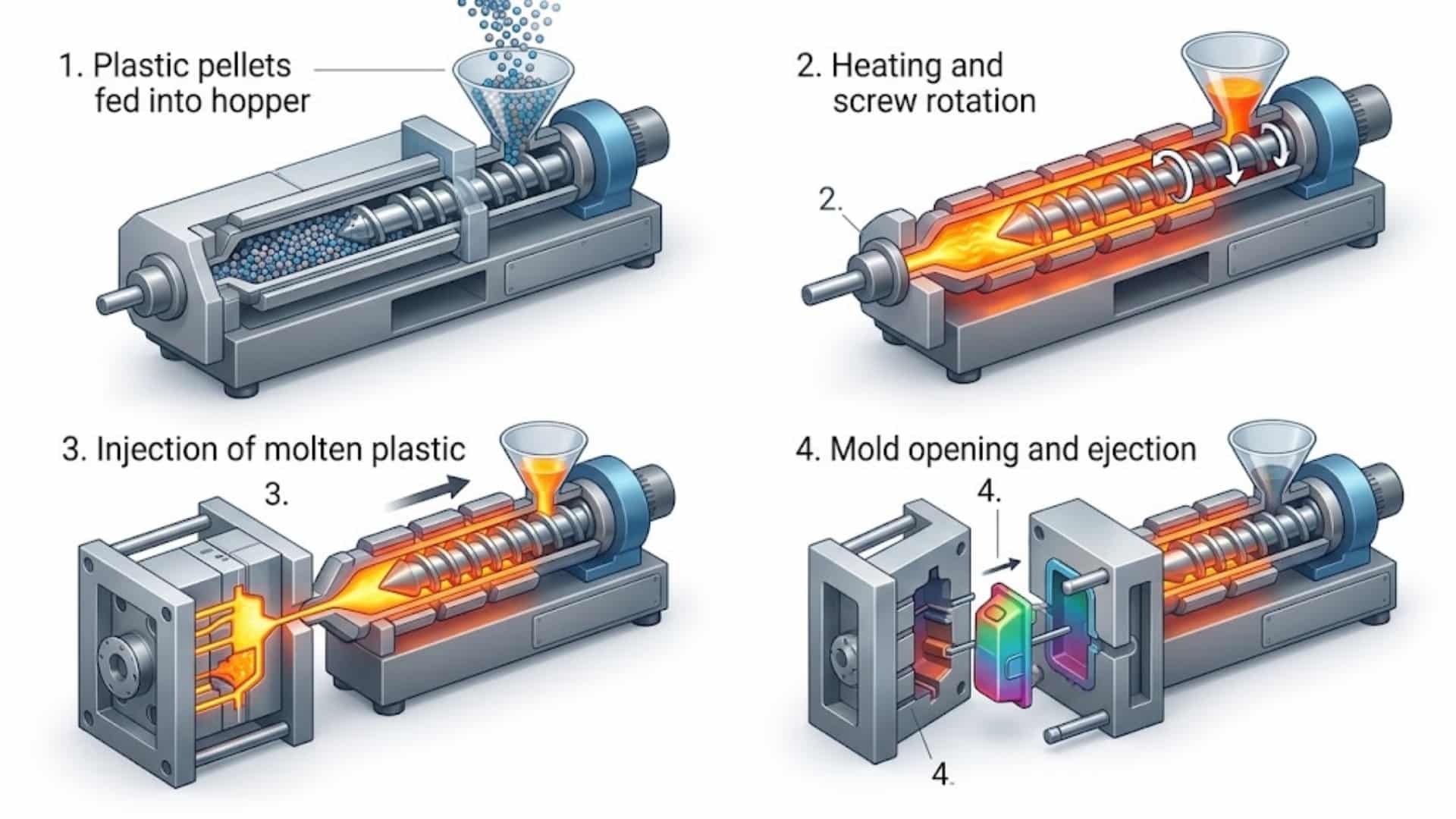
- Traditional injection molding is a physical process—melt thermoplastic → fill → cool → eject.
- RIM is a chemical process—mix reactive liquids → polymerize in situ → cure → demold.
The result is a thermoset part: chemically cross-linked and dimensionally stable, and (unlike a thermoplastic) unable to be remelted and reprocessed. RIM was developed in the late 1960s and gained wide automotive adoption in the 1970s–80s for bumper fascias and body panels; today it remains the go-to process for large, complex polyurethane parts at volumes where steel injection tooling is hard to justify.
How the RIM Process Works
The RIM cycle is a five-step sequence. The numbers below are typical production ranges drawn from process references:
- Metering. The two components (polyol blend = Component A; isocyanate = Component B) are stored in separate heated tanks and pumped at a precise ratio. A 10 °F temperature swing can shift viscosity 15–25%, so temperature control is critical.
- Mixing. The streams collide in a high-pressure impingement mixhead at 1,500–3,000 psi (≈10–20 MPa), creating turbulent, homogeneous mixing in milliseconds—no mechanical agitator needed. (Source: PMC technical review, 2026)
- Filling. The mixed liquid enters the mold at low pressure—typically 50–300 psi (≈0.4–1.1 MPa in-mold). Because the reacting mix has near-water viscosity, it fills thin walls, undercuts, and large cavities without high clamp force. (Source: PMC, 2026; ZetarMold, 2026)
- Curing. An exothermic reaction cross-links the polymer. Internal temperature can reach 250–350 °F even while the mold stays relatively cool; cure time ranges 1–10 minutes (some demold in 30–60 seconds). (Source: ZetarMold, 2026; reactioninjectionmolding.com, 2026)
- Demolding & finishing. The mold opens and the part is removed. RIM parts often benefit from a brief post-cure (24–48 hours at ambient) to reach full properties, followed by trimming, painting, or assembly.
Because mold pressure is so low, clamping force is minimal—a 10-ton clamp can produce parts that would need a 500-ton press in thermoplastic molding. (Source: ZetarMold, 2026)
RIM Materials: What Can You Mold?
Although thermoplastic injection molding offers thousands of resin grades, RIM is dominated by polyurethane (PU) chemistry—both its strength and its constraint. Non-PU systems make up less than ~15% of total RIM production. (Source: ZetarMold, 2026)
Polyurethane (PU) — the workhorse
- Solid (elastomeric) PU: Shore A 50 to Shore D 80; flexural modulus ~5,000–300,000 psi. Used for bumper fascias, fender extensions, industrial housings.
- Structural foam PU: a blowing agent (often water + excess isocyanate → CO₂) creates a cellular core with a solid skin, cutting weight 10–40% while keeping stiffness; wall thickness can reach ~12 mm without sink marks. (Source: ZetarMold, 2026; Jucheng Precision, 2026)
- Reinforced RIM (RRIM): 10–25% milled glass fiber or mineral filler raises flexural modulus 2–4×, suiting semi-structural automotive parts.
DCPD (dicyclopentadiene)
A pure-hydrocarbon thermoset that cures to a tough, non-cellular matrix. Extremely impact-resistant (tough even at −40 °C), chemical- and corrosion-resistant, with Class A surface quality and excellent paintability; cycles of 4–6 minutes. Telene®-type DCPD data: density ~1.03 g/cm³, Young’s modulus ~1.87 GPa, tensile ~43 MPa, flexural modulus ~1,850 MPa. (Source: KraussMaffei, 2026; PMC, 2026; Exothermic, 2026)
Nylon / NyRIM (polyamide 6)
A high-temperature RIM variant processing caprolactam (PA6 monomer). Wide operating range −50 to 140 °C (up to 180 °C short-term), impact-resistant at −40 °C, abrasion- and chemically resistant, and recyclable. (Source: KraussMaffei, 2026)
Typical material properties (guide values):
| Material system | Density (g/cm³) | Notes |
|---|---|---|
| Solid PU elastomer | 1.0–1.2 | Soft→rigid, widest use |
| Structural foam PU | 0.4–0.9 | Lightest; 10–40% mass saving |
| RRIM (≈20% glass) | 1.2–1.4 | Stiff, dimensionally stable |
| Polyurea | 1.0–1.1 | Faster cure, thermal stable |
| DCPD | 1.0–1.1 | Impact king, Class A |
RIM molding shrinkage is typically just 0.1–0.4%—far lower than nylon’s ~2%—which is why multi-meter panels hold flush-and-gap fit. (Source: Jucheng Precision, 2026)
Key Features & Advantages of RIM
- Low-pressure tooling = low cost. Molds run at 50–300 psi vs 5,000–20,000 psi for injection molding, so tooling can be aluminum, cast epoxy, or even 3D-printed resin for prototypes.
- High strength-to-weight. Structural foam and RRIM deliver rigid, lightweight parts ideal for large enclosures and mobility components.
- Design freedom. Water-like fill lets you mold undercuts, thin ribs, thick–thin transitions (up to ~3:1 wall variation), and encapsulated inserts in a single shot.
- Large-part capability. Bumper fascias over 1.8 m long, agricultural panels, and medical enclosures are routine—impractical for standard injection molding.
- Encapsulation. At <200 psi, sensitive electronics, PCBs, and metal brackets can be molded in without displacement.
- Lower waste. Reactive chemistry uses only what fills the cavity; thermoset scrap is minimal versus regrind-heavy thermoplastic loops.
RIM Design Guidelines (DFM)
- Wall thickness: aim for 3–6 mm typical; structural foam tolerates thicker sections (up to ~12 mm) without sink. Keep variation moderate for uniform cure.
- Draft & demold: low shrinkage means small draft angles suffice, but include a few degrees to aid release.
- Ribs & bosses: add stiffness without weight; design gating/venting for balanced fill.
- Tolerances: typical ±0.2–0.5 mm depending on size and material; the low-pressure, low-stress cure keeps parts flat and stable. (Source: Jucheng Precision, 2026)
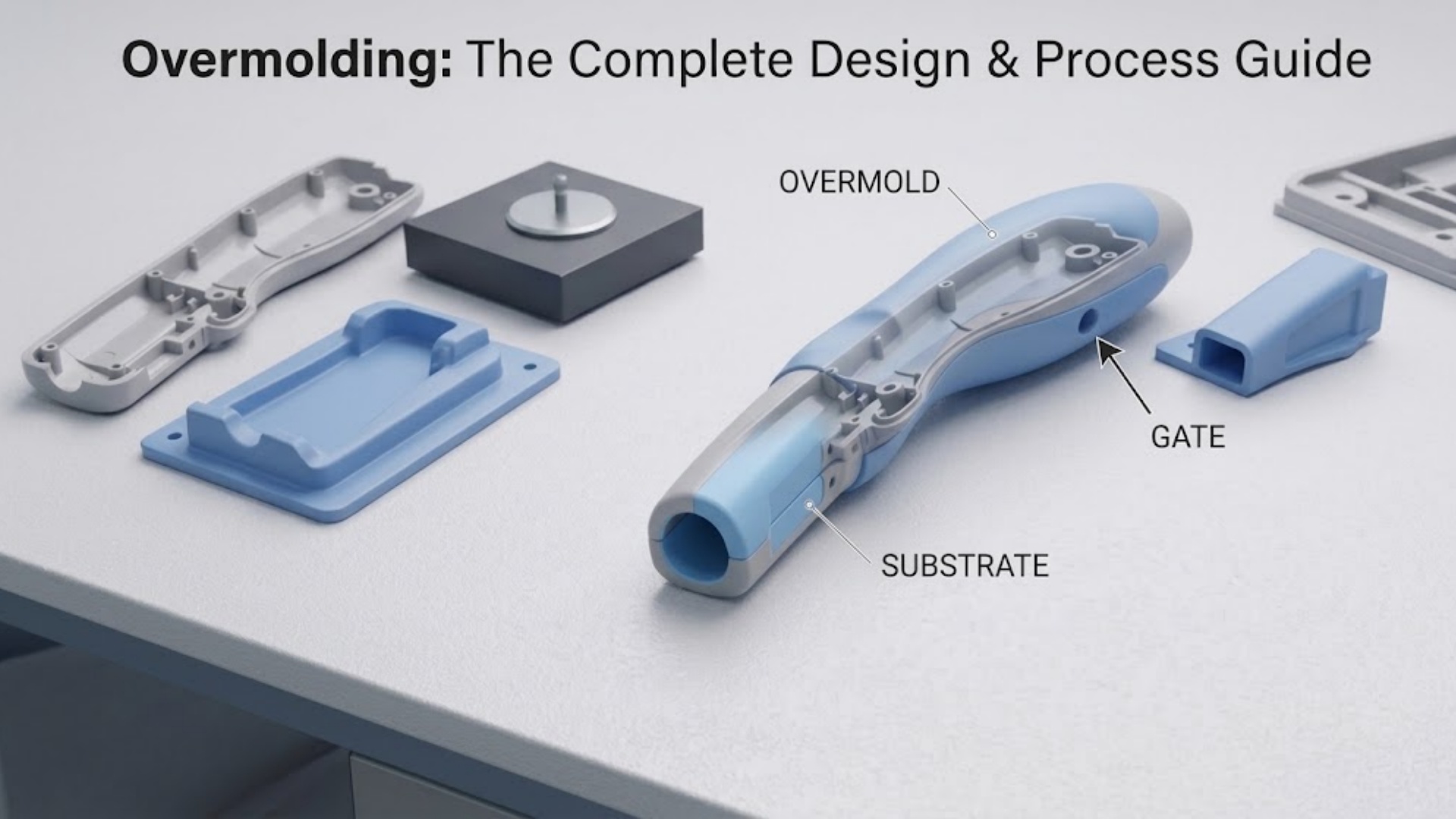
- Inserts & overmolding: metal or electronic inserts can be molded in place. See our overmolding applications guide for multi-material design detail.
RIM vs Traditional Injection Molding
| Dimension | Reaction Injection Molding (RIM) | Traditional Injection Molding |
|---|---|---|
| Forming mechanism | Chemical cross-link (thermoset) | Melt & cool (thermoplastic) |
| Mold pressure | 50–300 psi | 5,000–20,000 psi |
| Tooling | Aluminum / epoxy, low cost | Hardened steel, high cost |
| Best part size | Large, complex, thick | Small–medium, high-precision |
| Volume sweet spot | Low–mid (tens to ~5,000/yr) | High (1,000s–millions) |
| Cycle | 1–10 min cure | Seconds–minutes, faster |
| Design freedom | Undercuts, inserts, thick sections | Limited by packing pressure |
Rule of thumb: choose RIM for large, complex, or low-volume parts where steel tooling isn’t justified; choose injection molding for high-volume, smaller, tight-tolerance parts. For a deeper read, our two-shot vs overmolding and thermoset molding pages cover adjacent processes.
Common RIM Applications by Industry
- Automotive. Bumpers, fascia, fenders, spoilers, and body panels where impact absorption and paintability matter. See our RIM car wheel cover case study.
- Medical & healthcare. Diagnostic-machine housings, equipment enclosures, and mobile carts needing chemical resistance and large, stable surfaces. See our RIM medical cart with painting example.
- Consumer electronics. Large enclosures and bezels where size and finish beat unit cost. Related: electronics injection molding guide.
- Aerospace & industrial. Panels, interior components, and protective covers requiring durability.
RIM for Prototyping & Low-Volume Production
RIM is exceptionally strong as a bridge tooling process. Because molds are cheap and fast to make, you can validate a design with aluminum or silicone/epoxy tooling, then scale. The economically rational window is roughly 50–2,000 units/year, with the break-even versus thermoplastic injection molding typically falling between 2,000–5,000 units depending on geometry and material. (Source: ZetarMold, 2026) It’s also a natural alternative to vacuum casting for larger or more durable polyurethane parts.
Cost & Lead Time Considerations
- Tooling: a steel production RIM mold for a medium-complexity part runs about $5,000–$25,000, versus $30,000–$150,000 for a comparable injection mold. (Source: ZetarMold, 2026)
- Per-part cost drops as volume rises but is most favorable below the injection-molding break-even point.
- Lead time: low-pressure aluminum tooling is faster to cut than hardened steel, shortening development cycles—valuable when speed-to-market matters.
Is RIM Right for Your Project? (Decision Checklist)
RIM is likely a strong fit if your part:
- is large (hundreds of mm to multi-meter) or has complex geometry / undercuts;
- needs low-to-mid volume (tens to a few thousand per year);
- benefits from encapsulated inserts or variable wall thickness;
- requires a durable, lightweight, paintable surface;
- can’t justify steel injection tooling economics.
If instead you need millions of identical small precision parts, traditional injection molding is usually better.
FAQ
What’s the difference between RIM and injection molding?
RIM forms parts chemically (two liquids cross-link into a thermoset) at 50–300 psi; injection molding melts thermoplastic pellets and packs them at 5,000–20,000 psi. RIM wins on large/low-volume/complex parts and tooling cost; injection molding wins on high-volume precision.
What materials are used in RIM?
Mostly polyurethane (solid, structural foam, RRIM). Less common systems include DCPD, nylon/NyRIM, and polyurea—together under ~15% of RIM production.
How thick can RIM walls be?
Typical 3–6 mm; structural foam tolerates up to ~12 mm without sink marks. Thick–thin transitions up to ~3:1 are manageable.
How much does RIM tooling cost?
A steel production RIM mold for a medium part is roughly $5,000–$25,000, far below the $30,000–$150,000 of a comparable injection mold.
Can RIM parts be painted?
Yes. PU and especially DCPD take Class A, automotive-grade paint well—important for exterior and medical-cart finishes (see our painted medical cart).
Conclusion
Reaction injection molding is a chemistry-driven process built for large, complex, low-to-mid-volume thermoset parts—delivering low tooling cost, design freedom, and durable, paintable results that traditional injection molding can’t match at those volumes. If your program fits the checklist above, RIM is worth a serious look.
Ready to evaluate your part? Contact GoodTech for a RIM quote—we support RIM prototyping and low-volume production for medical, automotive, and consumer-electronics applications.