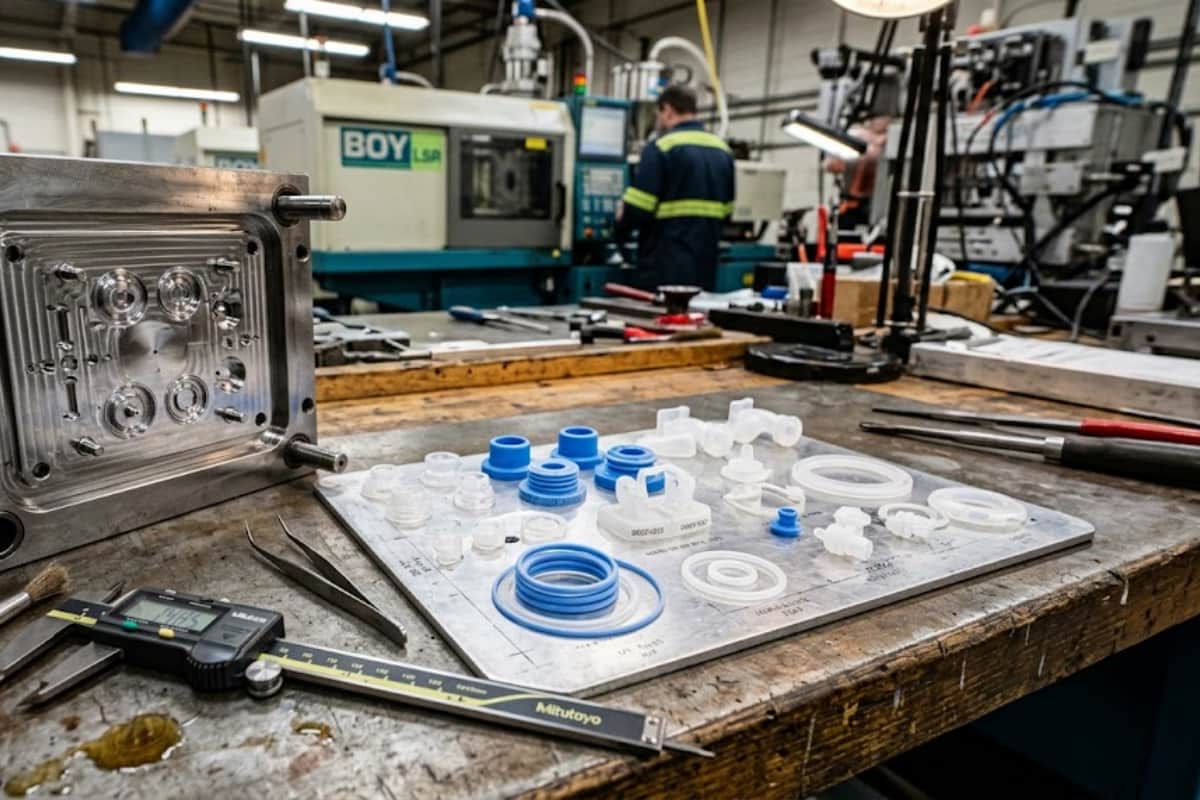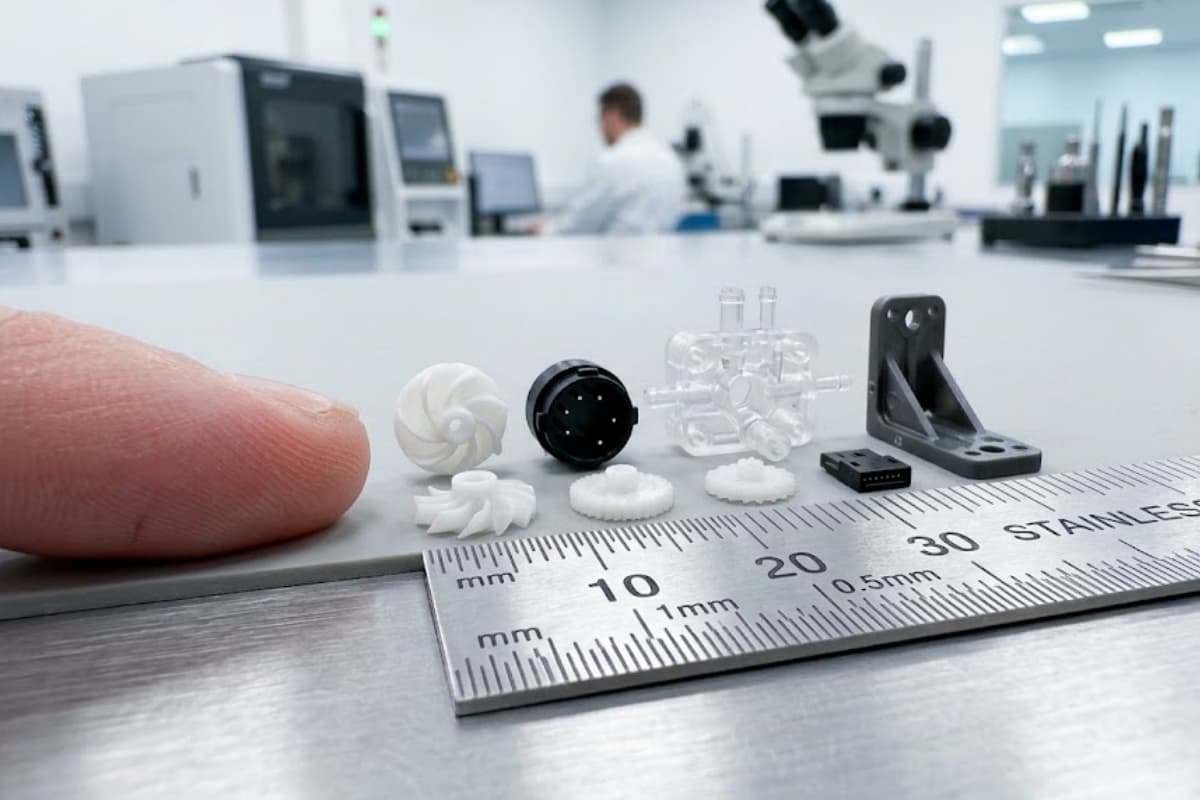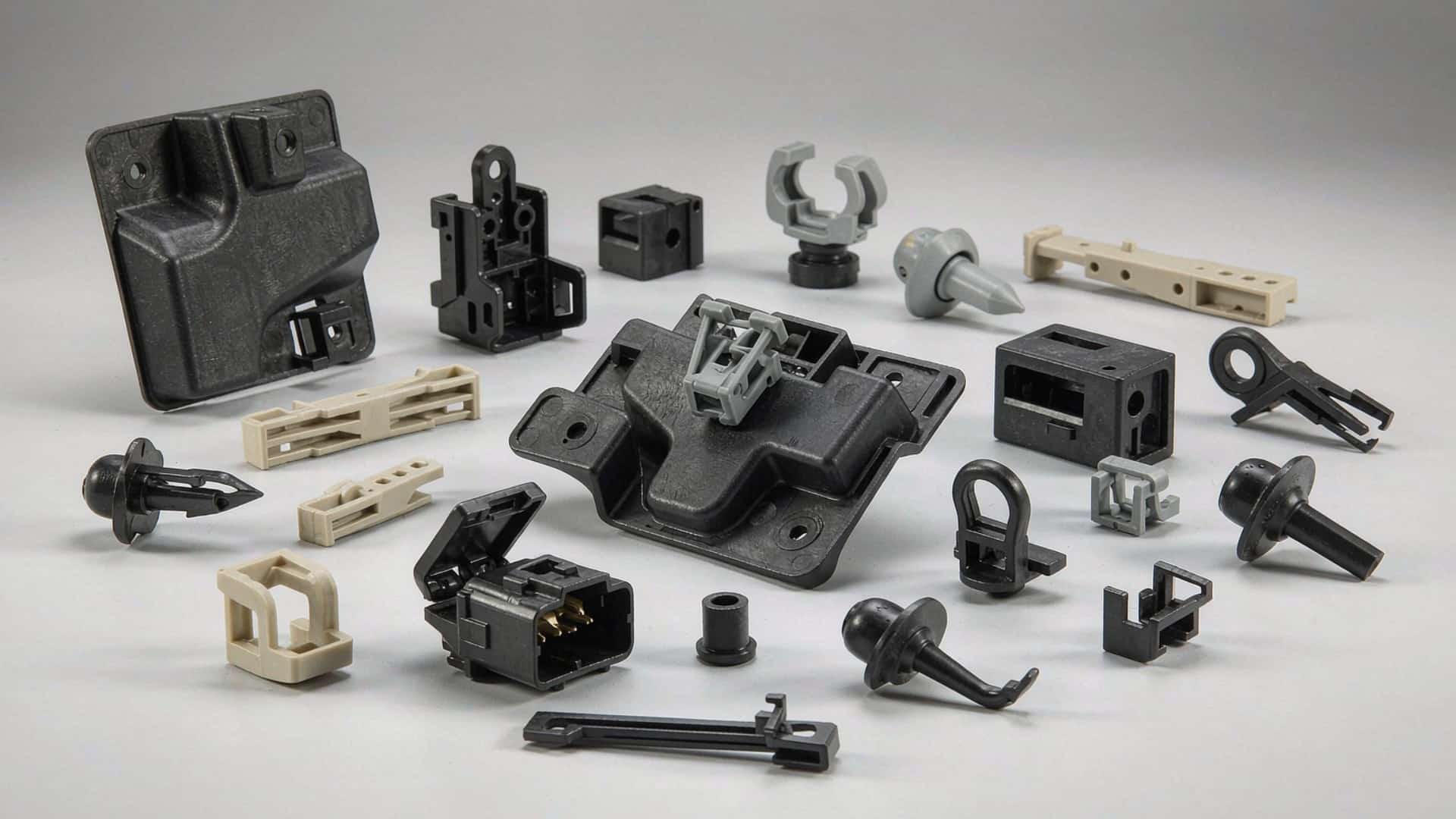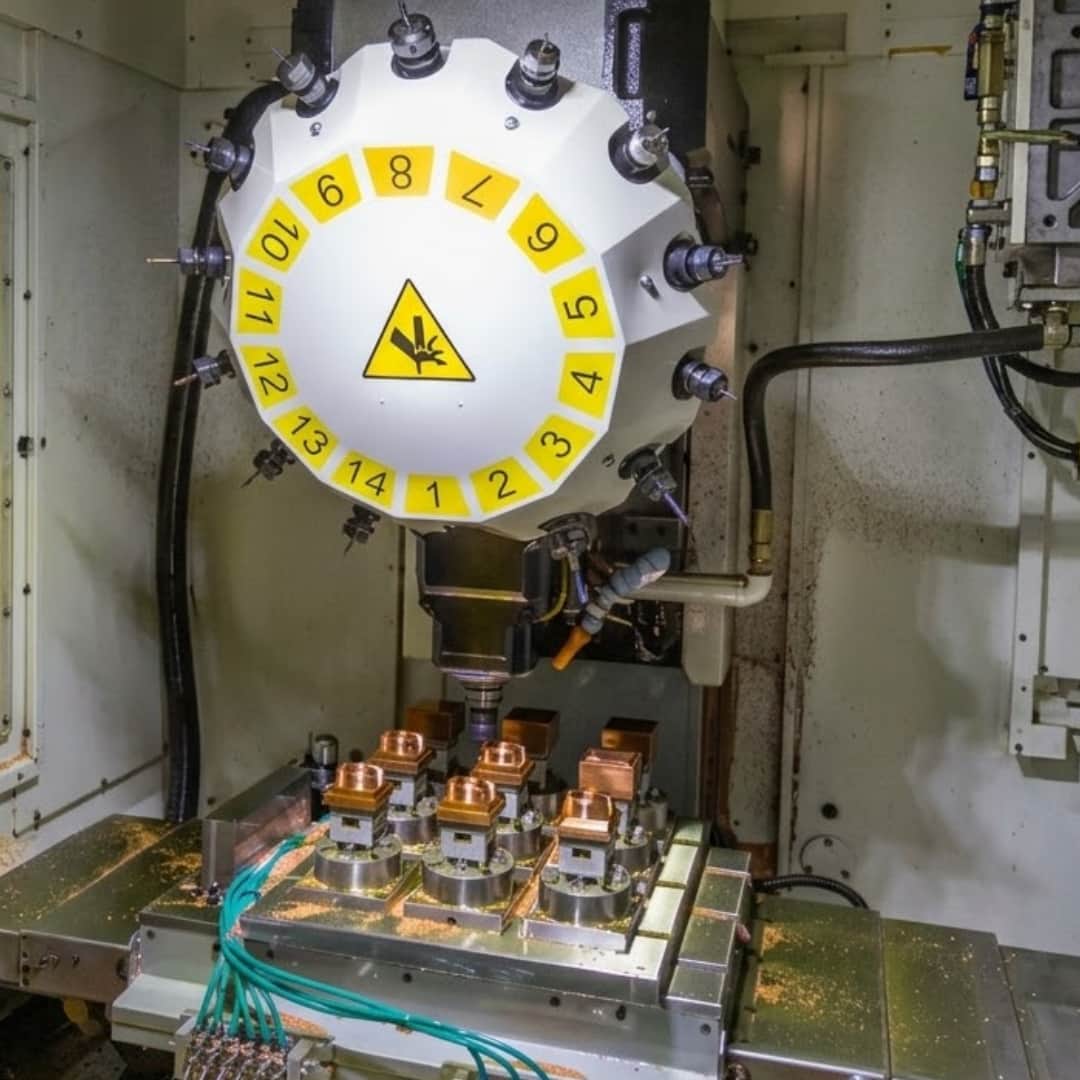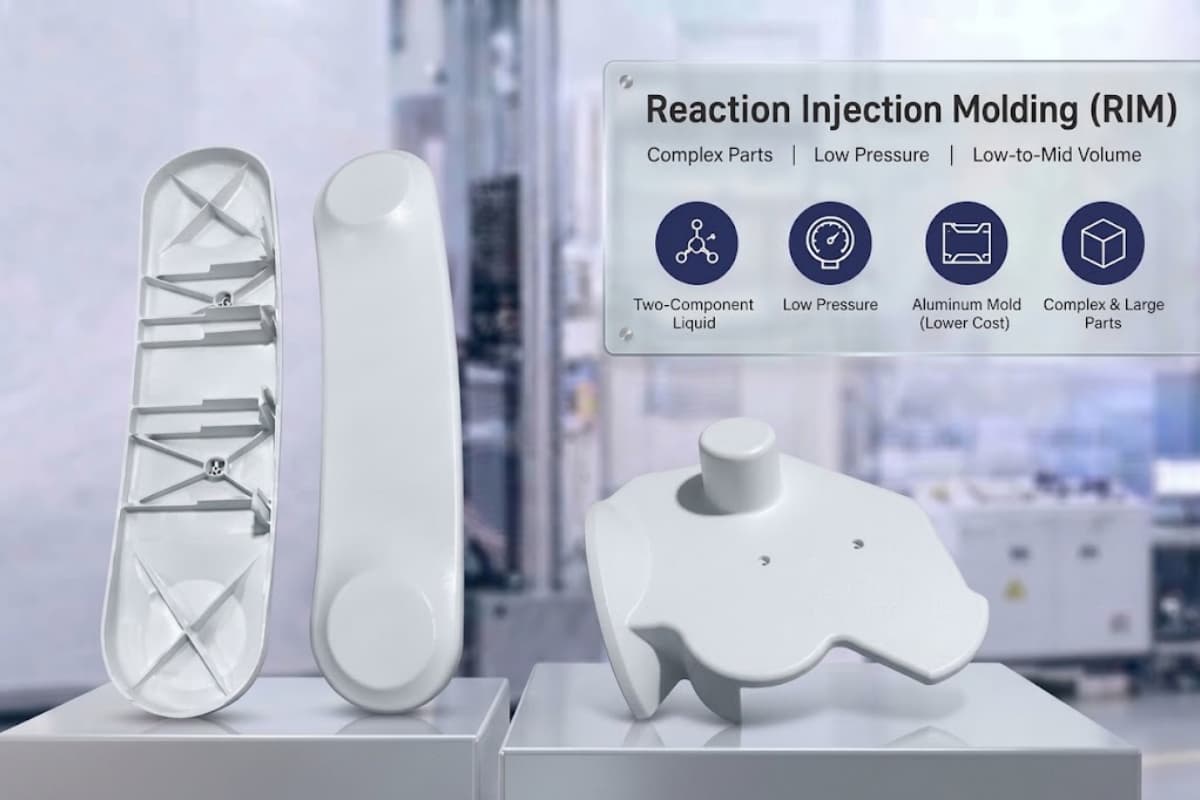

Liquid silicone rubber injection molding — most often written as LSR injection molding — is the process of metering and mixing two liquid silicone components, injecting the blend through a cold runner, and curing it into a solid elastomer inside the mold. Unlike thermoplastic molding, there is no pellet to melt and no part to cool — the material cross-links under heat, which changes the machine, the tool and the design rules. Three differences decide whether a part belongs in an LSR press at all: the material is a two-part liquid dosed by volume rather than a solid feedstock, the mold runs on a cold runner so the silicone never sets in the feed system, and the part cures in seconds inside the tool rather than solidifying by cooling. This guide works through what those differences mean for design, tolerances, material choice and process selection, and how to tell whether an LSR route — rather than TPE overmolding or silicone compression — is the right answer for your part.
Key Takeaways
- LSR is a thermoset liquid, not a thermoplastic. The machine meters, mixes, injects and cures it; the supplier needs dedicated dosing equipment, not a converted plastic press.
- Cold-runner tooling and vacuum venting are not optional refinements for LSR — they decide whether the cavity fills and whether the part comes out flash-free.
- Tolerances on LSR parts are governed by cure shrinkage and elastic recovery, typically referenced to rubber standards rather than plastic molding grades, and should be confirmed per part.
- LSR wins where the part must stay elastic across −50 to 200 °C, survive repeated sterilisation, or meet a biocompatibility requirement that thermoplastics cannot.
- Against TPE overmolding, LSR is chosen for heat and chemical resistance and permanent elasticity; against HCR compression, for automation and volume.
- The single most useful buyer check is whether a candidate molder runs real LSR dosing, cold-runner and degassing equipment rather than adapting a thermoplastic line.
What Is LSR Injection Molding and Where It Fits
Most “silicone” parts are not made the same way. LSR is a two-component liquid silicone that is pumped, proportioned, mixed and injected as a fluid, then cross-linked into a rubber inside a heated mold. That distinguishes it from high-consistency rubber (HCR), which arrives as a milled solid and is shaped by compression or transfer molding, and from thermoplastic elastomers (TPE), which are melted pellets that solidify by cooling.
The distinction matters commercially because the equipment and tooling are different. A good LSR candidate may be a poor TPE candidate, and vice versa; the wrong choice shows up as scrap, weak bonding or a process that cannot be automated.
| Process | Material form | Best suited to | Poor fit for |
|---|---|---|---|
| LSR injection molding | Two-part liquid, dosed by volume | High-volume, precise elastomeric parts; seals, medical, keypads | Very large simple parts where compression is cheaper |
| HCR compression / transfer | High-consistency rubber, milled | Low-to-medium volume, simple shapes, no automation | Tight-tolerance, high-volume, automated runs |
| TPE overmolding | Thermoplastic pellet, melted | Soft-touch overmold on rigid plastic; lower heat duty | Continuous service above roughly 100–120 °C, repeated sterilisation |
| Thermoplastic injection molding | Solid pellet, melted | Rigid parts, structural function | Applications needing permanent rubber elasticity |
LSR is the wrong answer when the part is rigid, when the duty temperature stays well inside the thermoplastic range, or when the annual quantity is too low to justify dedicated dosing equipment. Where the part must flex, seal, resist heat or meet a biocompatibility requirement, LSR moves to the front of the list. Our injection molding design guide covers the thermoplastic baseline; the rules below describe where silicone departs from it.
How the LSR Injection Molding Process Works
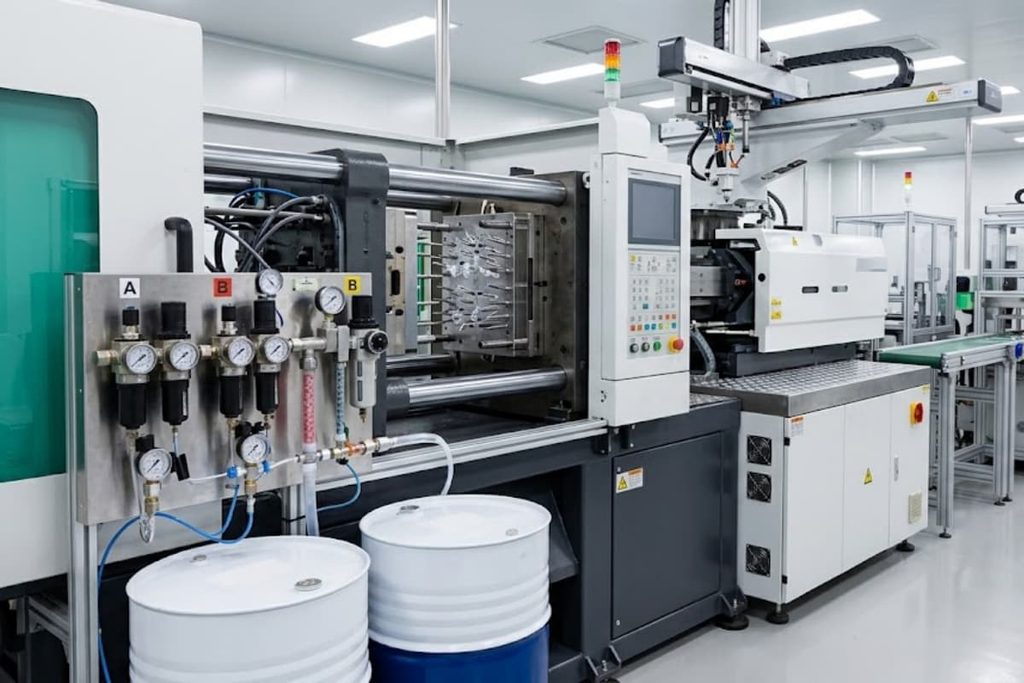
The mechanism is the reason LSR is a separate capability rather than a setting on a standard press. Four stages run in sequence on every shot.
Metering and mixing
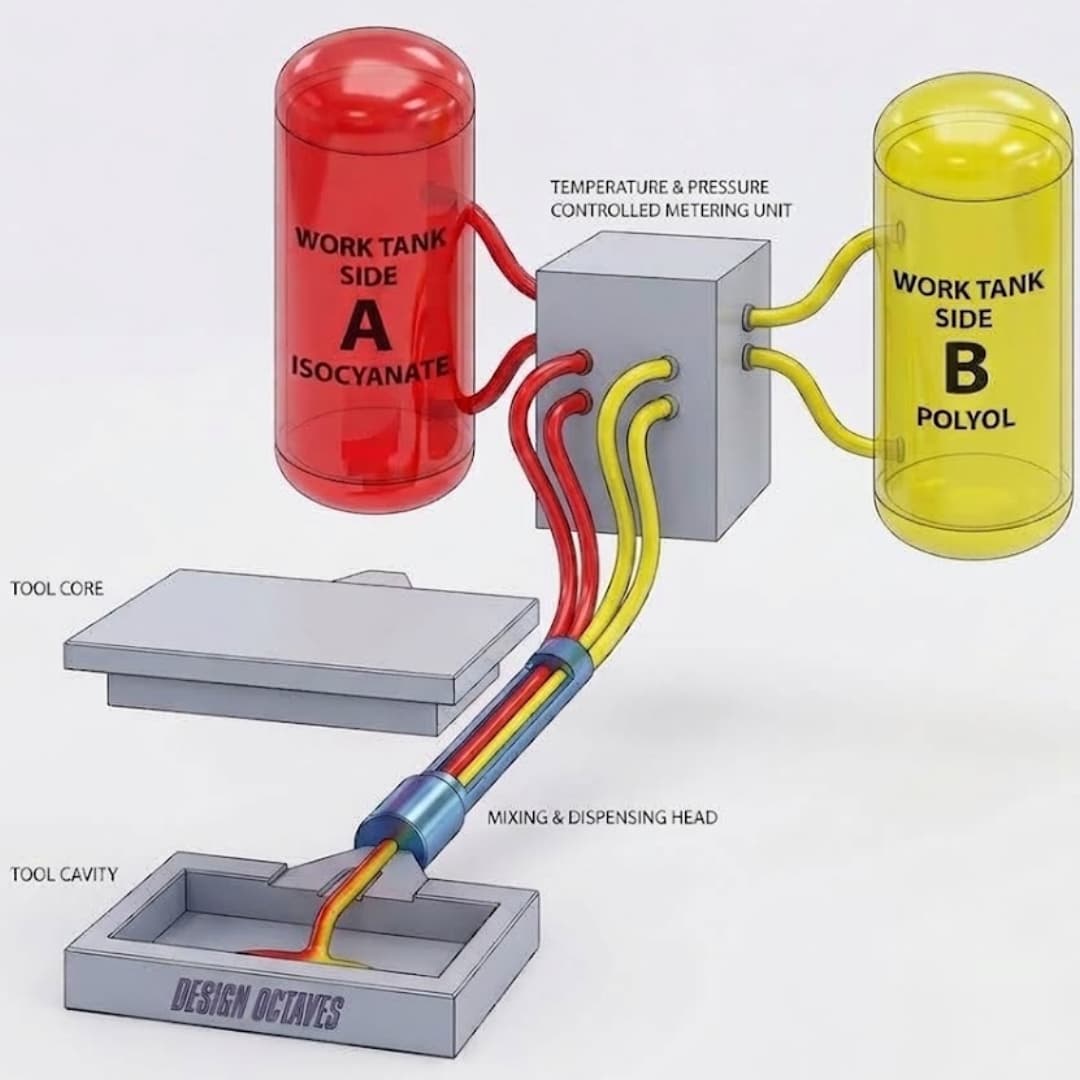
The two silicone components — a catalyst-bearing Part A and a cross-linker-bearing Part B — are pumped from separate drums through a precision metering unit that holds the mix ratio, most commonly 1:1 by volume. Static or dynamic mixers combine them immediately before the injection unit. The ratio is not adjustable per part and is set by the grade, so the first question about any LSR cell is whether it meters both components independently rather than dosing one pre-mixed material.
Cold runner injection
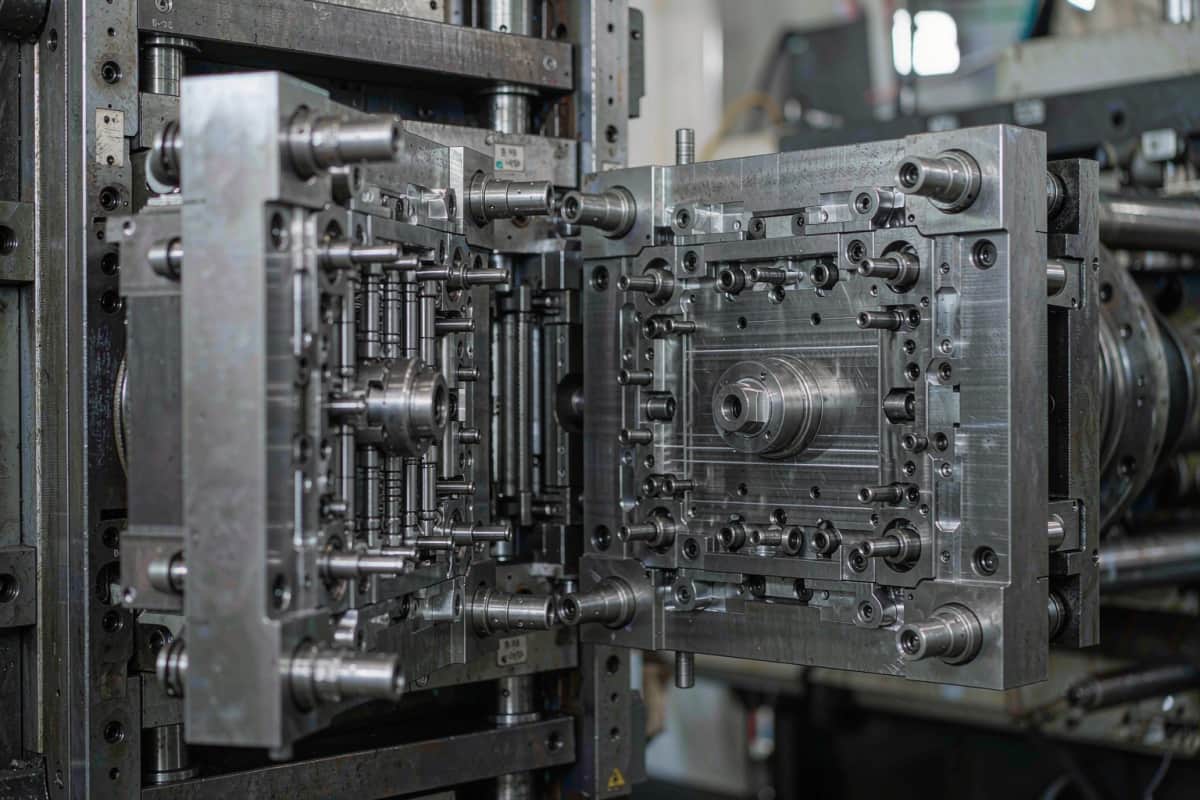
The mixed silicone is delivered through a cold runner, a feed system held below the cure temperature so the material stays liquid until it reaches the cavity. A hot runner would cure the silicone inside the nozzle, and a standard open sprue would waste material and leave a large gate vestige. Cold-runner or valve-gated tooling is therefore a structural requirement of the process, not an upgrade.
In-mold curing
The mold is heated to a temperature where the cross-link reaction completes in seconds. Because the part cures rather than cools, there is no cooling cycle waiting for the plastic to solidify, which is part of why LSR cycle times are short. The exact mold temperature and cure time depend on the grade and the wall section, and the safe window should be confirmed against the grade’s technical data sheet.
| Parameter | Typical range for common LSR grades | What to confirm |
|---|---|---|
| Mix ratio (A:B) | 1:1 by volume for most grades; some 10:1 systems | Confirm against the specific grade TDS |
| Mold temperature | Around 170–200 °C for the tool | Varies with grade and wall thickness |
| Cure time | Seconds per shot for thin sections | Longer for thick sections; confirm per geometry |
| Material temperature at metering | Ambient to room temperature | Cold runner keeps it from curing early |
These figures describe common practice across LSR grades, not a single approved value. The grade supplier’s processing data is the reference for any specific part, and the exact window should be confirmed before tooling.
Automated demolding
Cured silicone is flexible and self-releasing to a degree rigid plastics are not, which is why LSR parts are typically stripped or air-ejected and handled automatically rather than pushed out by pins that would mark a delicate feature. This is also why LSR suits small, thin or intricately shaped parts that would be hard to eject as a rigid plastic. The standard process side is covered on our plastic injection molding capabilities page; the dosing and curing steps above are specific to liquid silicone.
LSR Design Rules (DFM) — Flash, Draft, Venting & Wall Thickness
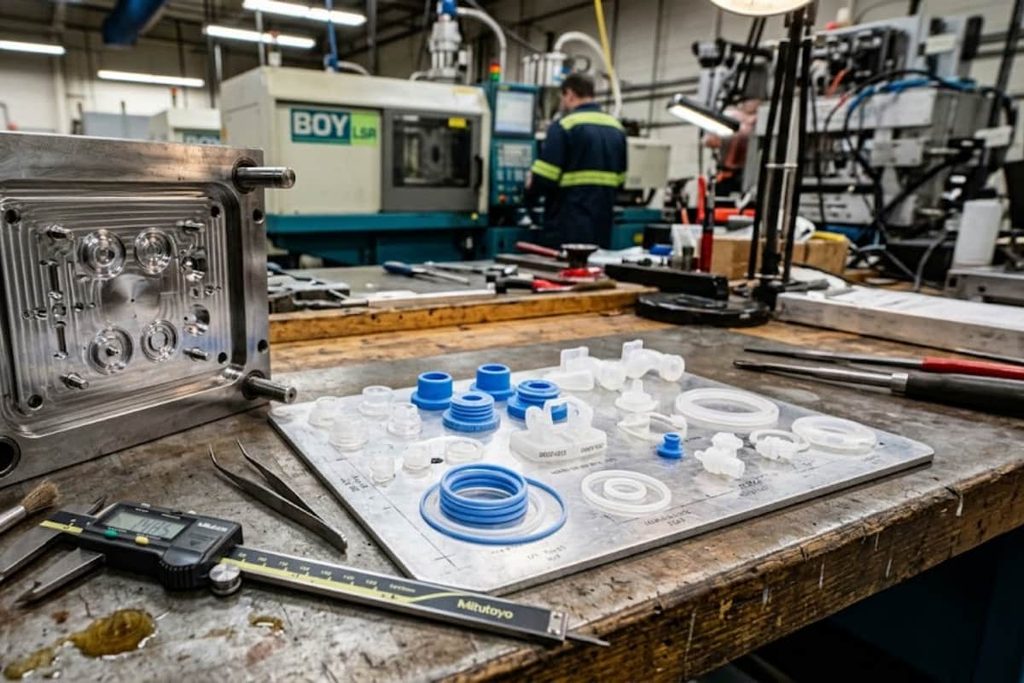
The design rules that protect a thermoplastic part do not transfer to silicone, and the most expensive mistakes are the ones inherited from plastic molding. Silicone is a low-viscosity liquid that reaches gaps a plastic melt never would, and it cures instead of cooling, so the mold has to control flow and air rather than just contain it.
| Design element | Silicone-specific rule | Why it changes |
|---|---|---|
| Flash control | Parting-line accuracy and clamp consistency are the primary concern | Liquid silicone fills gaps as small as a few micrometres, so flash follows every mismatch |
| Draft angle | Often 1–3°, and sometimes unnecessary on shallow features | Elastic parts release from the cavity without a rigid push |
| Venting | Vacuum degassing or fine vents are effectively mandatory | Trapped air cannot escape a thin cavity and causes short shots or burn marks |
| Minimum wall thickness | Can be very thin where flow allows, often below 0.2 mm | Low viscosity fills sections a plastic melt would not reach |
| Gate and cold runner | Cold-runner or valve-gated; gate vestige is a design decision | A hot feed would cure in place |
| Shrinkage allowance | Typically 1.5–4%, often anisotropic | Set by the cross-link density and the grade, not by mold cooling |
Three design choices turn a workable LSR part into an unquotable one.
Treating flash as a cosmetic issue. Flash on an LSR part is mostly a tooling and clamp question, not a trimming step added at the end. The parting line, the vent locations and the clamp force have to be specified together, and a part designed with a sloppy parting line will flash regardless of the press. Specify the flash tolerance up front and let it drive the tool concept.
Skipping vacuum venting. Because silicone flows into micrometre gaps, any air trapped ahead of it has nowhere to go. Parts with deep thin features or blind cavities need vacuum assistance or fine venting designed into the tool, not added after a short-shot problem appears. A venting plan agreed after the first mold is a rework cost.
Designing for rigid-plastic ejection. Ejector pins that work on a 2 mm ABS wall can tear or stretch a 0.3 mm silicone feature. LSR parts need a release strategy built into the geometry — stripper rings, air ejection or a draft angle sufficient for the feature — and a design that assumes pin ejection on every face will either deform or refuse to release. Where a micro-scale feature is involved, the venting and release problem is tighter still, and the micro injection molding guide covers the metrology side of those dimensions.
Tolerances for LSR Molded Parts: What to Expect
LSR tolerances are referenced to rubber standards rather than plastic molding grades, because the limiting step is cure shrinkage and elastic recovery, not the solidification of a melt. A part that springs back after demolding will not hold the same dimension a rigid plastic would, and a part that shrinks anisotropically on cure needs the draw direction accounted for on the drawing.
| Feature class | Indicative band for LSR parts | What sets the limit |
|---|---|---|
| Overall dimensions | Set by shrinkage and mold accuracy, typically specified to rubber tolerance classes | Cure shrinkage, part size, tool construction |
| Mating and assembly features | Tighter bands where function demands | Shrinkage direction, gate location, tool wear |
| Sealing and functional surfaces | Driven by elastic recovery after release | Demolding deformation, venting completeness |
| Feature-to-feature position | Limited by tool accuracy and thermal stability | Tool making and run-to-run consistency |
The bands above are indicative and point to the general framework used for elastomeric parts, such as ISO 3302, rather than to a fixed approval limit. The achievable figure for a specific feature depends on the grade, the geometry and the mold construction, and the exact specification should be confirmed with the supplier against the drawing. Where a broader comparison with rigid-molded-part grades helps, our note on achievable injection molding tolerances sets out the plastic side of the same question.
Four variables sit behind the number. Cure shrinkage is the first and the largest; silicone shrinks more than most engineering thermoplastics and not equally in every direction. Mold accuracy is the second — no molded part holds a tolerance tighter than the cavity it fills. Elastic recovery on demolding is the third and the one most often missed: a flexible feature relaxes after ejection, so the measured dimension is not the as-molded one. Metering consistency is the fourth; shot-to-shot variation in the mixed volume translates directly into dimensional variation, which is why the dosing unit matters as much as the clamp force.
LSR vs TPE Overmolding vs HCR Compression: Which to Choose
The choice between LSR, TPE overmolding and HCR compression is usually settled by duty temperature, bonding requirement and volume, in that order. They are not interchangeable soft materials, and picking on price alone tends to surface the limit in the field.
| Criterion | LSR injection molding | TPE overmolding | HCR compression |
|---|---|---|---|
| Material form | Two-part liquid, dosed by volume | Thermoplastic pellet, melted | High-consistency rubber, milled |
| Set mechanism | Thermoset cross-link in seconds | Solidifies by cooling | Vulcanises under heat and pressure |
| Heat resistance | Excellent, often −50 to 200 °C plus | Limited by TPE grade | Good |
| Permanent elasticity | Yes | Yes, lower heat ceiling | Yes |
| Bonding to substrate | Adhesion grades or mechanical lock | Chemical or mechanical to compatible rigid | Primer or mechanical |
| Biocompatibility options | Wide, with medical grades | Limited | Limited |
| Volume suitability | High-volume, automated | High-volume | Low to medium |
| Typical parts | Seals, gaskets, medical, keypads | Soft grips, overmolded handles | Simple gaskets, low-volume rubber |
A four-question decision framework
Work through these in order; the first constraint usually decides the route.
- Does the part see continuous heat above roughly 100–120 °C or repeated sterilisation? If yes, TPE is largely ruled out and LSR or HCR remain.
- Is the part bonded to a rigid plastic substrate? If so, LSR adhesion grades or TPE chemical bonding apply; HCR usually needs mechanical locking.
- What is the annual volume and the automation requirement? High, consistent volume favours LSR injection molding; low volume with no automation favours HCR compression.
- Is biocompatibility or a precise, repeatable elastomeric dimension required? Medical-grade LSR is the normal answer, and its compliance route is covered by our medical grade material selection guide.
The full comparison of soft-material compatibility is set out in our TPE and TPU overmolding materials guide; the table above answers the process-selection question rather than the material-compatibility one, and the overmolding design guide covers the bonding side in detail.
LSR Overmolding and Insert Molding
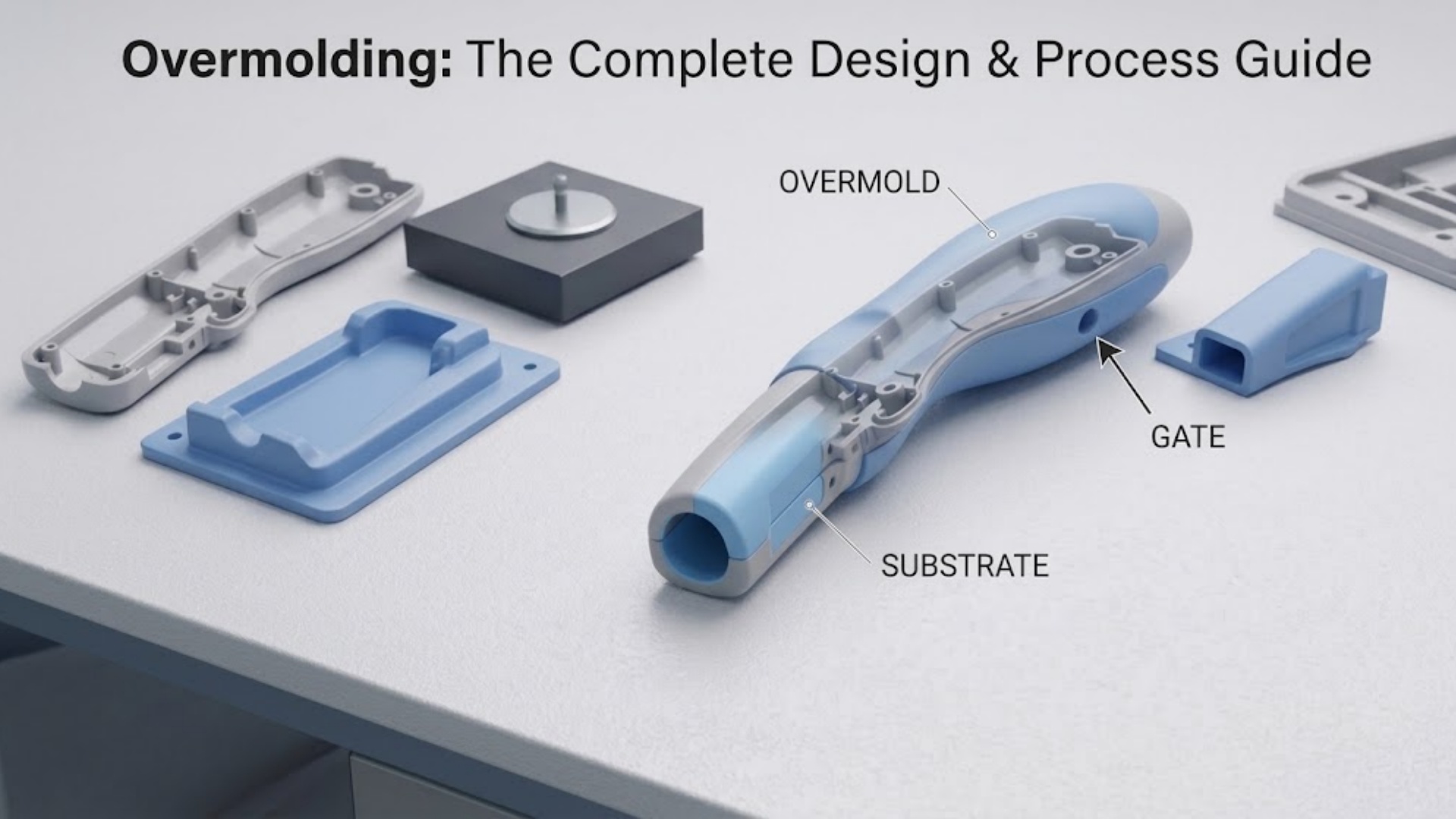
LSR is an effective overmolding and insert-molding material because it cures as a liquid and conforms to a substrate or an insert before it sets — a seal molded onto a rigid plastic housing, or silicone formed around a metal pin or a ceramic element where a permanent elastic interface is needed.
Three scenarios account for most LSR multi-material work. The first is a soft seal or gasket molded directly onto a rigid substrate, where the adhesion grade bonds the silicone to the plastic during the same shot. The second is an insert molded around a metal or ceramic component — a pin, a contact or an optical element — where the silicone both retains the insert and provides a flexible or dielectric function. The third is a living hinge or soft-touch feature formed in silicone where the rigid carrier is a separate molded part.
The constraint is the insert, not the molding. The insert has to stay located within the cavity under injection pressure, and its placement tolerance feeds directly into the assembled dimension. Where the assembly tolerance chain is the dominant risk, combining the operations in one LSR shot reduces it; where the insert can be placed accurately afterwards, a two-step approach is often simpler. The tooling questions for inserts are covered in our insert molding guide, and the bonding and interface rules in the overmolding design guidelines.
Medical-Grade LSR: Compliance Basics
Medical-grade LSR is the same process with a documentation and material-control layer on top, not a different machine. The part is still metered, injected and cured in the same way; what changes is the evidence trail behind the material and the environment it is made in. The compliance items below are the ones a buyer should ask about, and the depth behind each is handled in our medical material guide.
| Requirement | What it covers |
|---|---|
| ISO 10993 | Biological evaluation of the material in its intended medical use |
| ISO 13485 | Quality management system for medical device production |
| Controlled environment | Cleanroom or particulate control during molding and handling |
| Material traceability | Batch-level records of the resin and the process |
| Grade compliance certificate | Supplier certification of the specific LSR grade |
Which of these apply depends on the device class and the market, and the exact scope should be confirmed with the supplier rather than assumed from a data sheet. The compliance route and the material-selection logic are set out in our medical grade material selection guide, and the quality-system context on our quality system page describes how the production controls are normally documented. The process behaviour described here applies whether or not the part is a medical device.
How to Evaluate an LSR Molder
Because LSR needs equipment a general thermoplastic press does not have, the most reliable buyer check is whether a candidate actually runs LSR rather than adapting a plastic line. Six questions separate the two.
- Does the molder run a dedicated LSR dosing and mixing unit with independent A and B metering, rather than a press converted to accept pre-mixed material?
- Can they show cold-runner or valve-gated tooling, and do they treat flash control as a tooling specification rather than a trimming step?
- Is vacuum venting or controlled degassing part of their standard LSR mold, especially for thin or deep features?
- What process controls do they hold on shot consistency and cure, and how is variation measured across a run?
- Can they show real LSR parts or case references in a comparable application and volume?
- What compliance documentation — ISO 13485 registration, cleanroom capability, material traceability — can they provide if the part is medical?
A molder that answers all six with specifics is running LSR as a process, not experimenting with it. The six questions above decide whether an LSR project is in safe hands; the plastic injection molding capabilities page is the place to compare the broader process scope against your requirement.
FAQ
What is the difference between LSR and TPE overmolding? LSR is a two-part liquid silicone that cross-links into a permanent elastomer under heat, while TPE is a thermoplastic pellet that softens when melted and solidifies when cooled. LSR resists far higher continuous temperatures and repeated sterilisation and stays elastic across a wider range, whereas TPE is chosen for soft-touch overmolding on rigid plastic where the heat duty is modest.
What tolerance can LSR molding hold? LSR part tolerances are usually referenced to rubber standards rather than plastic molding grades, because cure shrinkage and elastic recovery set the limit. The achievable value depends on the grade, the geometry and the mold construction, and it should be confirmed with the supplier against the specific drawing rather than taken from a generic table.
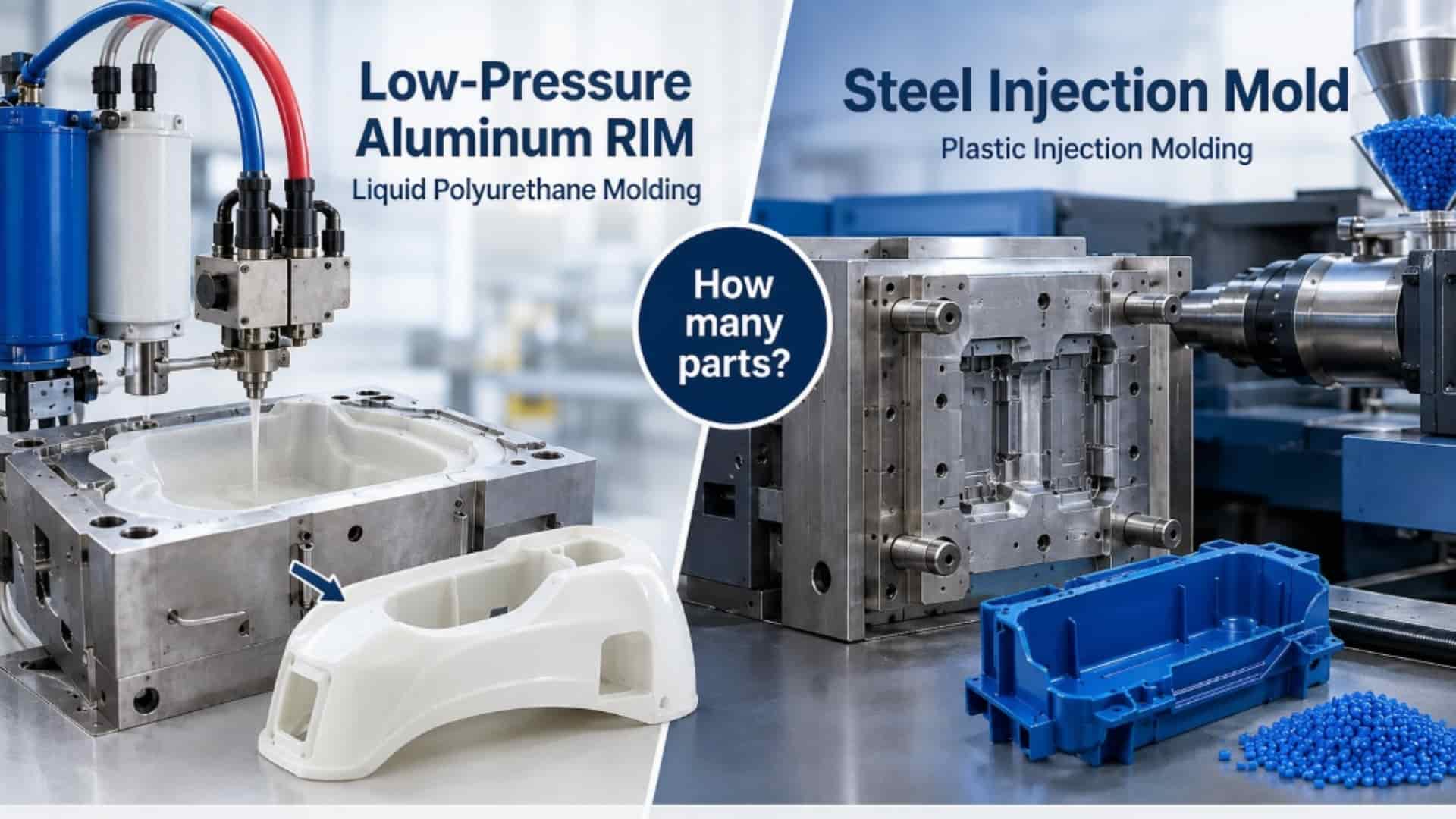
Is LSR molding more expensive than thermoplastic molding? Tooling and dosing equipment cost more because the process needs cold-runner tooling and a metering unit, but the part cost falls with volume in the same way molding always does. The relevant comparison is against the alternative soft-material route — TPE overmolding or HCR compression — at your actual annual volume and duty requirement, not against a rigid thermoplastic part.
Can LSR be used for medical devices? Yes, with the right grade and documentation. Medical-grade LSR is selected against ISO 10993 for biological evaluation and produced under ISO 13485 with material traceability and a controlled environment. Which requirements apply depends on the device class and market, and the scope should be confirmed with the supplier.
How do I know if a supplier really runs LSR? Ask whether they operate a dedicated A/B metering and mixing unit, show cold-runner tooling, use vacuum venting, and hold documented process controls. Real LSR molders answer those specifics and show comparable parts; a converted thermoplastic press adapted to pre-mixed material will not.
Conclusion
The decision behind liquid silicone rubber injection molding runs in one direction. Confirm that the part actually needs what only silicone delivers — permanent elasticity, high-temperature service, repeated sterilisation or biocompatibility — because that single check decides whether LSR is in scope at all. Choose the route by duty temperature, bonding and volume, using the LSR-versus-TPE-versus-HCR framework rather than defaulting to the cheapest soft material. Design for flash, venting and elastic recovery from the first draft, because those are the failure modes plastic rules do not warn you about. Then verify that the molder runs real LSR dosing, cold-runner and degassing equipment before the tool is cut.
A part that meets those conditions is built differently from the moment the design is reviewed, and the earlier the four questions are settled, the fewer changes are needed once a mold exists. If your part needs permanent elasticity, high-temperature resistance or biocompatibility, send us the drawing and the intended application. We will return a feasibility and DFM review covering material grade, gate and venting strategy, and the tolerance you can realistically hold with LSR. For the service side of that review, see lsr injection molding services.
Technical references
- ISO 3302-1, “Rubber — Tolerances for products — Part 1: Dimensional tolerances.” Used as the general tolerance framework for elastomeric parts, against which LSR molded part tolerances are compared; rubber classes are applied rather than plastic molding grades.
- Dow, SILASTIC liquid silicone rubber processing guidance. Used for the two-component metering, cold-runner and in-mold cure description in the process section.
- Wacker Chemie, ELASTOSIL LSR processing and technical data. Used for mold temperature, cure behaviour, flash control and venting guidance.
- ISO 10993-1, “Biological evaluation of medical devices — Part 1: Evaluation and testing within a risk management process.” Used for the medical-grade LSR compliance section.
- ISO 13485, “Medical devices — Quality management systems — Requirements for regulatory purposes.” Used for the quality-system reference in the medical-grade section.
Reference entries list the sources that informed the general process and material descriptions in this article. They are not product approvals, and none of the ranges reported in them should be treated as an approval limit for a specific part.